
7 Million Spaniards Seek Public Sector Jobs as Wage Gap Widens
Seven million citizens prepare for public exams, with 74% favoring government jobs. Public salaries exceed private sector pay by 58%, driving a massive shift toward state employment.
English · Original discussion in Spanish · Published
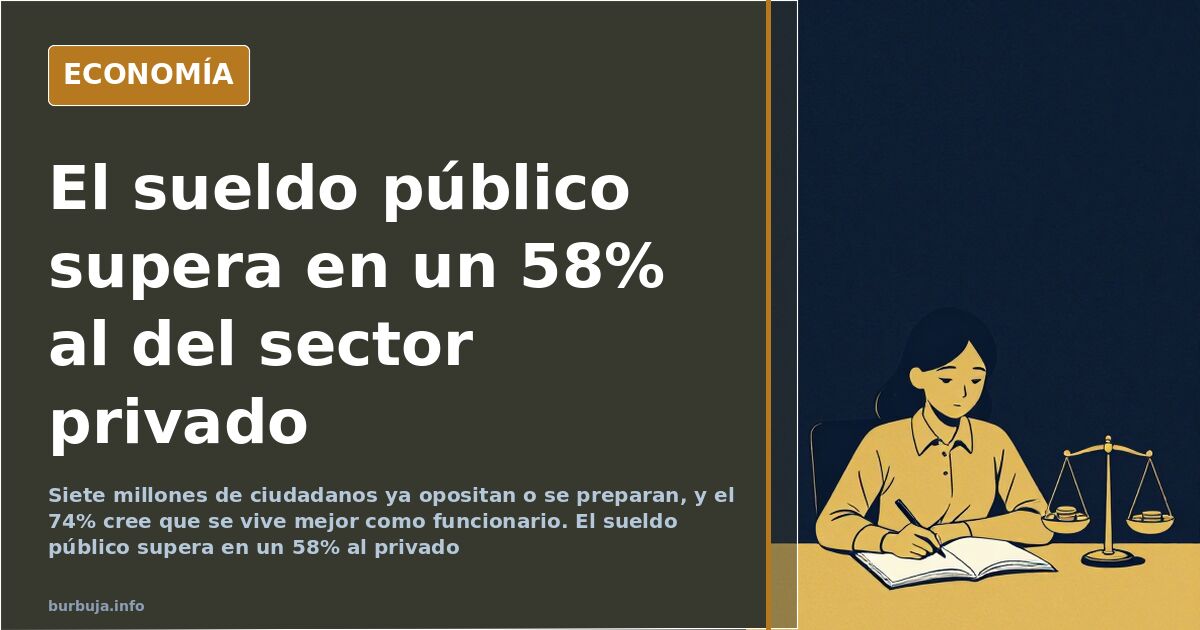
Spain’s Public Sector Fever: 7 Million Prepare for Government Exams
The rush for public employment in Spain is no longer a kitchen-table rumor: seven million citizens have taken or are preparing for civil service exams, and 74% believe government jobs offer a better quality of life. The wage gap reinforces this trend: public salaries exceed private sector pay by 58%, the largest differential in fifteen years. With these three figures on the table, the real question is no longer why so many want to be civil servants, but why anyone would choose the opposite.
Nearly All New Jobs in Spain Are Now in the Public Sector
55% of jobs created since the pandemic are in the public sector. Two out of three positions peine this summer came from government administrations, and four out of ten of these jobs do not even require passing a civil service exam. On the other side of the balance, the private sector destroyed 102,000 positions in the most active economic accounts. The labor market has shifted professions: there is an oversupply of civil servants and IT specialists, but a shortage of waiters and shopkeepers.
The regional picture supports this pattern. 58.5% of public employment depends on the autonomous communities and has grown by 63.6% over twenty years, keeping pace with the transfer of competencies.
Why Job Security Matters More Than Salary?
Because in much of the private sector, the premium for earning more no longer exists. 65% of respondents say they seek stability before remuneration, and 74% associate public positions with a better life. One quote summarizes the mood: “I don’t want to be rich; I want to live a normal life without antiestéticaring that tomorrow they will throw me out on the street.”
Among the personal stories circulating in the thread, an interim teacher (Level A1, fourteen teaching hours) earns 2,200 euros net and strings together courses without lacking work. An interim nurse (Level A2, with seniority, rotating shifts, and no on-call duties) earns the same and saves up for trips every few months, according to the same testimony. Neither has yet passed the civil service exam. In contrast, stories from the private sector speak of companies that do not offer permanent contracts, non-existent geographic mobility, and salaries that never reach what was promised.
Not everyone buys the headline figure. Some recall that several exercise calls have accumulated and that, without this effect, the percentage of public employment relative to total created jobs remains well below.
Civil Servants in Congress: 3.4% of the Population and 36% of Seats
The 3.4% of the population working for the Administration holds 36% of the seats in Congress. To the exams is added a parallel business. Each applicant pays fees in every call, a source of additional revenue that, according to the reading of a participant, functions as a hidden tax. The Government is studying scholarships of 7,000 euros annually for tax administration exam candidates.
The system is also not transparent. RTVE exams left 5,000 candidates out of the game due to fraud, and published reports about cronyism and rigged contracts accumulate in the courts: alleged relatives placed in the Junta de Andalucía and emails that would have been deleted before handing over the hard drive to the National Police, according to these same reports.
The Exam-Ocracy Is Now an Electoral Bloc
Retirees, public employees, and now exam candidates form an electoral mass that no political party can ignore. Hence a repeated reproach in the thread: that no party puts the real cost of the model on the table without nuances. The result is a long-distance race with millions of runners and a State that, as one participant summarizes, is the only company that cannot move to the Netherlands.
Meanwhile, trained youth emigrate. Spain has the record for medical faculties per population density, and yet there are still doctors missing across the country; technical profiles emigrate for conditions that, even adjusted for purchasing power, are considered better elsewhere.
Who Pays the Party If Everyone Wants a Position?
When asked where the money will come from if everyone ends up as a civil servant, the consensus breaks. One part argues that the model is already financed with debt and that the taxpayer will ultimately pay the bill. The other responds that the bulk of spending goes on pensions, not salaries, and that the problem is not the size of the Administration but the weakness of the private sector: disposable contracts, low wages, and zero incentives to retain talent.
Some attribute this deterioration to migratory pressure on labor conditions. The claim is launched without data to support it and competes with less noisy explanations: low productivity, bureaucracy, and a business association competing on price. An uncomfortable calculation also emerges regarding talent trained with public money but reporting to another country.
In the end, the analysis always gets stuck at the same point. The State guarantees the position, but not who pays for it, and the exam has become the only door many see open. With seven million in line and a 58% wage gap pushing, no one knows if the fever for public jobs is the disease or the symptom.
The rush for public employment in Spain is no longer a kitchen-table rumor: seven million citizens have taken or are preparing for civil service exams, and 74% believe government jobs offer a better quality of life. The wage gap reinforces this trend: public salaries exceed private sector pay by 58%, the largest differential in fifteen years. With these three figures on the table, the real question is no longer why so many want to be civil servants, but why anyone would choose the opposite.
Nearly All New Jobs in Spain Are Now in the Public Sector
55% of jobs created since the pandemic are in the public sector. Two out of three positions peine this summer came from government administrations, and four out of ten of these jobs do not even require passing a civil service exam. On the other side of the balance, the private sector destroyed 102,000 positions in the most active economic accounts. The labor market has shifted professions: there is an oversupply of civil servants and IT specialists, but a shortage of waiters and shopkeepers.
The regional picture supports this pattern. 58.5% of public employment depends on the autonomous communities and has grown by 63.6% over twenty years, keeping pace with the transfer of competencies.
Why Job Security Matters More Than Salary?
Because in much of the private sector, the premium for earning more no longer exists. 65% of respondents say they seek stability before remuneration, and 74% associate public positions with a better life. One quote summarizes the mood: “I don’t want to be rich; I want to live a normal life without antiestéticaring that tomorrow they will throw me out on the street.”
Among the personal stories circulating in the thread, an interim teacher (Level A1, fourteen teaching hours) earns 2,200 euros net and strings together courses without lacking work. An interim nurse (Level A2, with seniority, rotating shifts, and no on-call duties) earns the same and saves up for trips every few months, according to the same testimony. Neither has yet passed the civil service exam. In contrast, stories from the private sector speak of companies that do not offer permanent contracts, non-existent geographic mobility, and salaries that never reach what was promised.
Not everyone buys the headline figure. Some recall that several exercise calls have accumulated and that, without this effect, the percentage of public employment relative to total created jobs remains well below.
Civil Servants in Congress: 3.4% of the Population and 36% of Seats
The 3.4% of the population working for the Administration holds 36% of the seats in Congress. To the exams is added a parallel business. Each applicant pays fees in every call, a source of additional revenue that, according to the reading of a participant, functions as a hidden tax. The Government is studying scholarships of 7,000 euros annually for tax administration exam candidates.
The system is also not transparent. RTVE exams left 5,000 candidates out of the game due to fraud, and published reports about cronyism and rigged contracts accumulate in the courts: alleged relatives placed in the Junta de Andalucía and emails that would have been deleted before handing over the hard drive to the National Police, according to these same reports.
The Exam-Ocracy Is Now an Electoral Bloc
Retirees, public employees, and now exam candidates form an electoral mass that no political party can ignore. Hence a repeated reproach in the thread: that no party puts the real cost of the model on the table without nuances. The result is a long-distance race with millions of runners and a State that, as one participant summarizes, is the only company that cannot move to the Netherlands.
Meanwhile, trained youth emigrate. Spain has the record for medical faculties per population density, and yet there are still doctors missing across the country; technical profiles emigrate for conditions that, even adjusted for purchasing power, are considered better elsewhere.
Who Pays the Party If Everyone Wants a Position?
When asked where the money will come from if everyone ends up as a civil servant, the consensus breaks. One part argues that the model is already financed with debt and that the taxpayer will ultimately pay the bill. The other responds that the bulk of spending goes on pensions, not salaries, and that the problem is not the size of the Administration but the weakness of the private sector: disposable contracts, low wages, and zero incentives to retain talent.
Some attribute this deterioration to migratory pressure on labor conditions. The claim is launched without data to support it and competes with less noisy explanations: low productivity, bureaucracy, and a business association competing on price. An uncomfortable calculation also emerges regarding talent trained with public money but reporting to another country.
In the end, the analysis always gets stuck at the same point. The State guarantees the position, but not who pays for it, and the exam has become the only door many see open. With seven million in line and a 58% wage gap pushing, no one knows if the fever for public jobs is the disease or the symptom.
Summary of a discussion on Burbuja.info - Foro de economía, actualidad y política., translated from Spanish and reviewed before publication. Read the full discussion (285 replies).
More summaries
-
Muface: Bal estimates 1.5 million civil servants affected
Edmundo Bal says 1.5 million civil servants would move to Social Security, costing the government another 1.5 million votes.
-
Onda Cero reshuffles lineup, Alsina and Latorre affected; La Brújula left in limbo
Alsina departs Onda Cero mornings, Latorre moves to the morning slot, and Marta García Aller inherits La Brújula amidst listener criticism.
-
Shots Fired at Trump Rally in Pennsylvania: Candidate Evacuated After Ear Injury
Donald Trump was wounded in the ear and evacuated under fire during a Pennsylvania rally. The iconic raised-fist photo reshapes the US election narrative instantly.
-
Teen Death in Getafe: Autopsy Rules Out Pink Cocaine
A 14-year-old boy died in Getafe, Spain. The autopsy confirms a natural cardiac arrest, ruling out the initial pink cocaine poisoning claims.
-
185,000 lawyers in Spain: how oversupply paralyzes the legal market
185,000 Spanish lawyers saturate the market with low pay and AI threats. Family ties and mandatory bar membership fuel the crisis for Spain's legal sector.
-
The Handkerchief Test: A Ritual Science Rejects
A viral video resurfaces showing the handkerchief test. What it claims to prove, why evidence disputes it, and how it reflects a social market.