
Mad Max: Grow Your Own Food or Raid Neighbors?
Stealing yields more than farming, but lethal risks tip the balance. Self-sufficient gardens feed less than you think.
English · Original discussion in Spanish · Published
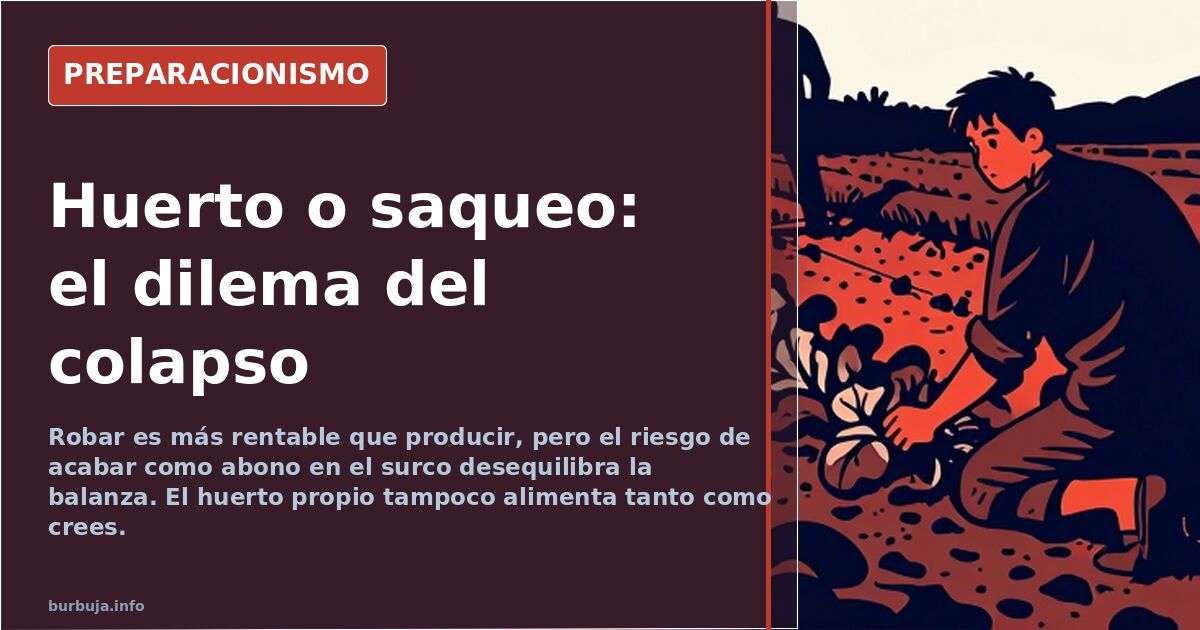
Mad Max: Cultivate your garden or loot the neighbor's?
The question sounds like bar talk, but it has gathered 104 replies and nearly three years of debate. The premise is simple: if society collapses, is it better to work your own plot or raid others'? The dominant answer isn't what you'd expect. Stealing is more profitable than producing, many admit, but the risk of ending up as fertilizer in your own furrow tips the scales. This isn't hypothetical: today, without any collapse, people report fruit trees stripped bare.
Your garden doesn't feed you as much as you think
The first myth to fall is self-sufficiency. A garden of lettuce, tomatoes, and parsley feeds no one; those are just side calories. Real food comes from potatoes, corn, wheat, oats, and legumes, plus chickens and goats if possible. That's where problems start. Some claim one hectare—10,000 square meters—with rain or irrigation can feed a family of four or five, including animals. Skeptics counter with data from those who farmed in northern Spain, supposedly the most fertile zone: without external fertilizer, soil productivity drops sharply after the second rotation. The figure cited is stark: fertilized fields produce up to 20 times more than unfertilized ones.
Nuance matters. Proponents of self-sufficiency cite using manure from animals fed on the land, crop rotation, and saving seeds year-to-year. Critics point to experience with store-bought seed potatoes and sulfates: without them, they argue, survival is impossible. Centuries-old tomato and pepper varieties held by grandparents vanished when they died. Modified varieties must be bought annually.
Water: Three days without drinking means death
Here the analysis turns serious. No water means no garden or survival. Those with springs seven kilometers away know the daily trek. The common home solution remains: collect decent spring water, let it settle for an hour, transfer containers, add two drops of bleach per liter, and wait another hour. All you need is a dropper and bleach. Alternatives include portable filters promising 1,000 liters, though untested with spring water.
Warnings from those who drank untreated stream water as children are blunt: multiple helminth and protozoan infestations, worst being giardiasis. Chlorinated, tested municipal water isn't a luxury; it's the difference between living and getting sick.
Defense: The problem preppers forget
The strongest consensus in the discussion is that a garden is useless if undefended. Preppers focusing on fires, preserves, and shelters overlook essentials: how to protect it all. Two options emerge. First, establish a garden or pen and defend it 24 hours with perimeters, patrols, and firing positions. Second, organize into hierarchical raider bands. Large groups with children and elderly tend toward defense; small mobile units toward raiding.
Historical examples cite the Spanish Civil War. Instead of isolated fortified ranches, traditional villages worked best: small, self-sufficient communities with distributed skills and armed neighbors. Maquis guerrillas attacked isolated houses, not towns of 50-100 people. Rural civil guards, local agents with operational latitude, handled the rest.
Rob once, die next time
Conclusions on looting are near-unanimous: you'll steal once, then get killed. Rural areas abound with hunters and weapons. An angry farmer strikes hard. Details repeat: anonymity vanishes in the countryside. Curtains watch everything. Accessible distant gardens face certain looting; hidden ones behind walls, with chickens and shotguns, stand a chance.
The scenario isn't total chaos but neo-feudalism. Without gasoline, mass movement stops. Urbanites flee cities, forming ~100-person groups occupying rural zones. Borders define regions, sparking wars among neighboring feudal lords. Numbers win. Remaining farmers either serve new lords for rice bowls or hang from nearby trees.
Analysis stalls at one point: collapse duration. If months or two years, armed villages endure. If permanent, bicycles replace cars, returning us to the Stone Age. Consensus on which scenario is realistic never arrives.
The question sounds like bar talk, but it has gathered 104 replies and nearly three years of debate. The premise is simple: if society collapses, is it better to work your own plot or raid others'? The dominant answer isn't what you'd expect. Stealing is more profitable than producing, many admit, but the risk of ending up as fertilizer in your own furrow tips the scales. This isn't hypothetical: today, without any collapse, people report fruit trees stripped bare.
Your garden doesn't feed you as much as you think
The first myth to fall is self-sufficiency. A garden of lettuce, tomatoes, and parsley feeds no one; those are just side calories. Real food comes from potatoes, corn, wheat, oats, and legumes, plus chickens and goats if possible. That's where problems start. Some claim one hectare—10,000 square meters—with rain or irrigation can feed a family of four or five, including animals. Skeptics counter with data from those who farmed in northern Spain, supposedly the most fertile zone: without external fertilizer, soil productivity drops sharply after the second rotation. The figure cited is stark: fertilized fields produce up to 20 times more than unfertilized ones.
Nuance matters. Proponents of self-sufficiency cite using manure from animals fed on the land, crop rotation, and saving seeds year-to-year. Critics point to experience with store-bought seed potatoes and sulfates: without them, they argue, survival is impossible. Centuries-old tomato and pepper varieties held by grandparents vanished when they died. Modified varieties must be bought annually.
Water: Three days without drinking means death
Here the analysis turns serious. No water means no garden or survival. Those with springs seven kilometers away know the daily trek. The common home solution remains: collect decent spring water, let it settle for an hour, transfer containers, add two drops of bleach per liter, and wait another hour. All you need is a dropper and bleach. Alternatives include portable filters promising 1,000 liters, though untested with spring water.
Warnings from those who drank untreated stream water as children are blunt: multiple helminth and protozoan infestations, worst being giardiasis. Chlorinated, tested municipal water isn't a luxury; it's the difference between living and getting sick.
Defense: The problem preppers forget
The strongest consensus in the discussion is that a garden is useless if undefended. Preppers focusing on fires, preserves, and shelters overlook essentials: how to protect it all. Two options emerge. First, establish a garden or pen and defend it 24 hours with perimeters, patrols, and firing positions. Second, organize into hierarchical raider bands. Large groups with children and elderly tend toward defense; small mobile units toward raiding.
Historical examples cite the Spanish Civil War. Instead of isolated fortified ranches, traditional villages worked best: small, self-sufficient communities with distributed skills and armed neighbors. Maquis guerrillas attacked isolated houses, not towns of 50-100 people. Rural civil guards, local agents with operational latitude, handled the rest.
Rob once, die next time
Conclusions on looting are near-unanimous: you'll steal once, then get killed. Rural areas abound with hunters and weapons. An angry farmer strikes hard. Details repeat: anonymity vanishes in the countryside. Curtains watch everything. Accessible distant gardens face certain looting; hidden ones behind walls, with chickens and shotguns, stand a chance.
The scenario isn't total chaos but neo-feudalism. Without gasoline, mass movement stops. Urbanites flee cities, forming ~100-person groups occupying rural zones. Borders define regions, sparking wars among neighboring feudal lords. Numbers win. Remaining farmers either serve new lords for rice bowls or hang from nearby trees.
Analysis stalls at one point: collapse duration. If months or two years, armed villages endure. If permanent, bicycles replace cars, returning us to the Stone Age. Consensus on which scenario is realistic never arrives.
Also available in: Deutsch
Summary of a discussion on Burbuja.info - Foro de economía, actualidad y política., translated from Spanish and reviewed before publication. Read the full discussion (104 replies).
More summaries
-
Hiding Food During Collapse: The Pit Digging Mistake
Burying barrels is a common survival plan, but if you aren't starving after three months, your secret is exposed.
-
Utopia 2013: Where to Download the British Series on P2P
The British series Utopia (2013), with two subtitled seasons, is still available on eMule, torrent and direct download
-
Man found alive after 17 years in the wild faces fine
A man presumed dead for 17 years has been found alive in a tent in Bulgaria, only to be issued an illegal camping fine.
-
Building on rural land: requirements and legal risks in Spain
Forum users detail the rules for building on non-developable land, including Andalusia's 2.5-hectare minimum and legalizing ruins via pre-1986 orthophotos.
-
Why some want collapse: from Mad Max to Spain's DANA floods
Forum debate: why some participants no longer ask for reforms, but for the entire system to fall and collapse to arrive
-
80s nostalgia and the conspiracy narrative in Spain
The generation that grew up playing in the street partly claims that 1945 buried its identity: this is how the conspiracy narrative about social change is articulated.