
80s nostalgia and the conspiracy narrative in Spain
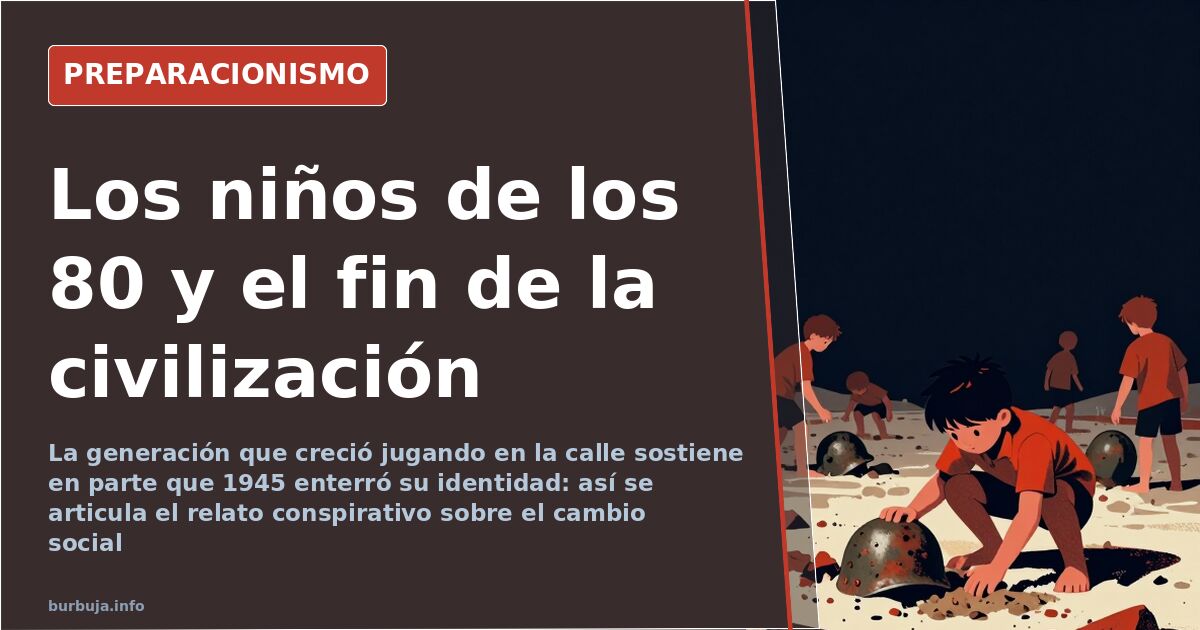
The generation that grew up playing in the street partly claims that 1945 buried its identity: this is how the conspiracy narrative about social change is articulated.
English · Original discussion in Spanish · Published
Why 80s nostalgia fuels conspiracy theories
A paradox runs through the entire approach: the generation that remembers itself as the last happy childhood is also the one that proclaims that civilization is already lost. Someone who was eight years old in 1985 is now around fifty and insists that they were born just before a door closed. The starting diagnosis mixes the defeat of 1945, a supposed cultural re-education of Europe, the loss of sovereignty and accelerated demographic change. And it ends with a political conclusion: continuing to vote for the system's parties is equivalent to being an accomplice.
What the starting diagnosis claims
The starting point is a rereading of World War II as a religious conflict: German tanks would have carried the cross of the Teutonic Order and the allies, in this reading, a different confessional symbol. It is a conspiracy narrative with an antisemitic matrix that attributes to an imaginary financial power—presented as a single, all-powerful bloc—the government of the planet since 1945. Not a single verifiable fact accompanies the thesis.
From there, consequences chain together: after the war the continent would have been re-educated with propaganda, cinema and documentaries, and the result would be a demilitarized Europe, without sovereignty and with a population indebted to the financial elites. Disparate social changes—secularization, women's incorporation into the labor market, diversity in the street—appear as steps of the same plan. Precisely that attribution to a single hidden will is what defines these narratives: it turns independent economic and demographic processes into an intentional design.
The Spain of the 80s that is vindicated
The emotional core is in the street: the spinning top, the caps, the marbles, improvised football. Neighborhood parks function as a lost paradise and as proof of later degeneration. The same timeline includes the arrival of migrant population and their incorporation into the Army in the late 90s and early 2000s, reinterpreted here as planned substitution.
The portrait is completed with two more fronts: the expansion of drug consumption among young people in the 80s and 90s and the change in family models. Women's incorporation into work outside the home, late childbirth or singlehood are described with explicit contempt. In the material itself there are nuances: some argue that the 90s were a reasonable balance between freedom and equality, and others recall that even then the seeds of the current problem were being planted.
Swastikas, triskeles and December 24
The most documented section of the material does not speak of politics, but of symbols. The swastika is defended as a millennia-old solar symbol present in Buddhist temples, Roman vessels, Tibet, China, India or Japan, with the Celtic triskel as a direct relative. It is recalled that the National Socialist version inverts the orientation of traditional representations and that a Swedish electric company used it as a logo before the movement existed.
On the specific origin that Adolf Hitler chose there is disagreement: a cited documentary maintains that he took it from the forging of a fence during his time in Vienna, while another part attributes it to the avant-garde aesthetics of the time and to the Thule Society. The digression also extends to Christmas: the date of December 24 is placed three days after the winter solstice and is linked to the solstice festivals documented in half the world since the Neolithic and to the Roman Sol Invictus.
Pessimism as the dominant response
There are hardly any concrete proposals. What abounds is the feeling that any peaceful initiative will end up clashing with the state machinery, and several responses maintain that the situation must degrade—hunger included—for a majority to react. The question of whether a minority movement can reverse the process is almost always answered with a no.
The arguments supporting that impotence are two. The first: the population does not have the material means to defend itself, regardless of what it thinks. The second, more uncomfortable: the cost of confrontation—prison, incivil record, loss of income—falls on those who already have something to lose. Against defeatism, technical notes appear: some argue that with available technology it would be possible to work four hours a day producing high-quality goods, and it is denounced that pogre is dedicated to surveillance, propaganda and split shifts. Empires fall, summarizes another repeated idea, when they can no longer defend private property.
Is there a way out?
Expectations are divided between rupture and oblivion. Some trust in an inevitable outbreak when the crisis hits the pocket; others, more skeptical, believe there will be no organized reaction because means, leadership and desire are lacking. There are also those who relativize the whole conflict with an argument of temporal scale: in 2,000 years not even the dust of anyone's bones will remain, neither of the victors nor of the vanquished.
The question that floats over the whole is not so much whether the narrative is true—it is not, at least in the verifiable—as how many people are willing to organize their lives around it. Is it a verbal escape valve, or the first step of something with consequences?
A paradox runs through the entire approach: the generation that remembers itself as the last happy childhood is also the one that proclaims that civilization is already lost. Someone who was eight years old in 1985 is now around fifty and insists that they were born just before a door closed. The starting diagnosis mixes the defeat of 1945, a supposed cultural re-education of Europe, the loss of sovereignty and accelerated demographic change. And it ends with a political conclusion: continuing to vote for the system's parties is equivalent to being an accomplice.
What the starting diagnosis claims
The starting point is a rereading of World War II as a religious conflict: German tanks would have carried the cross of the Teutonic Order and the allies, in this reading, a different confessional symbol. It is a conspiracy narrative with an antisemitic matrix that attributes to an imaginary financial power—presented as a single, all-powerful bloc—the government of the planet since 1945. Not a single verifiable fact accompanies the thesis.
From there, consequences chain together: after the war the continent would have been re-educated with propaganda, cinema and documentaries, and the result would be a demilitarized Europe, without sovereignty and with a population indebted to the financial elites. Disparate social changes—secularization, women's incorporation into the labor market, diversity in the street—appear as steps of the same plan. Precisely that attribution to a single hidden will is what defines these narratives: it turns independent economic and demographic processes into an intentional design.
The Spain of the 80s that is vindicated
The emotional core is in the street: the spinning top, the caps, the marbles, improvised football. Neighborhood parks function as a lost paradise and as proof of later degeneration. The same timeline includes the arrival of migrant population and their incorporation into the Army in the late 90s and early 2000s, reinterpreted here as planned substitution.
The portrait is completed with two more fronts: the expansion of drug consumption among young people in the 80s and 90s and the change in family models. Women's incorporation into work outside the home, late childbirth or singlehood are described with explicit contempt. In the material itself there are nuances: some argue that the 90s were a reasonable balance between freedom and equality, and others recall that even then the seeds of the current problem were being planted.
Swastikas, triskeles and December 24
The most documented section of the material does not speak of politics, but of symbols. The swastika is defended as a millennia-old solar symbol present in Buddhist temples, Roman vessels, Tibet, China, India or Japan, with the Celtic triskel as a direct relative. It is recalled that the National Socialist version inverts the orientation of traditional representations and that a Swedish electric company used it as a logo before the movement existed.
On the specific origin that Adolf Hitler chose there is disagreement: a cited documentary maintains that he took it from the forging of a fence during his time in Vienna, while another part attributes it to the avant-garde aesthetics of the time and to the Thule Society. The digression also extends to Christmas: the date of December 24 is placed three days after the winter solstice and is linked to the solstice festivals documented in half the world since the Neolithic and to the Roman Sol Invictus.
Pessimism as the dominant response
There are hardly any concrete proposals. What abounds is the feeling that any peaceful initiative will end up clashing with the state machinery, and several responses maintain that the situation must degrade—hunger included—for a majority to react. The question of whether a minority movement can reverse the process is almost always answered with a no.
The arguments supporting that impotence are two. The first: the population does not have the material means to defend itself, regardless of what it thinks. The second, more uncomfortable: the cost of confrontation—prison, incivil record, loss of income—falls on those who already have something to lose. Against defeatism, technical notes appear: some argue that with available technology it would be possible to work four hours a day producing high-quality goods, and it is denounced that pogre is dedicated to surveillance, propaganda and split shifts. Empires fall, summarizes another repeated idea, when they can no longer defend private property.
Is there a way out?
Expectations are divided between rupture and oblivion. Some trust in an inevitable outbreak when the crisis hits the pocket; others, more skeptical, believe there will be no organized reaction because means, leadership and desire are lacking. There are also those who relativize the whole conflict with an argument of temporal scale: in 2,000 years not even the dust of anyone's bones will remain, neither of the victors nor of the vanquished.
The question that floats over the whole is not so much whether the narrative is true—it is not, at least in the verifiable—as how many people are willing to organize their lives around it. Is it a verbal escape valve, or the first step of something with consequences?
Also available in: Deutsch
Summary of a discussion on Burbuja.info - Foro de economía, actualidad y política., translated from Spanish and reviewed before publication. Read the full discussion (104 replies).
More summaries
-
World War III conscription: desert, hide or fight?
In a potential World War III scenario, the dilemma is whether to join the front, desert, or hide. This article examines the arguments and precedents cited in this debate.
-
Post-25N survival: rent, don't borrow, pack your bags
In 2014, a manual advised renting, avoiding debt and preparing a bag after 25-N. A decade later, hundreds of responses audit what it got right.
-
Utopia 2013: Where to Download the British Series on P2P
The British series Utopia (2013), with two subtitled seasons, is still available on eMule, torrent and direct download
-
Man found alive after 17 years in the wild faces fine
A man presumed dead for 17 years has been found alive in a tent in Bulgaria, only to be issued an illegal camping fine.
-
Building on rural land: requirements and legal risks in Spain
Forum users detail the rules for building on non-developable land, including Andalusia's 2.5-hectare minimum and legalizing ruins via pre-1986 orthophotos.
-
Why some want collapse: from Mad Max to Spain's DANA floods
Forum debate: why some participants no longer ask for reforms, but for the entire system to fall and collapse to arrive