
Macron's warning over Russia and the fear of war
Macron warns that "we must prepare for Russia to attack" as NATO deploys troops in the Baltics and Sweden joins the alliance. The analysis suggests…
English · Original discussion in Spanish · Published
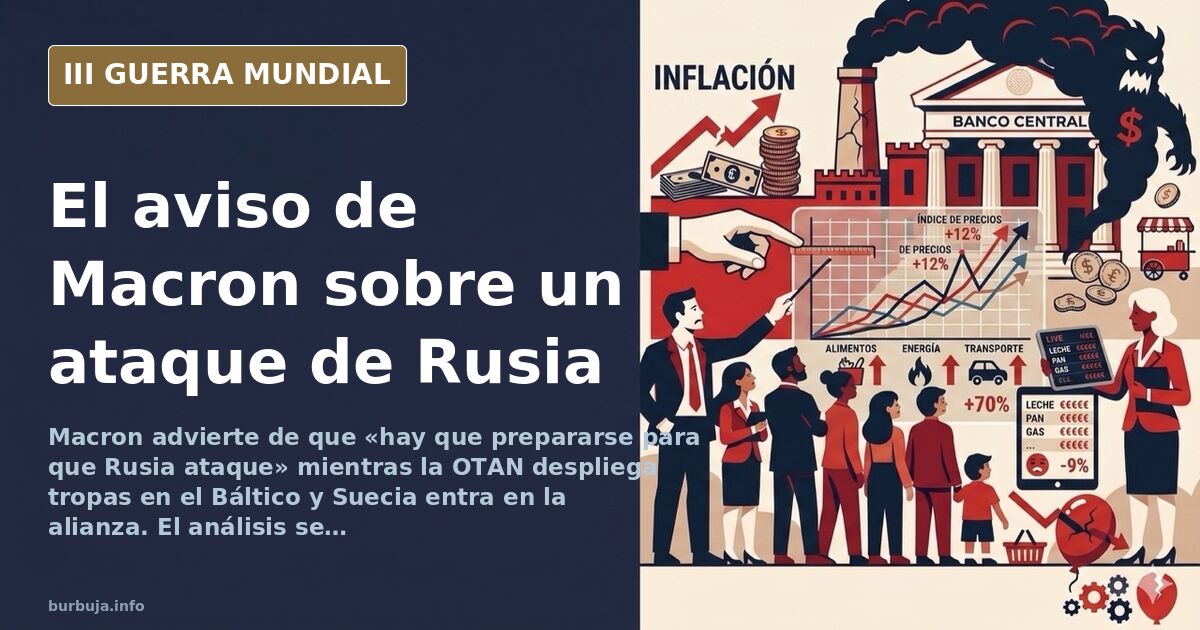
Europe prepares for war: Macron's warning and the antiestéticar of conflict
French President Emmanuel Macron has warned that "we must prepare for Russia to attack." The remark, made in a context of growing tension, has led part of the analysis to argue that NATO will enter into direct confrontation with Russia within a year, this time without Ukraine's shield. Slovak Prime Minister Robert Fico has gone further, asserting, citing a restricted document from the Paris summit, that several NATO and European Union member states are studying sending troops to Ukraine bilaterally. Thursday's front page of El País sums up the mood: "Europe prepares for war."
The deployment in the Baltic countries and Sweden's entry into NATO
The accumulating signs are of various kinds. According to one participant, enormous quantities of troops and war equipment of all kinds are being deployed in the Baltic countries. Sweden has joined NATO. Military agreements are being signed practically every day to ensure that, once the war begins, the necessary equipment can be quickly manufactured and distributed among member countries. Top army commanders have issued warnings to the civilian population: citizens will be part of the army one way or another. The Baltic countries are training new troops. And several NATO states are changing reservist laws and similar legislation to ensure that casualties can be quickly replaced.
Some argue that all this is the logical preparation for a real threat. Against it weighs an argument that is circulating widely: the United States does not even have 1,500 soldiers deployed among the three Baltic countries bordering Russia. Without the United States, the party does not start. The most optimistic calculation assumes deterrence works; the pessimistic scenario starts from the premise that deterrence has already failed.
Can Russia take on NATO directly?
The question runs through the analysis from top to bottom. Russia cannot defeat a country that, in relative terms, is a NATO poodle like Ukraine: thousands upon thousands of Russians die over months to take villages like Avdiivka. How on earth is it going to take on NATO directly? The most repeated answer is that it cannot, and that is precisely why direct confrontation would be a very short war. Very, very short.
Against that thesis, another current stresses that Ukraine is already better armed than almost every NATO country. And that Macron is announcing a "coalition" to provide Ukraine with "medium and long-range missiles and bombs." In that narrative, the escalation is not a hypothesis: it is a sequence of chained facts.
Oil, water and resources as the engine of the conflict
Part of the analysis shifts the focus from geopolitics to resources. The West has made the Middle East rich, and in the wars in Iraq and Libya the oil of those countries was no side issue. There are two ways to obtain oil: control exporting countries or destroy consuming countries. Western Europe is among the largest consumers. In that reading, the extension of the Ukraine war to Western Europe would have an economic motive.
The other current responds that oil is fundamental and that those who possess it become rich, but that does not necessarily miccionan it will run out. The United States invades countries to take their resources while at the same time trying to prevent the emergence of other rising powers. That could lead to a horrible war, but not necessarily over oil. The most extreme thesis holds that this time they want to wipe out half the population. And a third piece is added to the board: water as the absolute protagonist of this whole movie.
The dream of the seeds and the compass: when analysis becomes prophecy
In the realm of premonitions, two accounts coincide with a precision that unsettles those who share them. In one, the rider of Famine hands over three small jars of seeds and a compass. In the other, five people walk through a city, climb an abandoned building and, from up high, watch planes and missiles destroy the buildings they were looking at. The missiles were aimed at them, to prevent them from completing their mission. In both appear the whitish dust, the search for food and the idea of settling in a specific place to farm because everything will be contaminated by radiation. The seeds and the compass, in that reading, mark the way.
The coincidence of details between two dream accounts separated by years is, for some, a revelation. For others, it is exactly what it is: two dreams. The discussion resolves nothing, but it leaves a question hanging: why are we the ones being warned?
The prediction that fails to come true and the skepticism of those who have seen it all before
Skepticism has ammunition. A year ago, the same warning spoke of a few weeks. Two years ago, the prediction was that Russia would declare war on Japan and that Suvorikin would be defense minister. Other famous predictions: that Pedro Sánchez would not stand in the elections and that bitcoin would never return to 30,000. It may happen, but it will certainly have nothing to do with those forecasts. Looking at the track record of predictions, one can sleep soundly.
The counterargument is just as simple: until it gets one right and people have to come back to comment on it. Those who can, those who can.
The question is not whether Europe is prepared. The question is whether anyone has asked the Europeans.
Also available in: Deutsch
Summary of a discussion on Burbuja.info - Foro de economía, actualidad y política., translated from Spanish and reviewed before publication. Read the full discussion (99 replies).
More summaries
-
US weighs nuclear weapons in Poland and Baltics: a Russian red line?
The US is studying the deployment of tactical nuclear weapons in Poland and the Baltics. Provocation or a response to Russian weakness? Data and risk analysis.
-
Slovak PM Robert Fico Shot After Refusing Ukraine Arms
Robert Fico, Slovakia's prime minister, was shot after opposing arms to Ukraine and the Pandemic Treaty. The suspect is a 71-year-old writer.
-
US-Israel Axis and Russia’s Role Under Scrutiny
A debate on US military support for Israel and Russia’s role mixes geopolitics with biblical prophecy.
-
Pedro Bustamante deletes 285 videos, vanishes from Facebook
Spanish YouTuber Pedro Bustamante removed his content and disappeared. Rumors place him in Munich, reading German press.
-
CIA's Failed Ukraine Infiltration: All Agents Lost
Project AERODYNAMIC dropped 12 agents in Western Ukraine from 1949 to 1953. Soviet forces captured or killed all but one.
-
Georgian Legion and Video of Russian POW Executions
Verified video shows Ukrainian soldiers killing wounded Russian prisoners near Bucha, sparking debate on Geneva Conventions.