
Macgregor details the true cost of a US war with Iran
Colonel Macgregor's analysis predicts no US advantage in an Iran war, citing risks to Hormuz, Russian missiles, and 2,000 marines.
English · Original discussion in Spanish · Published
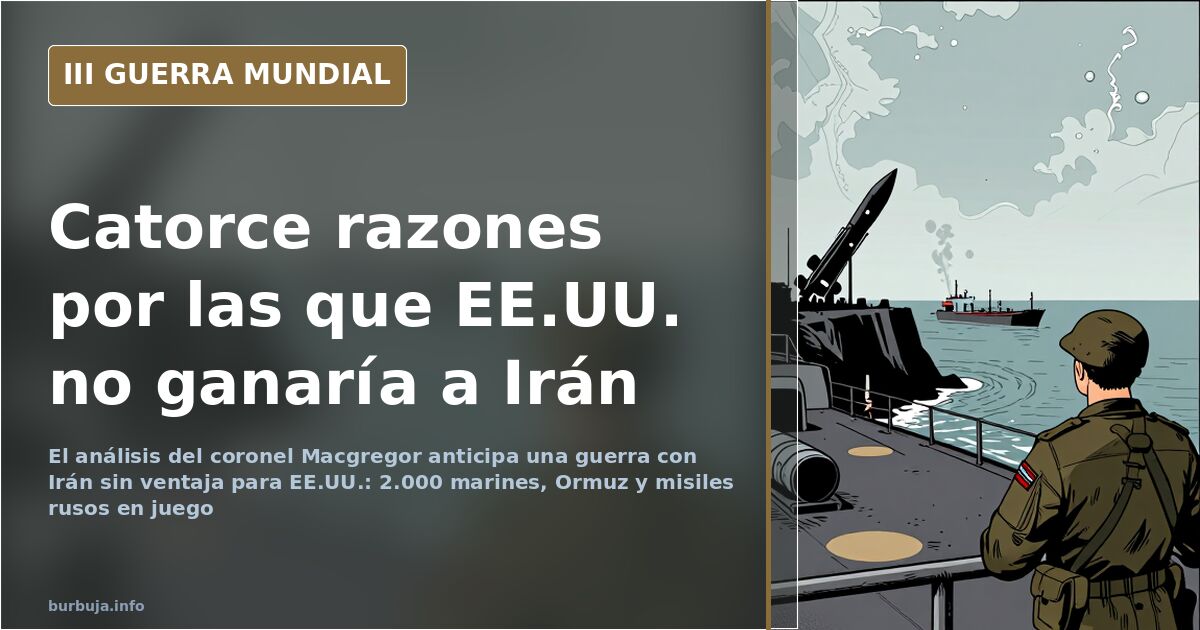
Fourteen reasons why the US would not win a war against Iran
Can the United States sustain an open war against Iran? This is the question driving the diagnosis attributed to Colonel Douglas Macgregor, spread by Tucker Carlson with a brief message: "Looks like we're actually going to war with Iran. Are we ready for this?" From this emerges a battery of fourteen arguments painting a giant with feet of clay: vulnerable bases across the Middle East, aircraft carriers forced to operate from Sicily and refuel in Israel, Russian hypersonic missiles in the Black Sea, and a deployed contingent of 2,000 Marines and 2,000 special forces personnel. The repeated conclusion: an army accustomed to fighting guerrillas is not ready to face a rival with modern weaponry.
Why is Iran no longer an easy target?
The first block of arguments is purely material. It holds that Iran is heavily armed and that all US bases in the region are attackable. Iranian air defense and its ballistic missile force are described as among the most powerful in the region, without needing anyone else to join the fight. The corollary is uncomfortable for naval doctrine: carrier strike groups could not approach the coast without entering the range of hypersonic missiles, pushing operations to distant ports and forcing refueling on Israeli territory.
An army that has never fought a conventional war
The second axis of the diagnosis is even more uncomfortable because it speaks not of hardware but of judgment. It asserts that the US has never participated in a conventional war against an army with current weapons, only against guerrillas with rifles and homemade rockets. Hence comes an internal critique: generals in Washington do not know what they are talking about because they lack direct combat experience. The war among the ruins of Gaza, they add, would be a massacre for Israel.
The 20% of oil passing through Hormuz
Closing the Strait of Hormuz is the trump card attributed to Tehran. Through it passes 20% of the world's oil, and the problem is not just crude prices: Qatar, Saudi Arabia, and Kuwait would see their exports cut off, and they are precisely the partners Washington cannot afford to anger. Added to this equation is money. The diagnosis circulates the idea that there is no budget for such an adventure nor logistical capacity to move Marines across the Atlantic in a global scenario. The growth of military-industrial mansions in Washington is read, in that same key, as a business parallel to war, not as preparation to win it.
Why do Turkey and Russia disrupt the board?
Here enters the geopolitical variable. It is argued that Russia does not need to enter the war: it suffices to sell Su-35 fighters and S-400 systems to Iran. As for Turkey, the thesis of support for Palestine clashes with a non-trivial detail: it is a NATO member and maintains an acompañante frigate integrated into the carrier group deployed in the area. That is, the same country presented as a future ally of Tehran sails today alongside the US fleet. Over the Turkish role also weighs the memory of the coup attempt that, according to this reading, was made against its president.
2050: the date that would bury hegemony
The temporal framework used is the most debated. The start of US hegemony is placed in 1945 and its end, at most, in 2050, coinciding with the centenary of the Chinese revolution and the deadline attributed to Beijing to annex Taiwan. From there, two exits: a nuclear war over an island or a silent retreat. The reindustrialization already observed is read as preparation for a period of withdrawal, not as a sign of strength. It is also suggested that the United States would not accept the fall of its empire without a great war or resorting to its nuclear arsenal.
The other side: ending the ayatollah regime
Not all analyses share the doom-laden tone. One school holds that the problem is not a long war, but a specific regime: if the ayatollahs are eliminated, they argue, much of the region's armed groups would fall with them, and even the Ukrainian conflict would be deactivated. They add that the Iranian population itself would be fed up with its rulers. Against that optimism rises another uncomfortable memory: 80 million buffalo and one million indigenous people are the figures used to underline the expansionist history of the United States and distrust its promises of stability.
The Ukrainian precedent nobody mentions quietly
None of these predictions is free: the comparison with Ukraine looms throughout. Ukraine started with some 400,000 soldiers and, when conscription of men over 60 arrived, what remained on the front was what remained. Russia, presumed to be the world's second army, remains stuck in positions without taking them. Failed forecasts in both directions teach the same thing: in war, everyone overestimates their favorite.
In the diagnosis used, everything fits until someone proposes the definitive test: whoever wins, someone else pays the bill. Meanwhile, 20% of the oil continues to pass through the same strait as always, indifferent to anyone's plans.
Also available in: Deutsch
Summary of a discussion on Burbuja.info - Foro de economía, actualidad y política., translated from Spanish and reviewed before publication. Read the full discussion (131 replies).
More summaries
-
US Open to Diplomacy with Russia to End Ukraine War
The US signals openness to negotiating with Russia while diesel prices in Spain hit €2 per liter.
-
Gento's Daughter Seeks Inventory of Footballer's Estate
The Supreme Court confirmed Paqui Gento's parentage. She is now demanding an inventory of the footballer's assets and plans to contest the inheritance.
-
Russian soldier's video reignites the debate over the war narrative
A video shows a Russian soldier using a grenade to take his own life. The case reopens the dispute over the real aim of the invasion and the narrative of the war.
-
Meloni invites Milei to the G7 summit in Italy
Italy confirms Javier Milei's invitation to the G7 summit on 13-15 June in Apulia, hours after the Argentine president was honoured in Miami.
-
The Windsor Tower burned in 2005: what the official report concluded
The 2005 Windsor Tower fire was officially closed as an accident caused by a short circuit. Another reading circulates: deliberate arson and documents from Spain's Ministry of Defence.
-
User claims nearly every tree is lit up as others slam food box celebrations
A participant says almost every tree has been decorated with Christmas lights, while others criticize families for celebrating food boxes worth under 20 euros.