
Lucid Dreaming: Techniques, Substances, and Risks
Techniques for lucid dreaming include dream journaling, alarms, and substances like Calea zacatechichi. Learn about the risks of sleep paralysis.
English · Original discussion in Spanish · Published
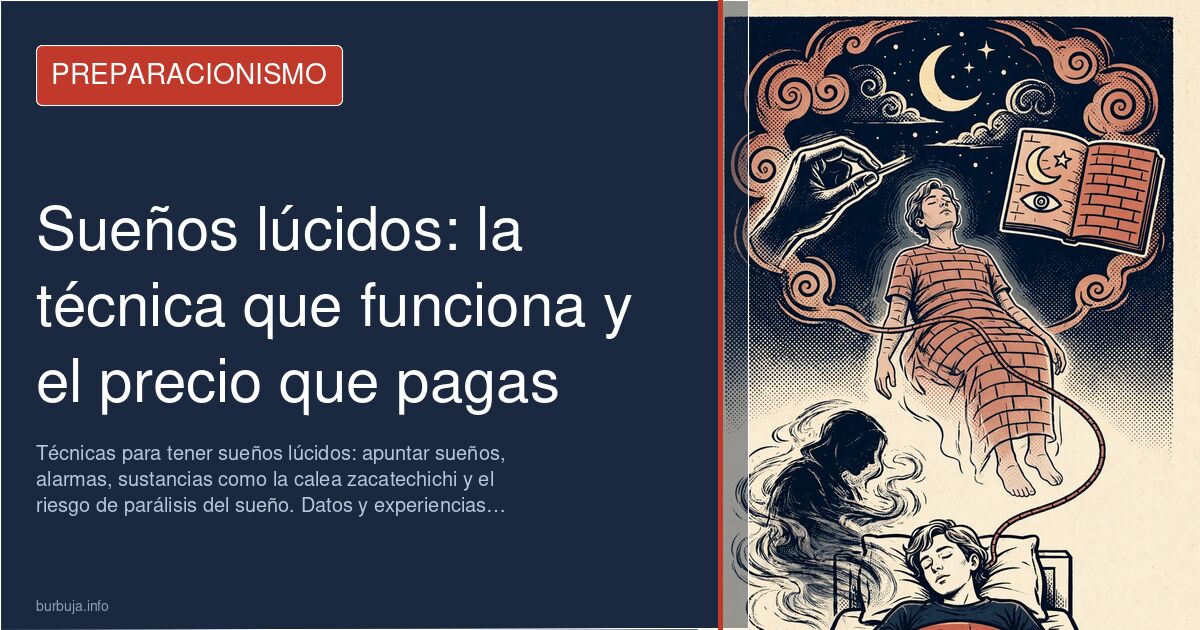
Lucid Dreams: Five Proven Techniques and Their Risks
Mastering lucid dreams is not a gift reserved for a few. It is a trainable skill, but the path is full of traps and side effects that few mention. The accumulated experience of long-term practitioners reveals a clear pattern: the techniques work, but conscious control within the dream is much harder than it seems.
The Most Cited Induction Techniques
The first step, almost unanimous, is recording dreams upon waking. Those who do this consistently ensure that dream memory is trained and, with it, the ability to realize one is dreaming. Some people remember three or four dreams per week after weeks of practice. From there, techniques diversify.
One of the most repeated is pre-sleep intention: repeating a phrase before bed such as "when I am in a dream, I will be aware." The idea is that repetition seeps into the unconscious and acts as a trigger. Another variant involves looking at your hands within the dream; doing so, the mind detects the anomaly and activates lucidity. The use of periodic alarms, every hour or two, is also mentioned to ask oneself if one is dreaming, until the habit transfers to the dream state.
The most elaborate technique involves waking up five hours after falling asleep, staying mentally active for 30 to 45 minutes with logic exercises or reading, and going back to sleep with the intention of having a lucid dream. Those who have tried it describe it as effective, though without guarantees.
The Role of Substances: From Galantamine to Blue Lotus
The debate on chemical enhancers is constant. Galantamine, a drug used for Alzheimer's, is mentioned as a facilitator of dream lucidity. Herbs such as Calea zacatechichi, known as "dream herb," and mugwort also circulate. Blue lotus (Nymphaea caerulea) appears as a traditional option, although its use has become so popular that, according to some, the "other side" has become more restrictive. Most experiences are anecdotal and there is no consensus on efficacy or safety.
Sleep Paralysis: The Price to Pay
The most antiestéticared side effect is sleep paralysis. Those who suffer from it describe an oppressive sense of presence, a crushing force, and the inability to move, often accompanied by hypnagogic hallucinations. Some accounts speak of a "malevolent presence" dragging them, and an instinctive resistance to avoid being taken over. It is not uncommon for those who experience it to decide to abandon the practice. The line between lucidity and waking is so fine that excess consciousness can cause abrupt awakening, while a defect leads to terror.
Neurology or Paranormal? The Underlying Debate
Opinions are divided between those who explain it as a neurological phenomenon, a brain mechanism for repair and rehearsal, and those who link it to astral projection and entities of the "lower astral plane." Some have recorded strange sounds while sleeping and attribute them to an entity, while others blame stress or febrile states. The most skeptical current maintains that everything is chemistry and that mystical interpretations are childish. The gap is difficult to close, and each side has its personal experiences as proof.
What Is It For? Utility Questioned
Beyond curiosity, the question of practical utility remains open. Some seek confirmation in astral travel that we are more than matter; others simply want to enjoy the sensation of flying or controlling the environment. In any case, the experience of those who achieve it is intense, sometimes unpleasant at first, but over time it can become a fascinating playground.
If the trend continues, the popularity of these techniques could grow, but the psychological risks associated with sleep paralysis and disturbing experiences remain unresolved. The boundary between control and antiestéticar is too thin to cross without caution.
Mastering lucid dreams is not a gift reserved for a few. It is a trainable skill, but the path is full of traps and side effects that few mention. The accumulated experience of long-term practitioners reveals a clear pattern: the techniques work, but conscious control within the dream is much harder than it seems.
The Most Cited Induction Techniques
The first step, almost unanimous, is recording dreams upon waking. Those who do this consistently ensure that dream memory is trained and, with it, the ability to realize one is dreaming. Some people remember three or four dreams per week after weeks of practice. From there, techniques diversify.
One of the most repeated is pre-sleep intention: repeating a phrase before bed such as "when I am in a dream, I will be aware." The idea is that repetition seeps into the unconscious and acts as a trigger. Another variant involves looking at your hands within the dream; doing so, the mind detects the anomaly and activates lucidity. The use of periodic alarms, every hour or two, is also mentioned to ask oneself if one is dreaming, until the habit transfers to the dream state.
The most elaborate technique involves waking up five hours after falling asleep, staying mentally active for 30 to 45 minutes with logic exercises or reading, and going back to sleep with the intention of having a lucid dream. Those who have tried it describe it as effective, though without guarantees.
The Role of Substances: From Galantamine to Blue Lotus
The debate on chemical enhancers is constant. Galantamine, a drug used for Alzheimer's, is mentioned as a facilitator of dream lucidity. Herbs such as Calea zacatechichi, known as "dream herb," and mugwort also circulate. Blue lotus (Nymphaea caerulea) appears as a traditional option, although its use has become so popular that, according to some, the "other side" has become more restrictive. Most experiences are anecdotal and there is no consensus on efficacy or safety.
Sleep Paralysis: The Price to Pay
The most antiestéticared side effect is sleep paralysis. Those who suffer from it describe an oppressive sense of presence, a crushing force, and the inability to move, often accompanied by hypnagogic hallucinations. Some accounts speak of a "malevolent presence" dragging them, and an instinctive resistance to avoid being taken over. It is not uncommon for those who experience it to decide to abandon the practice. The line between lucidity and waking is so fine that excess consciousness can cause abrupt awakening, while a defect leads to terror.
Neurology or Paranormal? The Underlying Debate
Opinions are divided between those who explain it as a neurological phenomenon, a brain mechanism for repair and rehearsal, and those who link it to astral projection and entities of the "lower astral plane." Some have recorded strange sounds while sleeping and attribute them to an entity, while others blame stress or febrile states. The most skeptical current maintains that everything is chemistry and that mystical interpretations are childish. The gap is difficult to close, and each side has its personal experiences as proof.
What Is It For? Utility Questioned
Beyond curiosity, the question of practical utility remains open. Some seek confirmation in astral travel that we are more than matter; others simply want to enjoy the sensation of flying or controlling the environment. In any case, the experience of those who achieve it is intense, sometimes unpleasant at first, but over time it can become a fascinating playground.
If the trend continues, the popularity of these techniques could grow, but the psychological risks associated with sleep paralysis and disturbing experiences remain unresolved. The boundary between control and antiestéticar is too thin to cross without caution.
Summary of a discussion on Burbuja.info - Foro de economía, actualidad y política., translated from Spanish and reviewed before publication. Read the full discussion (170 replies).
More summaries
-
UFO sightings, ghost voices and a stray 'h': 1,300 unexplained tales
A former soldier saw three figures in the air in 1993; another spotted a black triangle in 2019. Ghost voices and sleep paralysis fill 1,300 accounts that...
-
Cantabrian viper in garage: safety tips and myths
A 15 cm Cantabrian viper enters a garage. Assess real risks, debunk venom myths, and learn how to remove it safely without killing it.
-
Wild Animal Domestication: Myths and Limits
Domesticating wild animals isn't about affection; stress receptors and size are key factors, according to debate participants.
-
Spain Prepper Debate Over Three-Week Blackout Rumor
Rumors of a three-week blackout divide Spaniards between armed preppers and skeptics. Analysis of the phenomenon.
-
Squatting in Spain: Proving Primary Residence
Deeds prove ownership, not occupancy. Registration helps, but proving the home was primary residence before entry is key.
-
Killing is easy; hiding the body is hard
Human bodies are fragile, but phones and cameras turn perfect crimes into logistical nightmares.