
Killing is easy; hiding the body is hard
Human bodies are fragile, but phones and cameras turn perfect crimes into logistical nightmares.
English · Original discussion in Spanish · Published
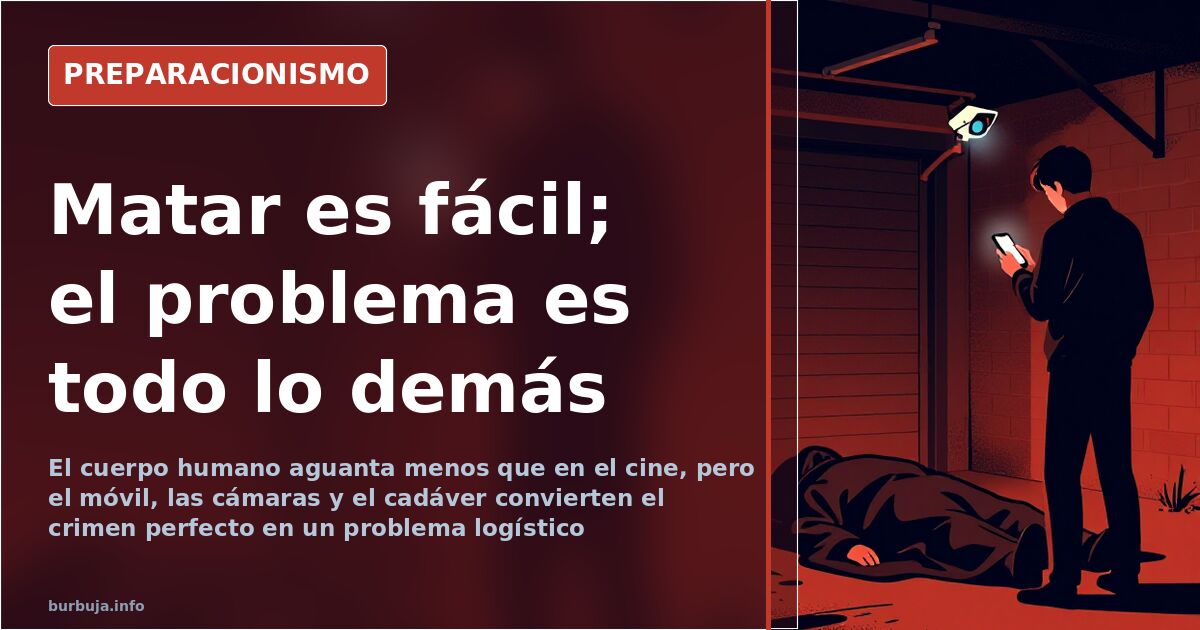
Killing someone is easy; the rest is difficult
Is it easy to kill someone? According to online discussions, yes: the human body is far more fragile than movies suggest. The act itself—a cut to the carotid artery, a well-placed ligature, or a sharp blow to the back of the neck—is simple. The complications arise afterward: the struggle, biological evidence, surveillance cameras, phone data revealing routes, and the need to move the corpse. As one user put it: "Killing someone is easy. Getting rid of the body is hard."
The discussion stems from a scene in Mindhunter, the Netflix series about the origins of incivil profiling at the FBI. In it, a serial killer explains that strangulation bears no resemblance to film portrayals: it requires significant strength, which many men lack, and sustained pressure for about five minutes. Fiction has built an imaginary where a head blow causes unconsciousness and victims die silently. Reality, according to those with firsthand experience, is much messier.
Head blows: unconsciousness or death, no middle ground
Blows to the head are cinema’s most effective narrative device and its most deceptive. The idea that a blunt object knocks someone out briefly before they wake up groggy is a fantasy, according to witnesses of real fights. One participant with brawl experience described knocking out two people and the subsequent panic: the sound of a head hitting concrete is "like a hammer on pavement," and the time until consciousness returned felt like an eternity. The recurring conclusion is that a blow with a bat or hammer strong enough to cause unconsciousness is, with high probability, lethal.
Basic neurology supports this intuition: the skull protects the brain only to a point. Beyond that, traumatic brain injury doesn’t distinguish between movie fainting spells and internal hemorrhaging. Prolonged unconsciousness isn’t restful sleep; it’s a medical emergency. Yet popular imagination still clings to the detective waking suspects with a slap.
Strangulation: five minutes not shown in credits
Strangulation dominated the discussion, not due to morbidity but physics. The figure cited repeatedly is the five minutes of sustained pressure mentioned in the series. Technically, cutting off air isn’t enough; you must cut off blood flow. A properly placed ligature from behind, using surprise, can work faster but requires cold blood and a single chance. The circulating advice—referring to the "rear naked choke," which induces unconsciousness in seconds—points the same way: first render the victim unconscious, then act.
Cautious voices note adrenaline as the problem. With victims struggling and perpetrators nervous, fine motor skills vanish. A theoretically infallible ligature can become a disaster if hands shake. Piano wire appears as a more aggressive alternative, though it leaves organic residue unlike rope. Suffocation, ultimately, is neither clean, quick, nor silent.
Knives and guns: human fragility
The conversation shifts to the relative ease of edged weapons. A four- or five-centimeter blade, even a cheap pocketknife, suffices to reach the carotid artery and cause massive bleeding in seconds. A slash to the jugular, a puncture to lungs, or an abdominal wound reveals that compared to other mammals, humans aren’t well-armored. The cinematic reference is the opening scene of No Country for Old Men, where Javier Bardem’s character uses a captive bolt pistol—compressed air and retractable screw—to kill a man. It’s not an electric gun, as many believed, but a slaughterhouse tool.
Firearms occupy less space in the debate, but a striking fact emerges: some suicide attempts involving headshots result in survival. While unexplained in the thread, this data dismantles the notion that a headshot guarantees death. Biology doesn’t work with switches.
The problem isn’t killing: it’s phones, cameras, and corpses
The longest and most revealing part of the discussion concerns evading consequences, not committing murder. Mobile phones are major informants: whether on or off, carriers log locations. Surveillance cameras pose the second obstacle. Participants detail planning entry/exit routes, avoiding filming, and leaving phones behind. References to real cases—such as a man who murdered two women and tried fleeing to Romania—illustrate how police start with phone data.
Corpses present the third problem. Disappearances without bodies complicate investigations but don’t stop them: if phone signals vanish near cliffs, hypotheses change. Dumping bodies in remote ravines seems safest but demands thorough terrain knowledge. Dismemberment, however, represents an insurmountable psychological barrier for normal people—not just cutting limbs but touching bodies with selfie sticks. Media references—like a man confessing via WhatsApp how difficult it was to dismember his aunt, uncle, and their children—highlight this point. Reading such conversations offers insight into psychopathic minds stripped of social masks.
Real death isn’t a sigh: agony, sphincters, and minutes
Movies teach that dying means closing eyes and stopping breathing. Reality involves processes lasting minutes, including agony, gasping for air driven by basic brain stimuli, sphincter relaxation, and muscle contractions. It’s not idyllic. Descriptions of hanged individuals writhing and releasing adrenaline align with this view: bodies don’t shut down—they resist.
This gap between fiction and reality threads through the entire conversation. Breaking Bad cites realistic crime complications versus action films where protagonists take bullet hits while jumping from moving vehicles. The uncomfortable conclusion stands: killing is easy, but doing so without traces, breakdowns, or phone betrayals is another category entirely. Fortunately, most people lack the stomach for it.
Is it easy to kill someone? According to online discussions, yes: the human body is far more fragile than movies suggest. The act itself—a cut to the carotid artery, a well-placed ligature, or a sharp blow to the back of the neck—is simple. The complications arise afterward: the struggle, biological evidence, surveillance cameras, phone data revealing routes, and the need to move the corpse. As one user put it: "Killing someone is easy. Getting rid of the body is hard."
The discussion stems from a scene in Mindhunter, the Netflix series about the origins of incivil profiling at the FBI. In it, a serial killer explains that strangulation bears no resemblance to film portrayals: it requires significant strength, which many men lack, and sustained pressure for about five minutes. Fiction has built an imaginary where a head blow causes unconsciousness and victims die silently. Reality, according to those with firsthand experience, is much messier.
Head blows: unconsciousness or death, no middle ground
Blows to the head are cinema’s most effective narrative device and its most deceptive. The idea that a blunt object knocks someone out briefly before they wake up groggy is a fantasy, according to witnesses of real fights. One participant with brawl experience described knocking out two people and the subsequent panic: the sound of a head hitting concrete is "like a hammer on pavement," and the time until consciousness returned felt like an eternity. The recurring conclusion is that a blow with a bat or hammer strong enough to cause unconsciousness is, with high probability, lethal.
Basic neurology supports this intuition: the skull protects the brain only to a point. Beyond that, traumatic brain injury doesn’t distinguish between movie fainting spells and internal hemorrhaging. Prolonged unconsciousness isn’t restful sleep; it’s a medical emergency. Yet popular imagination still clings to the detective waking suspects with a slap.
Strangulation: five minutes not shown in credits
Strangulation dominated the discussion, not due to morbidity but physics. The figure cited repeatedly is the five minutes of sustained pressure mentioned in the series. Technically, cutting off air isn’t enough; you must cut off blood flow. A properly placed ligature from behind, using surprise, can work faster but requires cold blood and a single chance. The circulating advice—referring to the "rear naked choke," which induces unconsciousness in seconds—points the same way: first render the victim unconscious, then act.
Cautious voices note adrenaline as the problem. With victims struggling and perpetrators nervous, fine motor skills vanish. A theoretically infallible ligature can become a disaster if hands shake. Piano wire appears as a more aggressive alternative, though it leaves organic residue unlike rope. Suffocation, ultimately, is neither clean, quick, nor silent.
Knives and guns: human fragility
The conversation shifts to the relative ease of edged weapons. A four- or five-centimeter blade, even a cheap pocketknife, suffices to reach the carotid artery and cause massive bleeding in seconds. A slash to the jugular, a puncture to lungs, or an abdominal wound reveals that compared to other mammals, humans aren’t well-armored. The cinematic reference is the opening scene of No Country for Old Men, where Javier Bardem’s character uses a captive bolt pistol—compressed air and retractable screw—to kill a man. It’s not an electric gun, as many believed, but a slaughterhouse tool.
Firearms occupy less space in the debate, but a striking fact emerges: some suicide attempts involving headshots result in survival. While unexplained in the thread, this data dismantles the notion that a headshot guarantees death. Biology doesn’t work with switches.
The problem isn’t killing: it’s phones, cameras, and corpses
The longest and most revealing part of the discussion concerns evading consequences, not committing murder. Mobile phones are major informants: whether on or off, carriers log locations. Surveillance cameras pose the second obstacle. Participants detail planning entry/exit routes, avoiding filming, and leaving phones behind. References to real cases—such as a man who murdered two women and tried fleeing to Romania—illustrate how police start with phone data.
Corpses present the third problem. Disappearances without bodies complicate investigations but don’t stop them: if phone signals vanish near cliffs, hypotheses change. Dumping bodies in remote ravines seems safest but demands thorough terrain knowledge. Dismemberment, however, represents an insurmountable psychological barrier for normal people—not just cutting limbs but touching bodies with selfie sticks. Media references—like a man confessing via WhatsApp how difficult it was to dismember his aunt, uncle, and their children—highlight this point. Reading such conversations offers insight into psychopathic minds stripped of social masks.
Real death isn’t a sigh: agony, sphincters, and minutes
Movies teach that dying means closing eyes and stopping breathing. Reality involves processes lasting minutes, including agony, gasping for air driven by basic brain stimuli, sphincter relaxation, and muscle contractions. It’s not idyllic. Descriptions of hanged individuals writhing and releasing adrenaline align with this view: bodies don’t shut down—they resist.
This gap between fiction and reality threads through the entire conversation. Breaking Bad cites realistic crime complications versus action films where protagonists take bullet hits while jumping from moving vehicles. The uncomfortable conclusion stands: killing is easy, but doing so without traces, breakdowns, or phone betrayals is another category entirely. Fortunately, most people lack the stomach for it.
Summary of a discussion on Burbuja.info - Foro de economía, actualidad y política., translated from Spanish and reviewed before publication. Read the full discussion (165 replies).
More summaries
-
Leave the World Behind: Netflix's Apocalyptic Thriller Sparks Conspiracy Theories
The Obama-produced Netflix thriller 'Leave the World Behind' sparks theories about civilizational collapse, communication breakdown, and power vacuums.
-
Pine processionary traps for tall, inaccessible trees
DIY funnel traps and fire methods against pine processionary moths when spraying is impossible due to height or safety.
-
2023 Alien Predictions: UFOs, GESARA and Alonso's Win
A self-proclaimed channeler shares 2023 alien predictions: more UFOs, GESARA NESARA, Alonso's 33rd win, and Ganymede ships in 2026.
-
Sleeping in a car at -2°C: The cost of dignity
A first-person account describes surviving a night in a car at -2°C, saving €40 versus a hostel while losing weight and suffering food poisoning.
-
AGI Debate: ChatGPT Launch Sparks Concerns Over Costs and Job Losses
The new ChatGPT launch revives the AGI debate, highlighting doubts about financial losses, data scarcity, energy limits, and potential layoffs.
-
Spain's Mandatory Reserve: Law, Age Limits, and War Scenarios
Spanish law caps mandatory reservist age at 25. Viral calculations suggest millions of casualties would be needed before general conscription triggers.