
AI Music: End of Singers or Playback?
Generative AI lowers commercial music costs, boosting live shows. The debate: who gets paid when songs cost a subscription, not studio time.
English · Original discussion in Spanish · Published
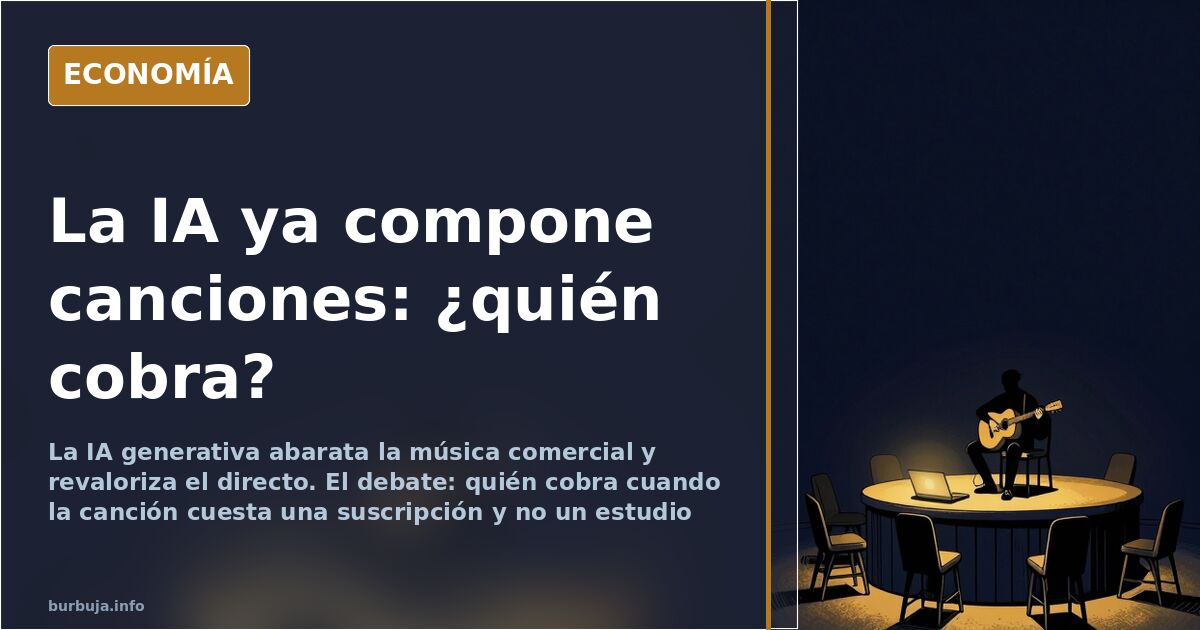
AI music doesn't kill singers: it kills playback
An amateur has been generating songs with AI for months and claims the results are already "commercially viable." He shares this without hesitation: original lyrics, synthetic voice, presentable output. The question that opens the issue isn't whether it sounds good or bad, but who gets paid when the tool costs a subscription and the recording studio costs a loan. In a sector where, according to one participant, 90% of what you hear repeats four chords, AI isn't coming to invent new music: it's coming to cheapen what already existed.
What AI writes and what it doesn't
There is consensus on the obvious: AI imitates, it doesn't feel. It analyzes statistical patterns, repeats combinations that worked, and serves them with a professional finish. That is enough for it to nail a reggaeton chorus, a stadium anthem, or a festival ballad. What it doesn't do — at least for now — is explain why one set of lyrics by Sabina raises goosebumps while another seemingly identical one causes second-hand embarrassment. One participant sums it up bluntly: "AI analyzes and repeats based on statistical algorithms. It doesn't feel, it doesn't understand."
The counterargument arrives quickly: neither has commercial music from the last two decades distinguished itself by its depth. If the bar is "Titi cómeme el toto," maybe the machine doesn't sound so out of tune.
The business was already automated
Here is the data that disorients purists. According to a participant, record labels have spent more than a decade running every song through software that analyzes if it will be a hit and suggests what to fine-tune. Generative AI doesn't invent the process: it democratizes it. What used to be an expensive program in an office in Madrid or Los Angeles is now a website with a free plan and a paid one.
The practical consequence is that the bottleneck moves. You no longer need to know how to play, sing, or pay for a studio. You need judgment to choose between a hundred versions and charisma to defend them live.
Live performance as the last refuge
The most repeated prediction points to the same place: AI will revalue those who play and sing without safety nets. Concerts where the audience pays to see real skill, not a USB plugged into a table. The comparison with the club DJ is inevitable: much of what sounds in a session is already pre-recorded, and the audience accepts it as long as the vibe works.
The problem is that this refuge has limited capacity. Not all musicians can tour, and those who make a living from weddings, communions, and bar gigs compete directly with a tool that does their work for twenty euros a month.
Locomía did it already without AI
The juiciest anecdote of the matter: the Locomía phenomenon was built from a studio, with dancers hired by regions who didn't sing or move their lips, and it worked for years. Playback wasn't invented by AI. What changes now is the cost of manufacturing the entire product, voice included.
With that perspective, the debate about whether AI will end singers sounds like a poorly posed question. The good question is how many of those we today call singers were already playing a role.
Dubbing, playback, and the domino effect
The same technological leap threatens dubbing: maintaining the tone and original voice of an actor while speaking in another language is already technically possible. This affects an entire guild of professionals who today provide voices for series, children's movies, and translations. If dubbing falls, a part of the live industry that depended on it also falls.
The emotional resistance is real: "you can tell it's music made by a ing robot," they write. But noticing it doesn't always miccionan rejecting it. The average ear doesn't distinguish perfect tuning from a machine.
What remains to be seen isn't whether AI sings better or worse. It's whether the audience will continue paying for a ticket when they know the voice on stage comes from a file. With these ingredients, the honest answer is that nobody knows yet.
An amateur has been generating songs with AI for months and claims the results are already "commercially viable." He shares this without hesitation: original lyrics, synthetic voice, presentable output. The question that opens the issue isn't whether it sounds good or bad, but who gets paid when the tool costs a subscription and the recording studio costs a loan. In a sector where, according to one participant, 90% of what you hear repeats four chords, AI isn't coming to invent new music: it's coming to cheapen what already existed.
What AI writes and what it doesn't
There is consensus on the obvious: AI imitates, it doesn't feel. It analyzes statistical patterns, repeats combinations that worked, and serves them with a professional finish. That is enough for it to nail a reggaeton chorus, a stadium anthem, or a festival ballad. What it doesn't do — at least for now — is explain why one set of lyrics by Sabina raises goosebumps while another seemingly identical one causes second-hand embarrassment. One participant sums it up bluntly: "AI analyzes and repeats based on statistical algorithms. It doesn't feel, it doesn't understand."
The counterargument arrives quickly: neither has commercial music from the last two decades distinguished itself by its depth. If the bar is "Titi cómeme el toto," maybe the machine doesn't sound so out of tune.
The business was already automated
Here is the data that disorients purists. According to a participant, record labels have spent more than a decade running every song through software that analyzes if it will be a hit and suggests what to fine-tune. Generative AI doesn't invent the process: it democratizes it. What used to be an expensive program in an office in Madrid or Los Angeles is now a website with a free plan and a paid one.
The practical consequence is that the bottleneck moves. You no longer need to know how to play, sing, or pay for a studio. You need judgment to choose between a hundred versions and charisma to defend them live.
Live performance as the last refuge
The most repeated prediction points to the same place: AI will revalue those who play and sing without safety nets. Concerts where the audience pays to see real skill, not a USB plugged into a table. The comparison with the club DJ is inevitable: much of what sounds in a session is already pre-recorded, and the audience accepts it as long as the vibe works.
The problem is that this refuge has limited capacity. Not all musicians can tour, and those who make a living from weddings, communions, and bar gigs compete directly with a tool that does their work for twenty euros a month.
Locomía did it already without AI
The juiciest anecdote of the matter: the Locomía phenomenon was built from a studio, with dancers hired by regions who didn't sing or move their lips, and it worked for years. Playback wasn't invented by AI. What changes now is the cost of manufacturing the entire product, voice included.
With that perspective, the debate about whether AI will end singers sounds like a poorly posed question. The good question is how many of those we today call singers were already playing a role.
Dubbing, playback, and the domino effect
The same technological leap threatens dubbing: maintaining the tone and original voice of an actor while speaking in another language is already technically possible. This affects an entire guild of professionals who today provide voices for series, children's movies, and translations. If dubbing falls, a part of the live industry that depended on it also falls.
The emotional resistance is real: "you can tell it's music made by a ing robot," they write. But noticing it doesn't always miccionan rejecting it. The average ear doesn't distinguish perfect tuning from a machine.
What remains to be seen isn't whether AI sings better or worse. It's whether the audience will continue paying for a ticket when they know the voice on stage comes from a file. With these ingredients, the honest answer is that nobody knows yet.
Also available in: Deutsch
Summary of a discussion on Burbuja.info - Foro de economía, actualidad y política., translated from Spanish and reviewed before publication. Read the full discussion (116 replies).
More summaries
-
AI Music: Human Lyrics, Synthetic Sound
AI now creates full songs: human lyrics, synthetic music, and a debate over legal limits and cloned voices on streaming platforms.
-
Suno: The AI That Composes Songs from Two Verses
Suno generates sung songs from four phrases and limits the free version to two verses. The AI that threatens to bring the cost of producing a track to zero.
-
Bonnie Tyler dies at 75, ending an era in music
Singer Bonnie Tyler dies in Portugal at 75. Known for her raspy voice and 'Total Eclipse of the Heart', she marks a generational shift.
-
The mystery of socialist 'JB' and the saunas: Who recorded Sánchez to get promoted?
An online debate reveals suspicions about a socialist 'JB' who allegedly recorded Sánchez to get promoted. Names like Bono, Borrell, and Blanco come into play.
-
Early retirement with minimum pension: forum user's calculation
Retiring early once minimum requirements are met yields better returns than working until ordinary age, according to a circulating calculation.
-
Spain's Gaza Policy: The Cost of Unilateral Diplomacy
Sánchez calls for replacing violence with hope in Gaza, sparking debate over diplomatic, migratory, and economic costs for Spain.