
Low turnout at Ferraz protests despite heavy media coverage
Protests on November 9, 2023, saw high digital engagement but low physical attendance in Spain, as the CGPJ criticized the PSOE-Junts pact.
English · Original discussion in Spanish · Published
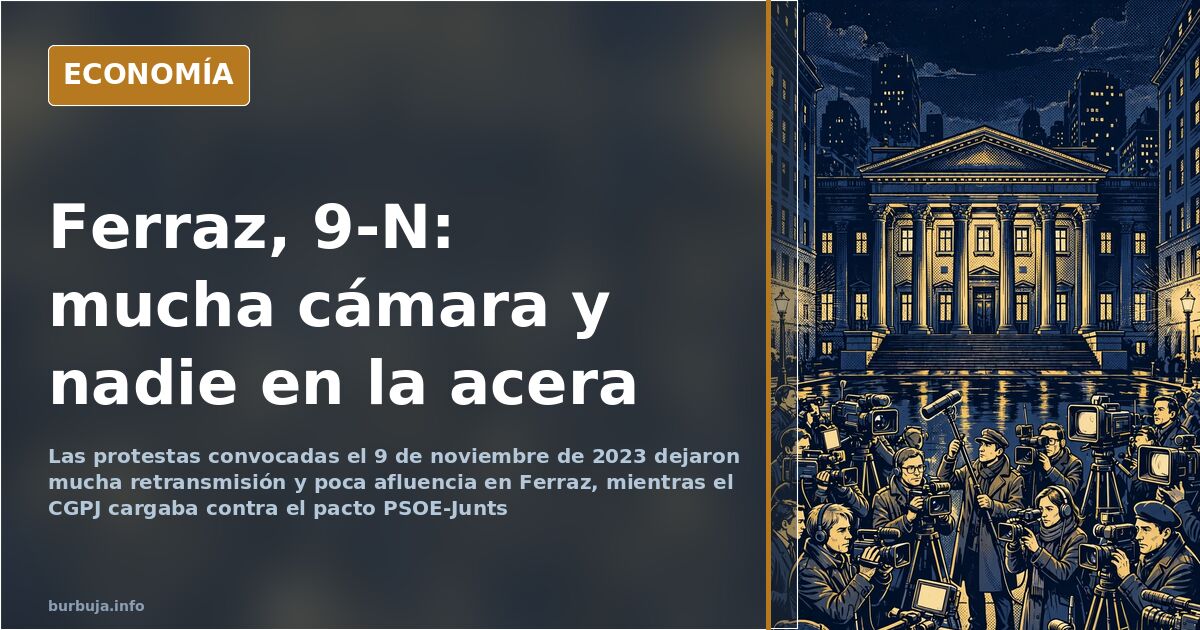
November 9 protests: Live streams, arrests, and low turnout
The call spread across Spain: to take to the streets on Thursday, November 9, 2023, in Ferraz and throughout the country, hours after the signing of the investiture agreement between the PSOE and Junts, and while the attack on Vidal-Quadras was still a fresh wound. The coverage was set up as a permanent deployment of cameras. However, what the streets delivered was far less epic: heavy broadcasting but attendance that failed to fill the sidewalks. The day ended up being defined more by what didn't happen than by what did.
What time were the November 9 protests?
The time was never clearly set: seven or eight in the evening, depending on whom you asked. This ambiguity served as a thermometer for everything else. Added to the timing confusion was the usual uncertainty regarding who was organizing them. The generic label—protest in front of the PSOE headquarters—acted as the organizer, without specific names or platforms behind it.
Those expecting a tide of people found only scattered groups and the sense that the calendar mattered more than the call to action. The date was not accidental: the investiture agreement had just been signed, and the attack on the leader had inflamed tempers. Everything pointed to a peak in mobilization. Cameras, yes. People, no.
The Vidal-Quadras attack: no confirmed authorship
The attack on Vidal-Quadras acted as the trigger for the protests. Regarding who was behind it, circulating information remained in the realm of suspicion: it was suggested that an Iranian passport was among the attacker's belongings, an extreme that was not confirmed and was circulated as a hypothesis rather than a settled fact. The investigation remained open at the time of this discussion.
The political use of the coincidence was immediate. Some analyses suggest the attack changed the tone of the week and served to amplify the reach of every protest call. Others warn of the opposite: that turning it into a rallying cry before knowing anything weakens any subsequent protest. The issue remains unresolved.
The CGPJ repudiates the PSOE-Junts pact
The Permanent Commission of the CGPJ (the General Council of the Judiciary, Spain's governing body for judges) issued a statement against the agreement. In a text dated November 9, 2023, at 21:36, the body described the submission of decisions belonging exclusively to the courts to parliamentary review as an "inadmissible interference in judicial independence" and a "flagrant assault on the separation of powers." There were no half-measures.
The statement provided ammunition to those who had been speaking of an institutional clash for weeks. Others turned it around, pointing out that the communiqué arrived late and failed to assign specific responsibilities. In parallel, a statement from Minister Bolaños circulated which, according to the version released, denied a judicial dirty war but spoke of false evidence against political rivals. The dispute was well and truly set.
Ferraz: many live streams, half-empty sidewalks
With cameras focused, the result was uneven. Live streams cut out for about three minutes in the middle of the night, coinciding with arrests that were never specified. Some spent the entire night in front of the Socialist headquarters only to return with an uncomfortable conclusion: there was no one protesting. The joke that they had been pranked summarizes the gap between digital noise and the reality of the streets better than any report.
There was also room for the unexpected. Iker Jiménez's live stream, which began at 22:00, became a must-watch event, and some saw this timing coincidence as a clue as to where the indignation was being channeled. The street furniture, meanwhile, remained without significant damage.
Ten thousand peaceful protesters, fifty radicals: the infiltration theory
A calculation circulated widely: that for every protest day, about 10,000 attendees came to make noise and barely 50 to cause trouble; of those 50, half were allegedly plainclothes officers, and of the remaining 25, about ten would end up arrested each night. This figure does not come from any official source and must be treated as what it is: an estimate. However, it neatly organized the narrative of those who claim these gatherings function as a cepo (a trap or sting operation) to catch the most radical elements.
In parallel, estimates regarding the police deployment placed intervention units at around 3,000 personnel. The official reading did not comment. The unofficial reading, which ran through monitoring channels, took it for granted that the ratio between officers and protesters was the true data point of the day.
Pacifism, boycotts, and violence: the underlying rift
This opens a discussion that never closes. One current argues that pacifism is the fastest way to avoid ending up in a dictatorship; another responds that in a country where those who have used violence have achieved their goals, asking for moderation is like handing flowers to someone who doesn't want them. "Violence works," summarized one of the most repeated arguments.
In response, the counter-argument arises: one does not respond to what is described as oppression by imitating its methods, and armchair radicalism only feeds the caricature. In the middle are proposals for everyday resistance, ranging from commercial boycotts to abandoning institutional politics. None of this translated, on that day, into a crowded street.
With that mix, the day left headlines more in the judicial sphere—the CGPJ statement—than on the sidewalks. The protest that was announced as a great awakening remained a trickle of live streams, arrests without official figures, and a question that reappears every evening: how many of the people trinc the minute-by-minute updates are actually willing to take to the streets. On that November 9, the numbers did not add up. And the analysis stalls right there.
The call spread across Spain: to take to the streets on Thursday, November 9, 2023, in Ferraz and throughout the country, hours after the signing of the investiture agreement between the PSOE and Junts, and while the attack on Vidal-Quadras was still a fresh wound. The coverage was set up as a permanent deployment of cameras. However, what the streets delivered was far less epic: heavy broadcasting but attendance that failed to fill the sidewalks. The day ended up being defined more by what didn't happen than by what did.
What time were the November 9 protests?
The time was never clearly set: seven or eight in the evening, depending on whom you asked. This ambiguity served as a thermometer for everything else. Added to the timing confusion was the usual uncertainty regarding who was organizing them. The generic label—protest in front of the PSOE headquarters—acted as the organizer, without specific names or platforms behind it.
Those expecting a tide of people found only scattered groups and the sense that the calendar mattered more than the call to action. The date was not accidental: the investiture agreement had just been signed, and the attack on the leader had inflamed tempers. Everything pointed to a peak in mobilization. Cameras, yes. People, no.
The Vidal-Quadras attack: no confirmed authorship
The attack on Vidal-Quadras acted as the trigger for the protests. Regarding who was behind it, circulating information remained in the realm of suspicion: it was suggested that an Iranian passport was among the attacker's belongings, an extreme that was not confirmed and was circulated as a hypothesis rather than a settled fact. The investigation remained open at the time of this discussion.
The political use of the coincidence was immediate. Some analyses suggest the attack changed the tone of the week and served to amplify the reach of every protest call. Others warn of the opposite: that turning it into a rallying cry before knowing anything weakens any subsequent protest. The issue remains unresolved.
The CGPJ repudiates the PSOE-Junts pact
The Permanent Commission of the CGPJ (the General Council of the Judiciary, Spain's governing body for judges) issued a statement against the agreement. In a text dated November 9, 2023, at 21:36, the body described the submission of decisions belonging exclusively to the courts to parliamentary review as an "inadmissible interference in judicial independence" and a "flagrant assault on the separation of powers." There were no half-measures.
The statement provided ammunition to those who had been speaking of an institutional clash for weeks. Others turned it around, pointing out that the communiqué arrived late and failed to assign specific responsibilities. In parallel, a statement from Minister Bolaños circulated which, according to the version released, denied a judicial dirty war but spoke of false evidence against political rivals. The dispute was well and truly set.
Ferraz: many live streams, half-empty sidewalks
With cameras focused, the result was uneven. Live streams cut out for about three minutes in the middle of the night, coinciding with arrests that were never specified. Some spent the entire night in front of the Socialist headquarters only to return with an uncomfortable conclusion: there was no one protesting. The joke that they had been pranked summarizes the gap between digital noise and the reality of the streets better than any report.
There was also room for the unexpected. Iker Jiménez's live stream, which began at 22:00, became a must-watch event, and some saw this timing coincidence as a clue as to where the indignation was being channeled. The street furniture, meanwhile, remained without significant damage.
Ten thousand peaceful protesters, fifty radicals: the infiltration theory
A calculation circulated widely: that for every protest day, about 10,000 attendees came to make noise and barely 50 to cause trouble; of those 50, half were allegedly plainclothes officers, and of the remaining 25, about ten would end up arrested each night. This figure does not come from any official source and must be treated as what it is: an estimate. However, it neatly organized the narrative of those who claim these gatherings function as a cepo (a trap or sting operation) to catch the most radical elements.
In parallel, estimates regarding the police deployment placed intervention units at around 3,000 personnel. The official reading did not comment. The unofficial reading, which ran through monitoring channels, took it for granted that the ratio between officers and protesters was the true data point of the day.
Pacifism, boycotts, and violence: the underlying rift
This opens a discussion that never closes. One current argues that pacifism is the fastest way to avoid ending up in a dictatorship; another responds that in a country where those who have used violence have achieved their goals, asking for moderation is like handing flowers to someone who doesn't want them. "Violence works," summarized one of the most repeated arguments.
In response, the counter-argument arises: one does not respond to what is described as oppression by imitating its methods, and armchair radicalism only feeds the caricature. In the middle are proposals for everyday resistance, ranging from commercial boycotts to abandoning institutional politics. None of this translated, on that day, into a crowded street.
With that mix, the day left headlines more in the judicial sphere—the CGPJ statement—than on the sidewalks. The protest that was announced as a great awakening remained a trickle of live streams, arrests without official figures, and a question that reappears every evening: how many of the people trinc the minute-by-minute updates are actually willing to take to the streets. On that November 9, the numbers did not add up. And the analysis stalls right there.
Also available in: Deutsch
Summary of a discussion on Burbuja.info - Foro de economía, actualidad y política., translated from Spanish and reviewed before publication. Read the full discussion (487 replies).
More summaries
-
Spain's top court warns amnesty law violates constitution before text exists
Spain's judicial council condemns the proposed amnesty law, citing constitutional violations and blocking its own advisory role due to the legislative procedure chosen.
-
Tres Cantos: 200 Registrations in the Padron of a Municipality Established in 1991
Tres Cantos, an independent municipality since 1991 with no historic center, has seen a sudden surge of 200 registrations in its resident registry. What is known and what doesn't add up.
-
Ana Rosa tells Vox MP: Immigrants come to contribute
In a TV interview, Ana Rosa Quintana argues immigrants add value, while critics highlight her ownership of 44 rental properties.
-
Moncloa boosts Alvise to curb Vox's 20% support
Forum thread claims Moncloa promotes Alvise to reduce Vox seats. One million votes might yield no MPs but could shift several.
-
Spain's Parasite Debate: Cultural Shock or Marketing?
Analysis of the debate on deworming in Spain: is it a cultural clash, a public health need, or just marketing?
-
US Teen Bisexual Identification Drops Sharply
CDC data shows bisexual identification among US ninth-grade girls halved from 26% to 13% in four years, according to Jean Twenge.