
Low-cost funerals clash with Spanish monopoly
Coffins bought for €80 are sold at €2,800. Low-cost burials face a market where clients cannot compare, negotiate, or wait.
English · Original discussion in Spanish · Published
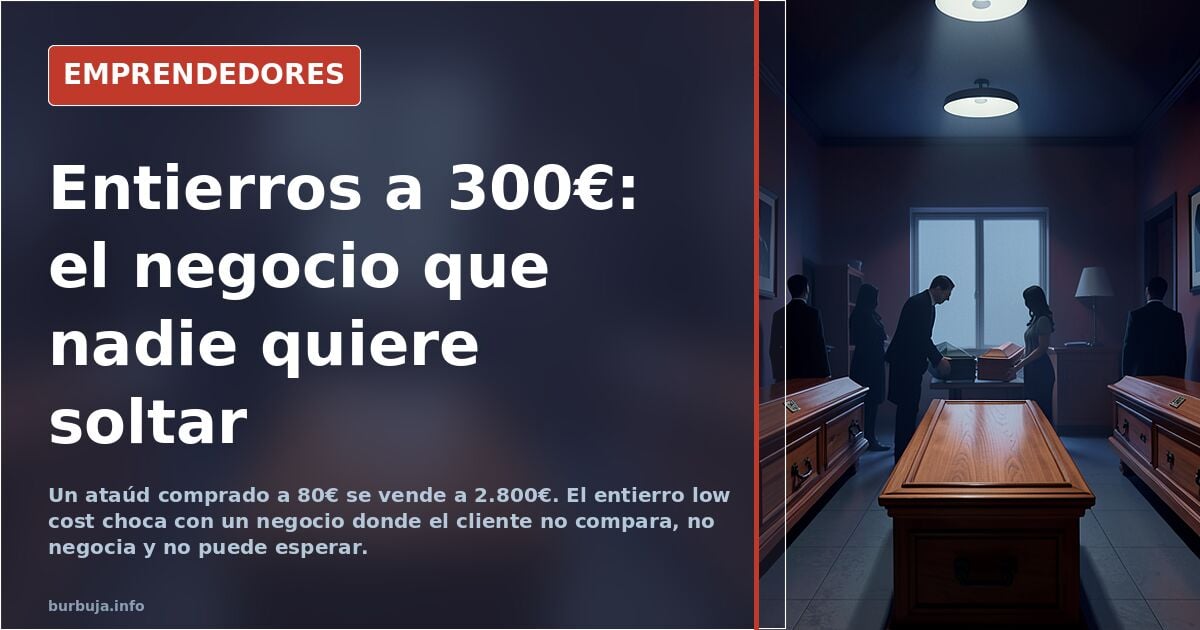
Low-cost funerals clash with the funeral monopoly
A minimum burial costs between €300 and €1,000 today, leading those who cannot afford it to question if paying more makes sense. The uncomfortable yet logical question arises: if the body serves no further purpose, why does the final procedure cost so much? The discussion starts with roadside ditch jokes and ends, as usual, in a shielded business where the client does not negotiate.
The diagnosis is repeated: funeral services are not rational purchases. When someone hires them, they are in the worst position to compare prices, review fine print, or haggle. The client does not choose: they sign. Funeral homes know this. Hence, margins depend on urgency and ignorance rather than volume.
What a burial really costs
The numbers circulating are painful. According to one testimony, a coffin bought for €80 is sold for €2,800. The most expensive catalog item, acquired for €295, retails at €4,200. Those dying without insurance and hiring basic services face a minimum of €4,500, according to the same source. The full calculation, line by line, reveals a differential explaining why few operators dare to break the market.
Real cost structures are not trivial: death certificates, Civil Registry registration, burial or cremation authorization, certified vans, and staff dedicated almost exclusively to paperwork. Some argue that starting a funeral home requires massive investment, meaning fixed costs would keep final prices similar to current ones. The counterargument is that the markup is not in the coffin or van, but in the margin applied when no one asks questions.
The mafia guarding the turf
The most repeated story concerns entry barriers, not costs. Opening a funeral home reportedly requires local power blessing, like pharmacies or gas stations. When someone tries without permission, the market defends itself. One case involves a man opening a reasonably priced funeral home in an Andalusian coastal town; during early burials, hired groups caused disturbances. Rumors spread, and no one hired him again for antiestéticar of scenes at their own family funerals.
The comparison with pharmacies and gas stations is no accident: these are concessions. The business does not compete on price because market access is rationed. Those controlling it do not need advertising.
Pre-paying for funerals: the model that works
The idea gaining traction is not lowering burial costs, but selling them beforehand. Paying in advance saves 50%, sounding like a discount rather than cheapness. Framing matters: presenting as low-cost gets you rejected by grieving families; presenting as pre-planning leads to cold-blooded signing, with clear heads and visible wallets.
This model exists elsewhere. In South America, from age 60, monthly premium offers for funeral planning increase with age. There, the state covers only the van and 48 hours of refrigeration, at best. Unlike Spain, where death insurance is paid until death, installment plans end once the service cost is reached.
Cardboard coffins and 3D printer niches
One path avoids funeral licenses: the product. Cardboard coffins, DIY pine kits. A simple pine board coffin can cost €50 or €60 in materials. However, industry reaction is hostile, questioning if cardboard suits burial or just burning, extending scrutiny to expiration dates. For 3D printer owners, decorative motifs remain an untapped niche.
The problem is not manufacturing, but placement. Families recently bereaved are not comparing coffins in hardware stores. Business closes before the death or not at all.
Undisputed fact: the body doesn't matter
The consensus view is most uncomfortable for the sector: non-believers care little about what happens to their bodies. Cheap cremation, pine coffins, science donation, or Viking funerals under religious freedom. Objections are administrative, not ideological: permits. Again, permits are signed by those controlling the turf.
With these elements, low-cost burials are not absurd ideas. They clash with a market where clients cannot choose, competitors cannot enter, and prices are not discussed. It remains unclear if the issue is service cost or the fact that no one has broken the market without being visited at their first funeral.
Also available in: Deutsch
Summary of a discussion on Burbuja.info - Foro de economía, actualidad y política., translated from Spanish and reviewed before publication. Read the full discussion (57 replies).
More summaries
-
The death business: licences, insurance and a cardboard coffin that's banned
A forum user claims a €100 cardboard coffin cannot be sold in Madrid and that 70% of Spain's population holds funeral insurance.
-
Low-Cost Funeral in Spain: 1,700 Euros for Cremation
An Asturian entrepreneur launches a low-cost funeral home in 2017, charging 1,700 euros for cremation. The business faces high vehicle costs and fierce competition with insurers.
-
Generali agent in Spain exposed by forum users over policy terms
A Generali exclusive agent in Cádiz, Spain, opened a forum thread to answer insurance queries but faced backlash over fake self-employment and hidden clauses.
-
South Korea's KOSPI plunges nearly 20% as president urges calm
South Korea's KOSPI has fallen almost 20% and the country's president has urged people not to take their own lives, reminding them of the 109 helpline. Extreme leverage lies beneath the…
-
How to Build the Perfect Electoral Program
A three-step method turns electoral promises into verifiable decisions using conditional logic and input/output tasks.
-
Hawkers: From €300 to €40M, The Fine Print of Elche’s Success
Hawkers generated €40 million in 2015 with Chinese-made sunglasses. The initial €300 investment story clashes with real business costs.