
Losing a lifelong friend over a social media disagreement
A single disagreeable comment on a post leads a childhood friend to block you, revealing how political polarization is fracturing long-standing friendships.
English · Original discussion in Spanish · Published
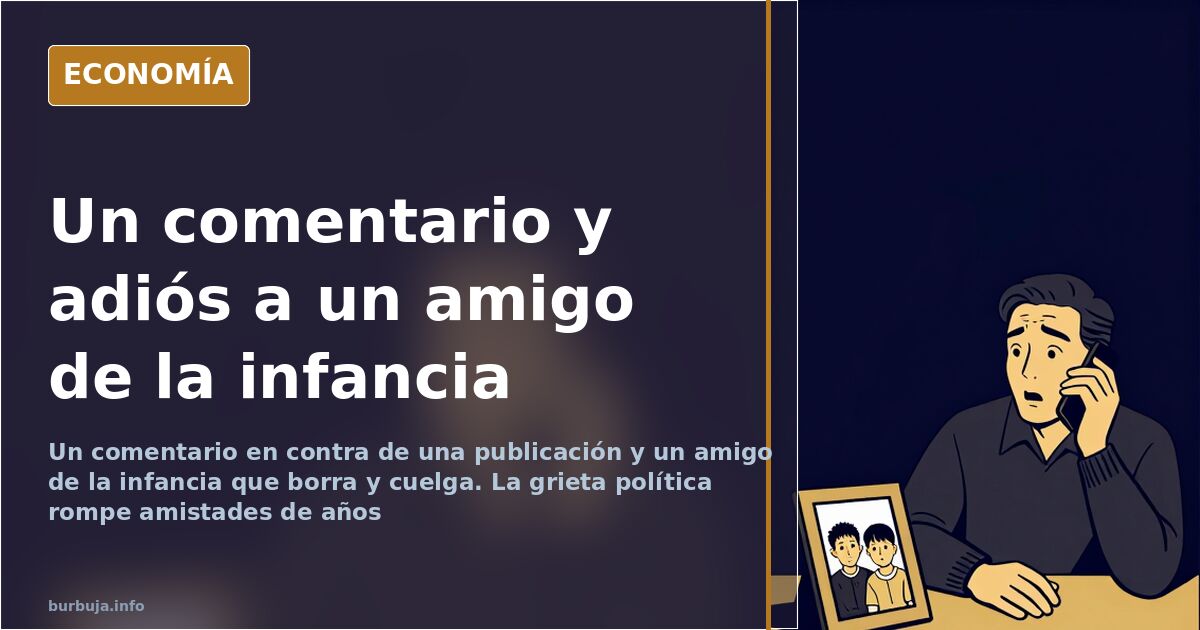
When a social media comment is enough to break a childhood friendship
A photograph of a migrant boat with a supportive message. A reasoned, insult-free comment against it. And, within minutes, a childhood friend removes you from their contact list, hangs up the phone, and dismisses the conversation with a derogatory remark. This is how someone who lived it describes it: a friendship forged since childhood, broken by a disagreement on a social network.
The case does not end on that screen. They maintain that they no longer have any true friends, only acquaintances, and that others left before them for similar reasons: immigration, feminism, the management of the pandemic, and the policies of successive governments. “You can’t say anything without the other person getting offended”, they summarize. And they add a more uncomfortable feeling than anger: the feeling of being out of place in their own society.
Do you lose a friend or discover they were never one?
The most repeated answer is blunt: if someone removes you for an opinion, they were not your friend. It is framed as a filter, not a loss. Someone who cannot tolerate a reasoned disagreement would not have tolerated what came next. Some add that confusing friends with people you hang out with is common, and the difference only becomes clear when disagreement arrives.
Not everyone sees it this way. Another current argues that the problem is not the quality of the friendship, but the climate: disagreement has become a test of loyalty, and those who step out of line are marked. In this framework, a comment is not just a comment, it is a declaration of allegiance. The consequence, they say, is less about a person losing friends and more about a society manufacturing suspects.
What almost no one disputes is the practical outcome. One argument is repeated with a sneer: the one who removes you does not take away a friend, they save you the trouble of doing it yourself.
From the pandemic to feminism: the topics that open the rift
Personal examples accumulate and almost all share a pattern: a conversation that starts as an exchange ends in rupture. One person says they cut off their entire group at age 23, including two childhood friends, due to what they describe as discrimination during the pandemic. Another recounts losing a friend while arguing about what they call fake feminism, and years later that friend contacted them to apologize and say they had peine their eyes. Reconciliation exists, but it comes late and with the bond already broken.
There is also testimony from the other side and closer to home. Someone recalls a mother telling her son they did not have to treat him in the hospital for refusing vaccination. The scene is used as proof of how far the fracture reached within families, not just among acquaintances.
The common denominator is that politics ceased to be a post-dinner topic. Healthcare, immigration, or equality are discussed with the temperature of an identity issue. When that happens, yielding seems like betrayal and disagreeing, an aggression.
The “silent majority” and the cost of disagreeing
One part of the analysis argues that those who advocate regulating immigration, deporting those in an irregular situation, or questioning certain policies are not a residual minority, but a silent majority that gets tired and makes noise. Another rebuttal reverses the argument: those who want to select people by origin or economic status are in a reduced camp and pay a social price, with fewer friends and less support networks.
Amidst this crossfire appears a harsher thesis. It is argued that there is not just a personal friction, but a form of social punishment: isolating someone who cannot be imprisoned for thinking differently by pushing their entire environment against them. It is an unnuanced reading and, as such, also debated: social life has a thousand reasons to break, and not all fit into one label.
Facebook, a minefield: the most repeated advice
Among practical recommendations, the most insistent is to abandon social media. One describes the exit as a magic touch: less noise, less wear and tear, fewer conversations that lead nowhere. Others have learned to keep quiet. It is admitted without shame that there are topics no longer touched and that the price of coexistence is not saying what you think.
The intermediate formula gaining adherents: sharing only common hobbies with friends. Football, meals, a match, a play. Nothing that requires agreeing on the world. It is a truce, not a complete friendship, and those who propose it know it.
With the testimonies on the table, the surprising fact is not that someone has lost friends arguing. It is that almost no one considers it a tragedy. The loss, it is said, is compensated by tranquility. The unanswered question is not whether these friendships could withstand a comment, but how many relationships are still standing today only because no one has brought up the topic.
A photograph of a migrant boat with a supportive message. A reasoned, insult-free comment against it. And, within minutes, a childhood friend removes you from their contact list, hangs up the phone, and dismisses the conversation with a derogatory remark. This is how someone who lived it describes it: a friendship forged since childhood, broken by a disagreement on a social network.
The case does not end on that screen. They maintain that they no longer have any true friends, only acquaintances, and that others left before them for similar reasons: immigration, feminism, the management of the pandemic, and the policies of successive governments. “You can’t say anything without the other person getting offended”, they summarize. And they add a more uncomfortable feeling than anger: the feeling of being out of place in their own society.
Do you lose a friend or discover they were never one?
The most repeated answer is blunt: if someone removes you for an opinion, they were not your friend. It is framed as a filter, not a loss. Someone who cannot tolerate a reasoned disagreement would not have tolerated what came next. Some add that confusing friends with people you hang out with is common, and the difference only becomes clear when disagreement arrives.
Not everyone sees it this way. Another current argues that the problem is not the quality of the friendship, but the climate: disagreement has become a test of loyalty, and those who step out of line are marked. In this framework, a comment is not just a comment, it is a declaration of allegiance. The consequence, they say, is less about a person losing friends and more about a society manufacturing suspects.
What almost no one disputes is the practical outcome. One argument is repeated with a sneer: the one who removes you does not take away a friend, they save you the trouble of doing it yourself.
From the pandemic to feminism: the topics that open the rift
Personal examples accumulate and almost all share a pattern: a conversation that starts as an exchange ends in rupture. One person says they cut off their entire group at age 23, including two childhood friends, due to what they describe as discrimination during the pandemic. Another recounts losing a friend while arguing about what they call fake feminism, and years later that friend contacted them to apologize and say they had peine their eyes. Reconciliation exists, but it comes late and with the bond already broken.
There is also testimony from the other side and closer to home. Someone recalls a mother telling her son they did not have to treat him in the hospital for refusing vaccination. The scene is used as proof of how far the fracture reached within families, not just among acquaintances.
The common denominator is that politics ceased to be a post-dinner topic. Healthcare, immigration, or equality are discussed with the temperature of an identity issue. When that happens, yielding seems like betrayal and disagreeing, an aggression.
The “silent majority” and the cost of disagreeing
One part of the analysis argues that those who advocate regulating immigration, deporting those in an irregular situation, or questioning certain policies are not a residual minority, but a silent majority that gets tired and makes noise. Another rebuttal reverses the argument: those who want to select people by origin or economic status are in a reduced camp and pay a social price, with fewer friends and less support networks.
Amidst this crossfire appears a harsher thesis. It is argued that there is not just a personal friction, but a form of social punishment: isolating someone who cannot be imprisoned for thinking differently by pushing their entire environment against them. It is an unnuanced reading and, as such, also debated: social life has a thousand reasons to break, and not all fit into one label.
Facebook, a minefield: the most repeated advice
Among practical recommendations, the most insistent is to abandon social media. One describes the exit as a magic touch: less noise, less wear and tear, fewer conversations that lead nowhere. Others have learned to keep quiet. It is admitted without shame that there are topics no longer touched and that the price of coexistence is not saying what you think.
The intermediate formula gaining adherents: sharing only common hobbies with friends. Football, meals, a match, a play. Nothing that requires agreeing on the world. It is a truce, not a complete friendship, and those who propose it know it.
With the testimonies on the table, the surprising fact is not that someone has lost friends arguing. It is that almost no one considers it a tragedy. The loss, it is said, is compensated by tranquility. The unanswered question is not whether these friendships could withstand a comment, but how many relationships are still standing today only because no one has brought up the topic.
Summary of a discussion on Burbuja.info - Foro de economía, actualidad y política., translated from Spanish and reviewed before publication. Read the full discussion (276 replies).
More summaries
-
Immigration on the front page: €30bn cost of management
Several outlets put immigration on the front page, and ABC's €30bn cost figure enters the debate amid an editorial shift and social pressure
-
Bodyguard intercepts man at Abascal event in Tarragona
A bodyguard intercepts a man approaching Abascal in Tarragona. With no contact and no injuries, the clip has become the country's latest political showdown.
-
Former ABC editor sparks January election rumors that quickly collapse
A former ABC editor claimed on COPE radio that elections would be held in January, but the electoral calendar and budget schedule disprove this.
-
Amenábar's El Cautivo Faces Criticism Over Slavery Depiction
Critics label Amenábar's 'El Cautivo' a homoerotic delirium, sparking debate over €2.9M subsidies and romanticized slavery in Spanish cinema.
-
Reverse mortgage: 5% interest burdening heirs
Reverse mortgages charge 5% interest versus 1.5% for standard loans, with costs deferred to inheritance.
-
Former Aragon President Javier Lambán Dies at 67
Javier Lambán, former president of Spain's Aragon region and a PSOE critic over Catalan fiscal autonomy, has died aged 67.