
Reverse mortgage: 5% interest burdening heirs
Reverse mortgages charge 5% interest versus 1.5% for standard loans, with costs deferred to inheritance.
English · Original discussion in Spanish · Published
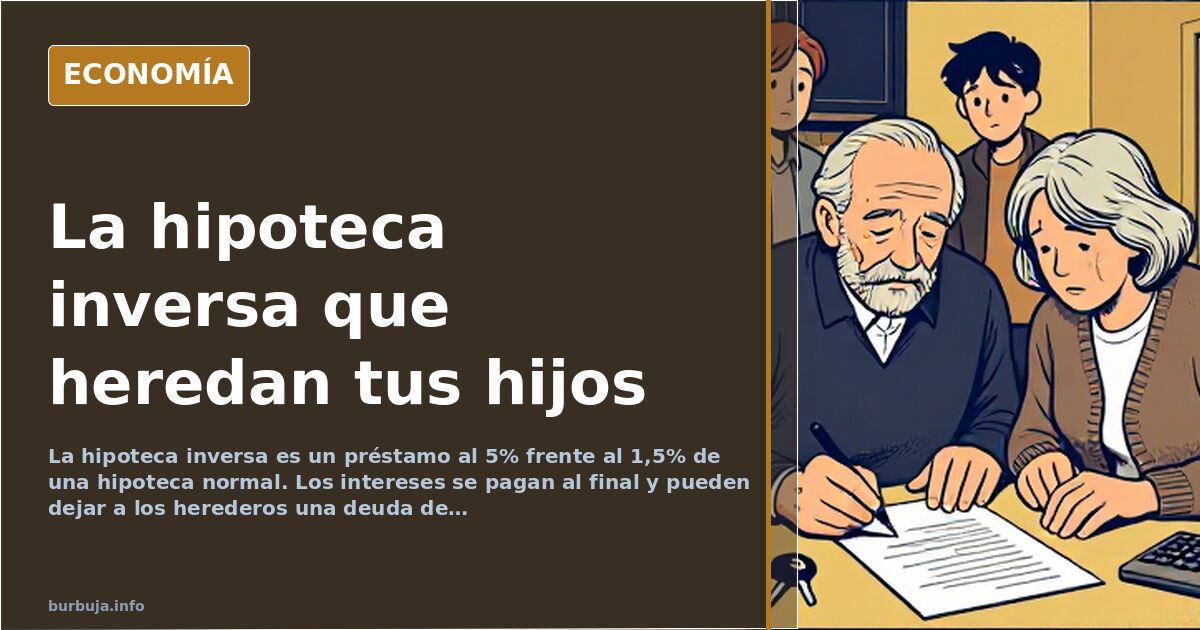
Reverse mortgage: the 5% loan that ends up paid by the heir
An example circulating in the debate: a married couple aged 75 signs a reverse mortgage on their apartment. They receive €150,000 lump sum, pay off debts, and continue living in the house. Five years later they sell the property for €350,000. Before signing the sale, they must repay nearly €170,000: €20,000 of which is interest. The house was collateral, not payment. And the loan remains there, with its rate and bill.
According to Banco de España, a reverse mortgage is a loan or credit secured by a mortgage on the primary residence. The difference from a normal mortgage is when it is paid: there is no monthly installment, interest is settled at the end, when the loan is cancelled or when the holder dies. That is where the problem begins. The average rate is 5%, compared to 1.5% for a standard mortgage, and can reach 7%.
What happens when the holder dies and who pays the reverse mortgage
The same €150,000 loan at 5% maintained for 20 years until death leaves heirs a debt of €237,500 to recover the house. That is €87,500 just in interest. The debt grows over time because interest accumulates on the drawn capital. The more you draw, the more you owe at the end.
At that moment, children choose between paying the debt plus interest and keeping the property, or receiving the remaining equity from the transaction. The first option usually compensates. The second, if anything remains, rarely covers expectations. The bank protects itself by design: it lends around 40% of the home's value to ensure repayment of money plus interest, not acquisition of the property.
How much is actually received and why income loses value
The most common modality converts the loan into a monthly annuity. It avoids spending capital all at once and does not consume the total mortgage amount, only what is drawn. The drawback is that this income is not indexed to inflation (CPI). Cost of living rises, the monthly payment does not. Purchasing power falls year after year, like a frozen pension.
To prevent funds running out before the holder dies, most products include a life annuity insurance. It guarantees monthly payments even if the loan is exhausted, but adds cost and is not always used. According to calculations from Asufin’s Mortgage Barometer, beneficiaries receive an average of 18% of the home's value as income.
Closing costs and collateral that is not payment
Formalizing a reverse mortgage costs money. Opening fee, administrative agency, notary, and property appraisal, paid by the applicant out of pocket. Added to this, depending on the modality, is the life annuity insurance. The initial disbursement does not appear in brochures selling the product as a way to turn the house into a salary.
The underlying confusion is conceptual. The home is loan security, not payment. If the debtor or their heirs repay capital plus interest, the house is not lost. If they do not, the lender enforces the guarantee. Just like any unpaid mortgage.
The family conflict almost nobody mentions
The product transfers to children a decision they did not ask for: pay the debt to keep the house or renounce it. Without prior explanation and planning, the result is a present problem and another future one, when settling the estate. Some argue nobody is obliged to leave anything, while others respond that the family home is the last asset of a generation that received no inheritance.
In extreme cases, the operation is read as a disguised sale to the bank. The holder enjoys the money while alive and the property ends up in the lender’s hands if nobody pays. The discussion on whether this is selfishness or simple property right remains open.
With a 5% rate and debt doubling in two decades, the reverse mortgage works while the holder lives. The problem starts immediately after.
An example circulating in the debate: a married couple aged 75 signs a reverse mortgage on their apartment. They receive €150,000 lump sum, pay off debts, and continue living in the house. Five years later they sell the property for €350,000. Before signing the sale, they must repay nearly €170,000: €20,000 of which is interest. The house was collateral, not payment. And the loan remains there, with its rate and bill.
According to Banco de España, a reverse mortgage is a loan or credit secured by a mortgage on the primary residence. The difference from a normal mortgage is when it is paid: there is no monthly installment, interest is settled at the end, when the loan is cancelled or when the holder dies. That is where the problem begins. The average rate is 5%, compared to 1.5% for a standard mortgage, and can reach 7%.
What happens when the holder dies and who pays the reverse mortgage
The same €150,000 loan at 5% maintained for 20 years until death leaves heirs a debt of €237,500 to recover the house. That is €87,500 just in interest. The debt grows over time because interest accumulates on the drawn capital. The more you draw, the more you owe at the end.
At that moment, children choose between paying the debt plus interest and keeping the property, or receiving the remaining equity from the transaction. The first option usually compensates. The second, if anything remains, rarely covers expectations. The bank protects itself by design: it lends around 40% of the home's value to ensure repayment of money plus interest, not acquisition of the property.
How much is actually received and why income loses value
The most common modality converts the loan into a monthly annuity. It avoids spending capital all at once and does not consume the total mortgage amount, only what is drawn. The drawback is that this income is not indexed to inflation (CPI). Cost of living rises, the monthly payment does not. Purchasing power falls year after year, like a frozen pension.
To prevent funds running out before the holder dies, most products include a life annuity insurance. It guarantees monthly payments even if the loan is exhausted, but adds cost and is not always used. According to calculations from Asufin’s Mortgage Barometer, beneficiaries receive an average of 18% of the home's value as income.
Closing costs and collateral that is not payment
Formalizing a reverse mortgage costs money. Opening fee, administrative agency, notary, and property appraisal, paid by the applicant out of pocket. Added to this, depending on the modality, is the life annuity insurance. The initial disbursement does not appear in brochures selling the product as a way to turn the house into a salary.
The underlying confusion is conceptual. The home is loan security, not payment. If the debtor or their heirs repay capital plus interest, the house is not lost. If they do not, the lender enforces the guarantee. Just like any unpaid mortgage.
The family conflict almost nobody mentions
The product transfers to children a decision they did not ask for: pay the debt to keep the house or renounce it. Without prior explanation and planning, the result is a present problem and another future one, when settling the estate. Some argue nobody is obliged to leave anything, while others respond that the family home is the last asset of a generation that received no inheritance.
In extreme cases, the operation is read as a disguised sale to the bank. The holder enjoys the money while alive and the property ends up in the lender’s hands if nobody pays. The discussion on whether this is selfishness or simple property right remains open.
With a 5% rate and debt doubling in two decades, the reverse mortgage works while the holder lives. The problem starts immediately after.
Summary of a discussion on Burbuja.info - Foro de economía, actualidad y política., translated from Spanish and reviewed before publication. Read the full discussion (158 replies).
More summaries
-
Variable mortgage rate hikes: Suspicion of undercharging
Professionals handling mortgage payments claim some banks apply smaller increases than agreed to avoid defaults and social alarm.
-
Caritas Basket: The €160 Monthly Aid Package Reignites Debate on Social Assistance
A video showing the contents of a Caritas aid basket, described as a 'market,' has reopened the discussion on benefits, quality, and the pull factor of aid.
-
ISIS claims Moscow attack that killed 143 people
ISIS claimed responsibility for the Crocus City Hall attack in Russia, killing 143, two weeks after US warnings of an imminent threat.
-
Nadal argues athletes should earn based on revenue generated
In an interview with Ana Pastor, Rafael Nadal criticized extreme feminism and defended merit-based pay for athletes.
-
Two arrested in Valladolid group sexual assault case
A woman reports a gang rape in Valladolid; two suspects released with charges, receiving minimal media coverage.
-
Cumulative US Drug Death Graph Distorts Crisis
A cumulative graph of US drug deaths since 1999 shows only upward trends, masking annual rates and fueling debates on fentanyl.