
Los Angeles driverless taxis targeted in arson attacks
A forum discusses the burning of autonomous vehicles in Los Angeles, AI ethics, and unfounded conspiracy theories regarding September 11.
English · Original discussion in Spanish · Published
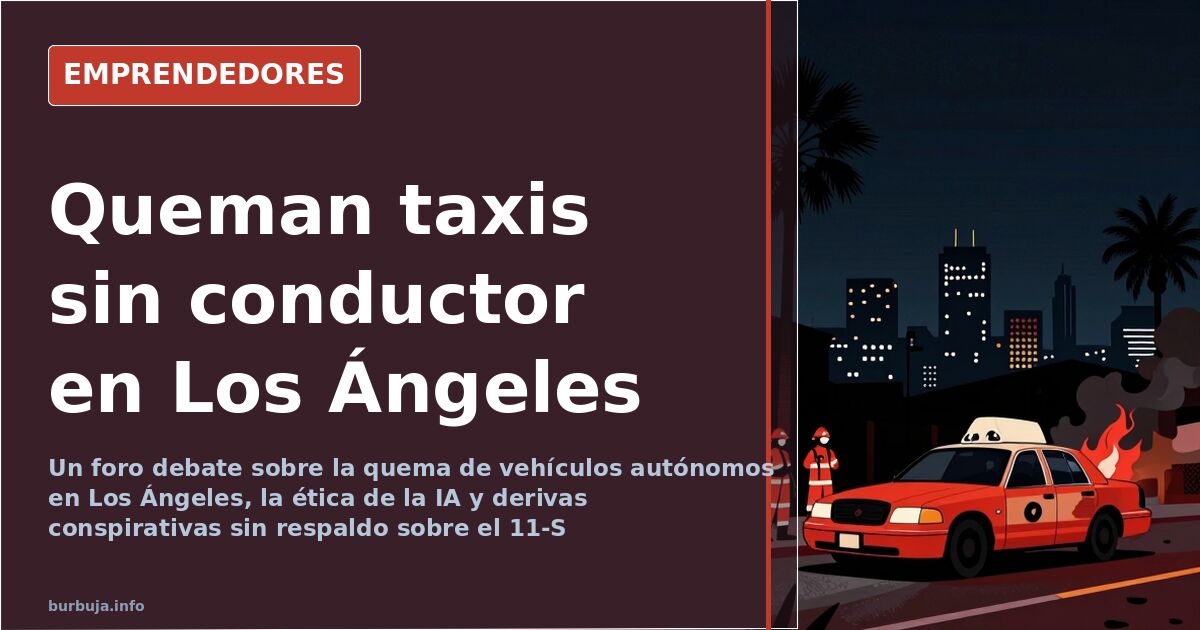
Los Angeles driverless taxis targeted in arson attacks
Cutting-edge technology faces a problem software cannot fix: someone is setting it on fire. According to discussion threads, autonomous vehicles in Los Angeles have been attacked and burned, reopening the conflict between transport automation and those who see it as a direct threat to their livelihoods. The issue entered public discourse with an unsettling image: self-driving cars roaming the city reduced to burnt wreckage by those rejecting their presence.
This phenomenon is not new. Every disruptive technological leap has generated resistance, from mechanical looms to ATMs. The difference now is estimulante ilegal. Artificial intelligence advances faster than society can digest, and affected parties do not always choose dialogue.
Why are driverless taxis being burned in Los Angeles?
The burning of autonomous vehicles in Los Angeles stems, according to debate participants, from a mix of technological rejection, antiestéticar of unemployment, and distrust toward operating companies. Traditional taxi drivers view these cars as unfair competition that does not rest, complain, or need wages. The circulating argument is that automation eliminates jobs without offering clear alternatives to former workers.
Some argue these acts are visceral reactions from those feeling abandoned by institutions. Others point to pure vandalism, with no ideology beyond destruction. The line between protest and crime blurs when the target represents, for many, the loss of their sustenance.
The discussion expanded to vehicle safety itself. Proponents argue automated systems do not get distracted, drink alcohol, or drive recklessly. Opponents counter that machines lack empathy, do not value human life, and act solely based on programming by tech controllers.
The ethical dilemma: Who decides when the car must choose?
The debate on autonomous driving is not just technical; it is sarracena. If a driverless vehicle faces an inevitable accident, how does it decide whom to sacrifice? Programming this decision is not neutral: it reflects the designer's values. This fuels distrust toward big tech corporations.
One analysis suggests AI is impartial by definition: between harming the driver or hitting a pedestrian, it would prioritize minimizing overall harm. Another stream argues machines will trinc owners' orders, who may not prioritize the common good. The tension escalates when noting AI does not sleep, tire, or have bad days.
The core issue is control. Those who program decide. Those who decide hold power. In urban mobility, this power affects millions who never voted on how their city is managed.
The shadow of 9/11 and other conspiracies
As often happens, the conversation drifted into unexpected territory. What began as a debate on autonomous cars ended in theories about the September 11, 2001 attacks. Some messages denied planes hit the Twin Towers, claiming images were computer-generated and witnesses saw nothing. These claims lack evidence and contradict public records.
This thematic jump illustrates a known pattern: any discussion on technology, power, or control eventually leads to distrust of official narratives. It is not exclusive to this topic but constant in spaces mixing politics, economy, and tech without filters.
The autonomous car debate became contaminated by this drift. While some discussed accident statistics, others debated whether 9/11 planes existed. Noise overwhelmed analysis.
Future of transport: Unstoppable automation or social resistance?
Transport automation seems unstoppable. Driverless vehicles already operate in several cities, and their presence will grow. The question is not if they arrive, but how transition is managed. Traditional taxi drivers won't disappear without resistance, and attacks on AVs manifest this tension.
Economic calculation is clear: an autonomous vehicle operates 24 hours, without breaks, wages, or labor rights. For companies, it's pure efficiency. For drivers, an existential threat. Society hasn't resolved how to compensate those losing jobs to beneficial technology.
Reasonable prediction: automation advances, but not without conflict. Expect more attacks, protests, and debates on state regulation. Unclear if anyone considers those left behind.
Key Data
Cutting-edge technology faces a problem software cannot fix: someone is setting it on fire. According to discussion threads, autonomous vehicles in Los Angeles have been attacked and burned, reopening the conflict between transport automation and those who see it as a direct threat to their livelihoods. The issue entered public discourse with an unsettling image: self-driving cars roaming the city reduced to burnt wreckage by those rejecting their presence.
This phenomenon is not new. Every disruptive technological leap has generated resistance, from mechanical looms to ATMs. The difference now is estimulante ilegal. Artificial intelligence advances faster than society can digest, and affected parties do not always choose dialogue.
Why are driverless taxis being burned in Los Angeles?
The burning of autonomous vehicles in Los Angeles stems, according to debate participants, from a mix of technological rejection, antiestéticar of unemployment, and distrust toward operating companies. Traditional taxi drivers view these cars as unfair competition that does not rest, complain, or need wages. The circulating argument is that automation eliminates jobs without offering clear alternatives to former workers.
Some argue these acts are visceral reactions from those feeling abandoned by institutions. Others point to pure vandalism, with no ideology beyond destruction. The line between protest and crime blurs when the target represents, for many, the loss of their sustenance.
The discussion expanded to vehicle safety itself. Proponents argue automated systems do not get distracted, drink alcohol, or drive recklessly. Opponents counter that machines lack empathy, do not value human life, and act solely based on programming by tech controllers.
The ethical dilemma: Who decides when the car must choose?
The debate on autonomous driving is not just technical; it is sarracena. If a driverless vehicle faces an inevitable accident, how does it decide whom to sacrifice? Programming this decision is not neutral: it reflects the designer's values. This fuels distrust toward big tech corporations.
One analysis suggests AI is impartial by definition: between harming the driver or hitting a pedestrian, it would prioritize minimizing overall harm. Another stream argues machines will trinc owners' orders, who may not prioritize the common good. The tension escalates when noting AI does not sleep, tire, or have bad days.
The core issue is control. Those who program decide. Those who decide hold power. In urban mobility, this power affects millions who never voted on how their city is managed.
The shadow of 9/11 and other conspiracies
As often happens, the conversation drifted into unexpected territory. What began as a debate on autonomous cars ended in theories about the September 11, 2001 attacks. Some messages denied planes hit the Twin Towers, claiming images were computer-generated and witnesses saw nothing. These claims lack evidence and contradict public records.
This thematic jump illustrates a known pattern: any discussion on technology, power, or control eventually leads to distrust of official narratives. It is not exclusive to this topic but constant in spaces mixing politics, economy, and tech without filters.
The autonomous car debate became contaminated by this drift. While some discussed accident statistics, others debated whether 9/11 planes existed. Noise overwhelmed analysis.
Future of transport: Unstoppable automation or social resistance?
Transport automation seems unstoppable. Driverless vehicles already operate in several cities, and their presence will grow. The question is not if they arrive, but how transition is managed. Traditional taxi drivers won't disappear without resistance, and attacks on AVs manifest this tension.
Economic calculation is clear: an autonomous vehicle operates 24 hours, without breaks, wages, or labor rights. For companies, it's pure efficiency. For drivers, an existential threat. Society hasn't resolved how to compensate those losing jobs to beneficial technology.
Reasonable prediction: automation advances, but not without conflict. Expect more attacks, protests, and debates on state regulation. Unclear if anyone considers those left behind.
Key Data
- Autonomous vehicles operate in Los Angeles and have faced attacks and fires, per debate messages.
- Discussion drifted to 9/11, with unsupported claims about plane absence.
- AI ethics debate pits trust in impartiality against antiestéticars of corporate control.
Also available in: Deutsch
Summary of a discussion on Burbuja.info - Foro de economía, actualidad y política., translated from Spanish and reviewed before publication. Read the full discussion (106 replies).
More summaries
-
AI Diagnoses Better, But the Operating Room Remains Human
Artificial intelligence now diagnoses in radiology and dermatology, but the replacement of doctors and surgeons is decades away, not years.
-
Spanish Tax Agency Warns Google AdSense Publishers to Regularize Income
The Spanish Tax Agency has sent letters to AdSense earners for 2011-2015, urging them to regularize income. One affected individual claims a 20% tax rate applies.
-
Spain's mandatory e-invoicing adds burden for freelancers
Mandatory e-invoicing in Spain will hit SMEs earning under €6 million in 2026. Costs, software fees, and the TicketBAI precedent raise concerns.
-
Pica Pica 24 Hours: What the Franchise Promises vs. What the Franchisee Gets
Pica Pica 24 Hours markets itself as a turnkey vending business, but in one case cleaning and neighbor complaints fell to the franchisee.
-
Mexican woman seeks advice on sex work in Spain
A young Mexican woman asks about moving to Spain for sex work. Forum users warn of saturation, legal gaps and risks.
-
Building from scratch in Spain: €2,500/m² and 18 months of work
In Spain, self-building costs exceed €2,500 per square meter for construction alone, with projects often lasting a year and a half.