
Lord Miles opens a form to invade Haiti: 9,000 sign up
Lord Miles publishes a form to recruit volunteers for an invasion of Haiti and boasts 9,000 sign-ups: those carrying the rifle pay nothing
English · Original discussion in Spanish · Published
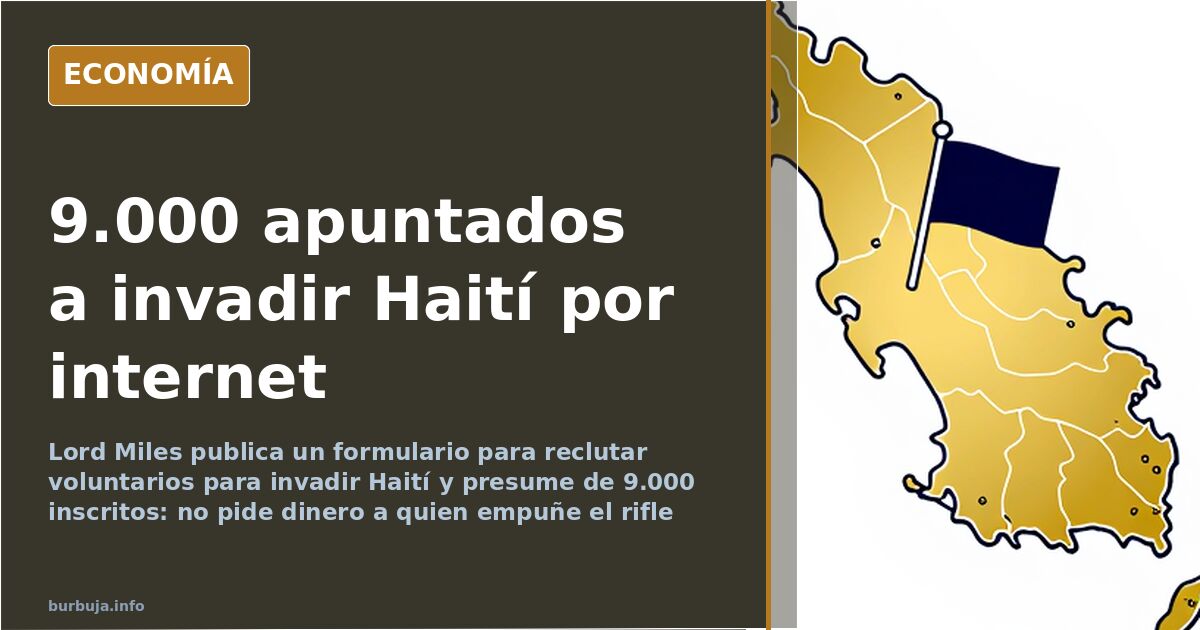
Lord Miles is recruiting to invade Haiti and already has 9,000 volunteers
Those who carry the rifle aren't asked for money. Those who only want to put up the cash, are. That's the idea running through the form that Lord Miles, an internet figure presenting himself as the operation's promoter, has published to recruit volunteers to invade Haiti and which, according to the message spreading it, has already racked up 9,000 sign-ups. The announcement itself boasts that "every protected group" will be discriminated against, and closes with a "Happy war". In other words: if the anti-discrimination law has to be skipped, it gets skipped.
Underneath it all, an operation that is pitched like a business deal rather than a war. And one detail that throws you off: so far, not a single shot has been documented.
Who pays and who shoots in the invasion of Haiti?
The structure described in the messages accompanying the form has two tiers. At the top, the financiers. Below, the fighters. The organizer is said to have justified it this way: the volunteer puts up no money as long as they're willing to carry a rifle. It's the old logic of cannon fodder with a venture-capital veneer.
The selection process, as it's told, includes a one-on-one video call with each applicant before acceptance. We're not talking about anonymous battalions: profiles are reviewed one by one. The promised compensation, according to the same version, is a split of the spoils: dividing the country among the volunteers if the operation succeeds. No vacations, no days off, and a level of occupational risk no collective agreement would ever cover.
And what happens to the personal data left along the way? That's the question hanging over every claim from someone saying they're about to fill out the form. Handing over your identity — especially with this look about it — is no small thing.
What they say is in Haiti that's worth an invasion
The economic argument circulating is the usual one: resources. They mention gold and copper deposits, large sugar and rice plantations, and miles of beach. The most elaborate version speaks of newly discovered "high-grade" rare earths and compares the area with the south of the Dominican Republic, presented as a testing ground for future interventions.
None of this comes with an audit. These are claims repeated in the very same messages promising land distribution, and that's where the story starts to creak: the more they insist on the spoils, the less they explain who will guarantee them.
The leaked operational plan doesn't help either. Lord Miles is said to have been negotiating with a small island that declared itself independent from the rest of Haiti in order to use it as a base. A base, to invade the neighboring country. Understandably, more than one person finds it sounds like a role-playing game.
Haiti, meanwhile, isn't waiting for anyone
It's worth recalling the state of the ground. The UN withdrew from Haiti even though the country's government begged for help, "practically on its knees". Kenya tried to deploy police officers with Washington's and the UN's blessing, but internal problems stalled the deployment. Then the government collapsed, gangs carved up the territory, and a new administration survived only with the consent of those gangs, which soon after began fighting each other.
The result is a country split in two: the current government fights some gangs by relying on others. Part of the capital and the south are outside its control. On top of that, the country has been the scene of drone attacks for months, with reports placing a well-known American security contractor behind them, working for the Haitian government. All of this is what is claimed, not what any official report confirms.
A joke, a scam, or something serious?
Here opinion splits. One camp dismisses it as an internet joke going nowhere. Another suspects the opposite: that the real goal is harvesting the sign-ups' data, the textbook scam where nobody pays money but everyone leaves their name. The third line, the most uncomfortable one, argues the project is serious because it has already crossed too many red lines to back out.
The detail that dismantles the classic-fraud argument is precisely that: the volunteer going to fight isn't asked for cash. If no money is involved, the scam would have to be of a different kind. Some point out that for operations like this, what's needed isn't an army but money to buy off a local warlord and let others do the shooting.
International law, meanwhile, hardly seems the biggest problem. The theory going around is that the promoter doesn't care: if he wins, he's never returning to the UK; if he loses, he'll hardly be in any condition to stand trial.
Nine thousand sign-ups, an open form, and no news for weeks. How many of those 9,000 would answer a video call if things got real?
Those who carry the rifle aren't asked for money. Those who only want to put up the cash, are. That's the idea running through the form that Lord Miles, an internet figure presenting himself as the operation's promoter, has published to recruit volunteers to invade Haiti and which, according to the message spreading it, has already racked up 9,000 sign-ups. The announcement itself boasts that "every protected group" will be discriminated against, and closes with a "Happy war". In other words: if the anti-discrimination law has to be skipped, it gets skipped.
Underneath it all, an operation that is pitched like a business deal rather than a war. And one detail that throws you off: so far, not a single shot has been documented.
Who pays and who shoots in the invasion of Haiti?
The structure described in the messages accompanying the form has two tiers. At the top, the financiers. Below, the fighters. The organizer is said to have justified it this way: the volunteer puts up no money as long as they're willing to carry a rifle. It's the old logic of cannon fodder with a venture-capital veneer.
The selection process, as it's told, includes a one-on-one video call with each applicant before acceptance. We're not talking about anonymous battalions: profiles are reviewed one by one. The promised compensation, according to the same version, is a split of the spoils: dividing the country among the volunteers if the operation succeeds. No vacations, no days off, and a level of occupational risk no collective agreement would ever cover.
And what happens to the personal data left along the way? That's the question hanging over every claim from someone saying they're about to fill out the form. Handing over your identity — especially with this look about it — is no small thing.
What they say is in Haiti that's worth an invasion
The economic argument circulating is the usual one: resources. They mention gold and copper deposits, large sugar and rice plantations, and miles of beach. The most elaborate version speaks of newly discovered "high-grade" rare earths and compares the area with the south of the Dominican Republic, presented as a testing ground for future interventions.
None of this comes with an audit. These are claims repeated in the very same messages promising land distribution, and that's where the story starts to creak: the more they insist on the spoils, the less they explain who will guarantee them.
The leaked operational plan doesn't help either. Lord Miles is said to have been negotiating with a small island that declared itself independent from the rest of Haiti in order to use it as a base. A base, to invade the neighboring country. Understandably, more than one person finds it sounds like a role-playing game.
Haiti, meanwhile, isn't waiting for anyone
It's worth recalling the state of the ground. The UN withdrew from Haiti even though the country's government begged for help, "practically on its knees". Kenya tried to deploy police officers with Washington's and the UN's blessing, but internal problems stalled the deployment. Then the government collapsed, gangs carved up the territory, and a new administration survived only with the consent of those gangs, which soon after began fighting each other.
The result is a country split in two: the current government fights some gangs by relying on others. Part of the capital and the south are outside its control. On top of that, the country has been the scene of drone attacks for months, with reports placing a well-known American security contractor behind them, working for the Haitian government. All of this is what is claimed, not what any official report confirms.
A joke, a scam, or something serious?
Here opinion splits. One camp dismisses it as an internet joke going nowhere. Another suspects the opposite: that the real goal is harvesting the sign-ups' data, the textbook scam where nobody pays money but everyone leaves their name. The third line, the most uncomfortable one, argues the project is serious because it has already crossed too many red lines to back out.
The detail that dismantles the classic-fraud argument is precisely that: the volunteer going to fight isn't asked for cash. If no money is involved, the scam would have to be of a different kind. Some point out that for operations like this, what's needed isn't an army but money to buy off a local warlord and let others do the shooting.
International law, meanwhile, hardly seems the biggest problem. The theory going around is that the promoter doesn't care: if he wins, he's never returning to the UK; if he loses, he'll hardly be in any condition to stand trial.
Nine thousand sign-ups, an open form, and no news for weeks. How many of those 9,000 would answer a video call if things got real?
Also available in: Deutsch
Summary of a discussion on Burbuja.info - Foro de economía, actualidad y política., translated from Spanish and reviewed before publication. Read the full discussion (100 replies).
More summaries
-
Private Invasion Plan for Haiti Demands Volunteer Funding
Lord Miles' private invasion plan for Haiti promises wealth to investors, but forced exploitation of 11.5 million Haitians sparks intense debate.
-
Dominican Republic Deporting 30,000 Haitians Monthly; Searches Extend to Hospital Maternity Wards
The Dominican Republic expels 30,000 Haitians monthly, searching even in hospitals. Over 200,000 have already been returned.
-
Spain rare earth fires linked to Sánchez China deals
Analysis of the alleged link between Spanish wildfires, rare earth deposits, and government agreements with China.
-
Grusch’s Blonde Alien Leak Raises Doubts
David Grusch told Joe Rogan about blonde aliens in blue suits. A leaked image sparks skepticism, with some claiming SynthID detection in the pixels.
-
Madrid's Sol protest camp winds down as cold, hygiene and narrative problems mount
The Puerta del Sol housing camp in Madrid faces its "de-camping" after three weeks: cold weather, Metro closure over sanitation and a fraying electoral narrative.
-
Trump executive order: buying homes is no longer a safe investment
Trump signs an executive order restricting hedge funds from buying single-family homes. The end of 'brick is the new gold' or just a political patch?