
López Ibor: Spanish Psychiatrist Who Lobotomized Homosexuals
Juan José López Ibor, founder of the Spanish Society of Psychiatry, boasted in 1973 about lobotomizing gay men to 'cure' them.
English · Original discussion in Spanish · Published
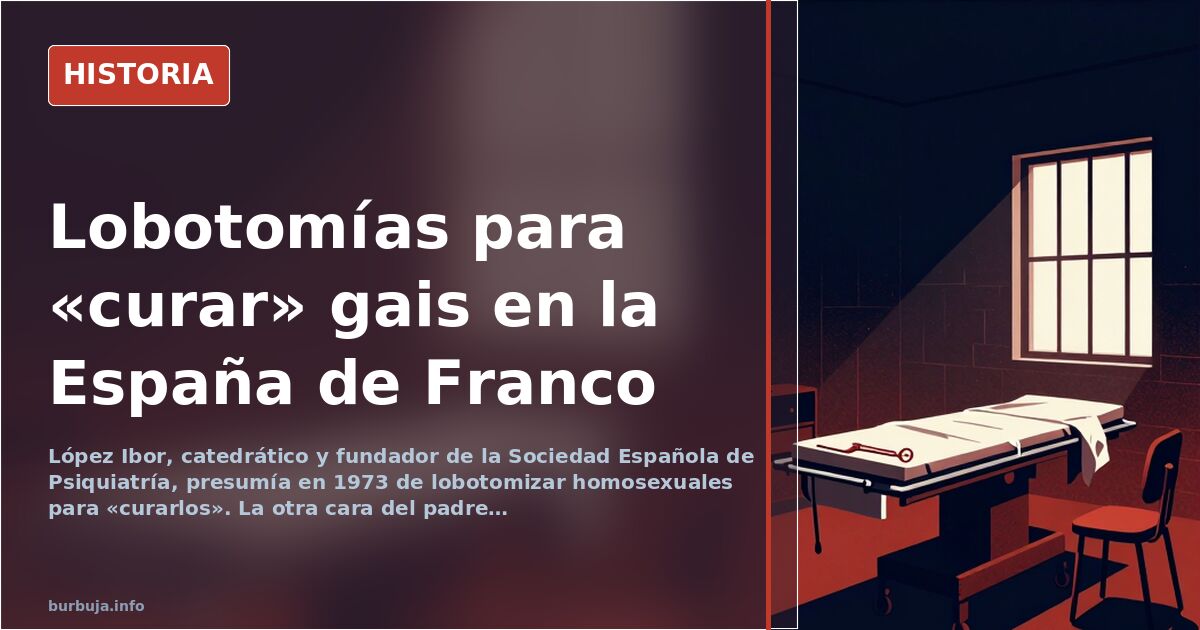
López Ibor, the psychiatrist who lobotomized to 'cure' gaiity
In 1973, at a conference in Italy, psychiatrist Juan José López Ibor described his last patient with chilling detachment: "My last patient was a deviant. After the intervention on the lower lobe of the brain, he indeed presents memory and vision disorders, but shows a slighter attraction to women." The quote appeared in the magazine Interviú. This was not idle boasting: according to debate materials, López Ibor claimed to have performed lobotomies and electroshock therapies on psychiatric patients during the dictatorship to attempt to alter their sensual orientation.
The figure was no marginal character. Professor of Psychiatry at the Complutense University, Head of Neuropsychiatry at Madrid's General Hospital since 1943, member of the Royal Academy of Medicine since 1950, and co-founder of the Spanish Society of Psychiatry alongside Vallejo-Nájera, as well as the Society of Psychosomatic Medicine and Psychotherapy. A fervent Catholic, advisor to the Vatican on marriage annulments and contraceptive methods, and close to Opus Dei. Official biographies present him as the father of modern Spanish psychiatry. The other side of that biography includes surgical interventions on the brains of people who had committed no crime other than being who they were.
What exactly was a lobotomy and why was it practiced?
A lobotomy involved severing connections in the frontal lobe to "calm" psychiatric disorders. It became popular in the West in the mid-20th century, and its inventor, Portuguese Egas Moniz, received the Nobel Prize in Medicine in 1949. In Spain, it was applied enthusiastically in the 1940s and 1950s. In the United States, one doctor traveled the country in a van performing the technique indiscriminately, and among the victims was a sister of President Kennedy.
The argument of the time was that the alternative—overcrowded asylums, patients restrained for days—was worse. Some analyses suggest this reasoning turned lobotomy into the panacea of its era, embraced with the same enthusiasm later abandoned treatments would receive. The difference here is that the scalpel did not seek to alleviate suffering: it sought to erase an identity.
Was it considered a crime in its time?
No, and that is the most uncomfortable point. In Spain during the 1950s and 60s, gaiity was classified as social danger. International psychiatry had classified it as pathology since 1870, when Carl Westphal described it as "a symptom of a neuropathic condition." It was not until a century later that it ceased to be considered a disease. Practices in other democratic countries were not more benign: in the UK, Alan Turing was sentenced to chemical castration in 1952 for his relationship with another man.
This does not make lobotomy acceptable. It makes it a product of its time, raising an uncomfortable question: should López Ibor be judged by today's standards or those of then? Some argue that barbarism is barbarism in any era and that the fact many practiced it does not legitimize it. Others contend that turning an individual into a demon absolves the system that trained, rewarded, and placed him at the head of Spanish psychiatry.
The institutional legacy nobody disputes
López Ibor was not an isolated case. From his service at the General Hospital emerged a school of psychiatry that trained generations of specialists. His name remains linked to institutions that function normally today. The lingering question is what we do with such legacies when the founder turns out to be something different from what the commemorative plaque suggests.
There is a detail that disconcerts: at the same time gais were being lobotomized in Madrid, Soviet psychiatry used schizophrenia diagnoses to imprison political dissidents. Each system had its way of turning medicine into a tool of control. The Spanish one was surgical.
The magazine Interviú published the 1973 lecture. Half a century later, the quote remains there, in the same paragraph where López Ibor describes his patient's "memory and vision disorders" as an acceptable price for making him "slightly more attracted to women." There is no remorse in those words. Only the clinical record of a man convinced he had done the right thing.
In 1973, at a conference in Italy, psychiatrist Juan José López Ibor described his last patient with chilling detachment: "My last patient was a deviant. After the intervention on the lower lobe of the brain, he indeed presents memory and vision disorders, but shows a slighter attraction to women." The quote appeared in the magazine Interviú. This was not idle boasting: according to debate materials, López Ibor claimed to have performed lobotomies and electroshock therapies on psychiatric patients during the dictatorship to attempt to alter their sensual orientation.
The figure was no marginal character. Professor of Psychiatry at the Complutense University, Head of Neuropsychiatry at Madrid's General Hospital since 1943, member of the Royal Academy of Medicine since 1950, and co-founder of the Spanish Society of Psychiatry alongside Vallejo-Nájera, as well as the Society of Psychosomatic Medicine and Psychotherapy. A fervent Catholic, advisor to the Vatican on marriage annulments and contraceptive methods, and close to Opus Dei. Official biographies present him as the father of modern Spanish psychiatry. The other side of that biography includes surgical interventions on the brains of people who had committed no crime other than being who they were.
What exactly was a lobotomy and why was it practiced?
A lobotomy involved severing connections in the frontal lobe to "calm" psychiatric disorders. It became popular in the West in the mid-20th century, and its inventor, Portuguese Egas Moniz, received the Nobel Prize in Medicine in 1949. In Spain, it was applied enthusiastically in the 1940s and 1950s. In the United States, one doctor traveled the country in a van performing the technique indiscriminately, and among the victims was a sister of President Kennedy.
The argument of the time was that the alternative—overcrowded asylums, patients restrained for days—was worse. Some analyses suggest this reasoning turned lobotomy into the panacea of its era, embraced with the same enthusiasm later abandoned treatments would receive. The difference here is that the scalpel did not seek to alleviate suffering: it sought to erase an identity.
Was it considered a crime in its time?
No, and that is the most uncomfortable point. In Spain during the 1950s and 60s, gaiity was classified as social danger. International psychiatry had classified it as pathology since 1870, when Carl Westphal described it as "a symptom of a neuropathic condition." It was not until a century later that it ceased to be considered a disease. Practices in other democratic countries were not more benign: in the UK, Alan Turing was sentenced to chemical castration in 1952 for his relationship with another man.
This does not make lobotomy acceptable. It makes it a product of its time, raising an uncomfortable question: should López Ibor be judged by today's standards or those of then? Some argue that barbarism is barbarism in any era and that the fact many practiced it does not legitimize it. Others contend that turning an individual into a demon absolves the system that trained, rewarded, and placed him at the head of Spanish psychiatry.
The institutional legacy nobody disputes
López Ibor was not an isolated case. From his service at the General Hospital emerged a school of psychiatry that trained generations of specialists. His name remains linked to institutions that function normally today. The lingering question is what we do with such legacies when the founder turns out to be something different from what the commemorative plaque suggests.
There is a detail that disconcerts: at the same time gais were being lobotomized in Madrid, Soviet psychiatry used schizophrenia diagnoses to imprison political dissidents. Each system had its way of turning medicine into a tool of control. The Spanish one was surgical.
The magazine Interviú published the 1973 lecture. Half a century later, the quote remains there, in the same paragraph where López Ibor describes his patient's "memory and vision disorders" as an acceptable price for making him "slightly more attracted to women." There is no remorse in those words. Only the clinical record of a man convinced he had done the right thing.
Also available in: Deutsch
Summary of a discussion on Burbuja.info - Foro de economía, actualidad y política., translated from Spanish and reviewed before publication. Read the full discussion (120 replies).
More summaries
-
Rommel: From Captain to General in Peace
Rommel ended WWI as a captain and was a major general by 1939. His Pour le Mérite, non-aristocratic origins, and army expansion...
-
Why Spanish Food Fails to Go Global as Fast Food
Spanish staples like tortilla and calamari sandwiches struggle globally due to format issues, lack of business structure, and weak brand Spain.
-
ETA and GAL: two arms of the same Gladio network in Spain
Investigation linking ETA and GAL as arms of the same NATO Gladio network, with drug trafficking funding and CIA control.
-
Bilbao's Bid for Spain's Third City Status
With 350,000 residents and an 860,000 metro area, Bilbao trails Valencia, Seville, Malaga and Zaragoza by population.
-
Spanish Arabization Myth: Genetics and Culture
Forum debate on whether Spaniards are Arabized whites. Data suggests a real Andalusian legacy but challenges genetic and linguistic claims.
-
Spain Divided Over Palestine Support Debate
Public opinion in Spain is split on Palestine, citing historical grievances and geopolitical skepticism. Key arguments fuel an unresolved national debate.