
Spanish Arabization Myth: Genetics and Culture
Forum debate on whether Spaniards are Arabized whites. Data suggests a real Andalusian legacy but challenges genetic and linguistic claims.
English · Original discussion in Spanish · Published
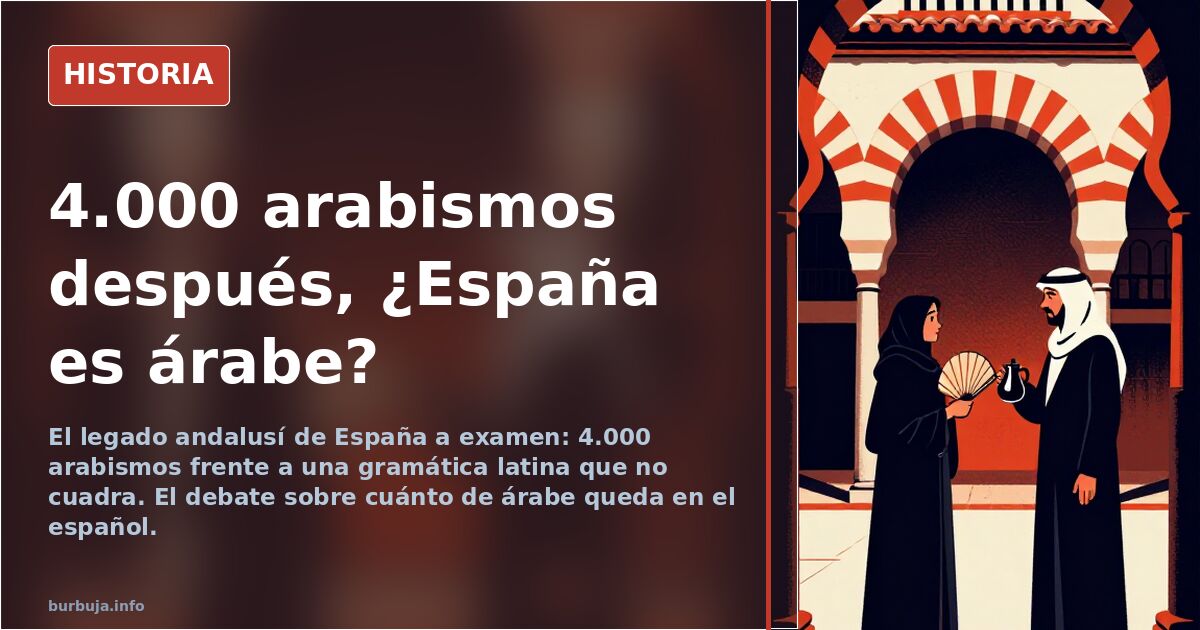
The myth of the Arabized Spaniard: what genetics says
Are Spaniards Arabized whites? This question, circulating in history forums and social media, has an uncomfortable answer for those expecting a clear conclusion: it depends on what "Arabized" means. The debate starts with a provocative thesis: that the average Spaniard lives immersed in an Andalusian legacy spanning language, gastronomy, urbanism, music, and lifestyle. Under jeans and t-shirt, this argument goes, lives a neo-Arab.
Most participants respond with a firm no, but with nuances worth noting. The discussion quickly shifts to genetics, phenotype, and comparative history, leaving a trail of data to organize.
What genetics says about North African components
The most repeated argument is that most non-European genetics in the average Spaniard is North African, but from Roman times, not the Sarracinic invasion. DNA analyses cited place this component around 12% on average in the peninsula, with specific examples: Basques show 1.21% Northwest African and 0.57% Southwest Asian, according to Gedmatch data shared in the discussion.
It is argued that without this component, Spaniards would be genetically similar to Southern French people. Those defending this position conclude that Arabized is not the same as genetically North African, and confusing both is the initial premise's fundamental error.
Language: Arabic loans, but Romance structure
Linguistics is where the discussion heats up most. The initial message claims Spanish and Arabic share verbal structure, with three past forms and conjugation by subject and tense. The rebuttal is strong: Arabic lacks verbs like to be, to stay, or to have, dismantling the comparison. Also, Spanish is SVO while Arabic is VSO.
Lexical weight is acknowledged: about 4,000 words of Arabic origin in Spanish, mostly nouns and place names, with barely one preposition (hasta). Curious doublets like aceituna/oliva, alacrán/escorpión, or aceite/óleo are mentioned. But moving from there to structural Arabization is a gap no one crosses with data.
Chickpeas and other gastronomic myths
Gastronomy is another front. The initial claim states chickpeas are a basic Spanish diet component absent elsewhere in Europe. The response is sharp: in Italy, Greece, and much of the Mediterranean, chickpeas are equally common. Attributing to Al-Andalus what is shared Mediterranean heritage is called a recurring attribution error.
Similar issues arise with pogre temperature baths, which trace back to Roman thermal traditions. Arabs added purification rituals, but architectural and functional structures are older. The discussion clarifies the Andalusian footprint exists, but not with the exclusivity suggested initially.
Phenotype and whiteness: the identity debate
Conversation turns to physical appearance and defining white. Images of Andalusian faces are shared, debating if they fit an Arab or Mediterranean archetype. One view holds that Southern Peninsula phenotypes might pass unnoticed in Kuwait or UAE, but not in Segarro or Algeria, pointing to an ancient Arab rather than Maghrebi component.
Another stream rejects the category of Arabized white as an ideological construct without historical basis. It notes Visigoths were already mixed before arriving in the peninsula, and Romanization left a deeper mark than Sarracinization. Full genetic component calculations by region reveal differences surprising to those expecting uniformity.
The Andalusian legacy that does exist
Beyond controversy, consensus exists that Al-Andalus left a real mark: place names like Guadalquivir, Guadalajara, or Algeciras, agricultural techniques, architectural elements like ajimeces, and an aesthetic sensibility persisting in Andalusian urbanism. Town names in La Alpujarra sounding Galician (Pampaneira, Capileira) are actually Mozarabic, with Andalusian Romance suffixes.
The discussion also covers family and kinship structures, argued to be radically different between Arab and Spanish worlds. Family as life's center, hypersensitivity to honor, or revenge are traits the initial message attributes to both, but rebuttals consider them universal Mediterranean antiestéticatures, not specifically Arab.
In the end, the headline question remains unanswered definitively. Some see a country deeply marked by eight centuries of Sarracinic presence; others, a corner of Europe with cultural loans like any neighbor. What no one disputes is that chickpeas are eaten in more places than the official narrative suggests. And in a history forum, that is almost heresy.
Are Spaniards Arabized whites? This question, circulating in history forums and social media, has an uncomfortable answer for those expecting a clear conclusion: it depends on what "Arabized" means. The debate starts with a provocative thesis: that the average Spaniard lives immersed in an Andalusian legacy spanning language, gastronomy, urbanism, music, and lifestyle. Under jeans and t-shirt, this argument goes, lives a neo-Arab.
Most participants respond with a firm no, but with nuances worth noting. The discussion quickly shifts to genetics, phenotype, and comparative history, leaving a trail of data to organize.
What genetics says about North African components
The most repeated argument is that most non-European genetics in the average Spaniard is North African, but from Roman times, not the Sarracinic invasion. DNA analyses cited place this component around 12% on average in the peninsula, with specific examples: Basques show 1.21% Northwest African and 0.57% Southwest Asian, according to Gedmatch data shared in the discussion.
It is argued that without this component, Spaniards would be genetically similar to Southern French people. Those defending this position conclude that Arabized is not the same as genetically North African, and confusing both is the initial premise's fundamental error.
Language: Arabic loans, but Romance structure
Linguistics is where the discussion heats up most. The initial message claims Spanish and Arabic share verbal structure, with three past forms and conjugation by subject and tense. The rebuttal is strong: Arabic lacks verbs like to be, to stay, or to have, dismantling the comparison. Also, Spanish is SVO while Arabic is VSO.
Lexical weight is acknowledged: about 4,000 words of Arabic origin in Spanish, mostly nouns and place names, with barely one preposition (hasta). Curious doublets like aceituna/oliva, alacrán/escorpión, or aceite/óleo are mentioned. But moving from there to structural Arabization is a gap no one crosses with data.
Chickpeas and other gastronomic myths
Gastronomy is another front. The initial claim states chickpeas are a basic Spanish diet component absent elsewhere in Europe. The response is sharp: in Italy, Greece, and much of the Mediterranean, chickpeas are equally common. Attributing to Al-Andalus what is shared Mediterranean heritage is called a recurring attribution error.
Similar issues arise with pogre temperature baths, which trace back to Roman thermal traditions. Arabs added purification rituals, but architectural and functional structures are older. The discussion clarifies the Andalusian footprint exists, but not with the exclusivity suggested initially.
Phenotype and whiteness: the identity debate
Conversation turns to physical appearance and defining white. Images of Andalusian faces are shared, debating if they fit an Arab or Mediterranean archetype. One view holds that Southern Peninsula phenotypes might pass unnoticed in Kuwait or UAE, but not in Segarro or Algeria, pointing to an ancient Arab rather than Maghrebi component.
Another stream rejects the category of Arabized white as an ideological construct without historical basis. It notes Visigoths were already mixed before arriving in the peninsula, and Romanization left a deeper mark than Sarracinization. Full genetic component calculations by region reveal differences surprising to those expecting uniformity.
The Andalusian legacy that does exist
Beyond controversy, consensus exists that Al-Andalus left a real mark: place names like Guadalquivir, Guadalajara, or Algeciras, agricultural techniques, architectural elements like ajimeces, and an aesthetic sensibility persisting in Andalusian urbanism. Town names in La Alpujarra sounding Galician (Pampaneira, Capileira) are actually Mozarabic, with Andalusian Romance suffixes.
The discussion also covers family and kinship structures, argued to be radically different between Arab and Spanish worlds. Family as life's center, hypersensitivity to honor, or revenge are traits the initial message attributes to both, but rebuttals consider them universal Mediterranean antiestéticatures, not specifically Arab.
In the end, the headline question remains unanswered definitively. Some see a country deeply marked by eight centuries of Sarracinic presence; others, a corner of Europe with cultural loans like any neighbor. What no one disputes is that chickpeas are eaten in more places than the official narrative suggests. And in a history forum, that is almost heresy.
Also available in: Deutsch
Summary of a discussion on Burbuja.info - Foro de economía, actualidad y política., translated from Spanish and reviewed before publication. Read the full discussion (301 replies).
More summaries
-
ETA and GAL: two arms of the same Gladio network in Spain
Investigation linking ETA and GAL as arms of the same NATO Gladio network, with drug trafficking funding and CIA control.
-
Napoleon's Top Generals: The Seven He Chose
Napoleon ranked seven ancient and modern commanders, excluding himself. The debate on who was truly the greatest remains open.
-
Debate: Al-Andalus and European History
A forum discusses Jean Batou's thesis on Al-Andalus as a key piece of European history. The thread shifts to conquest figures, genetics, and politics.
-
Reconquista: Myths and Debates on Origins
Denial of the Visigothic Kingdom, Islamic conquest, and nativist myths fuel a debate challenging the eight-century Reconquista narrative in Spain.
-
Sea Peoples: The Bronze Age Collapse Mystery
Around 1200 BC, Sea Peoples devastated the Eastern Mediterranean. Iron, climate, and Luwians are key to this unexplained collapse.
-
Bilbao's Bid for Spain's Third City Status
With 350,000 residents and an 860,000 metro area, Bilbao trails Valencia, Seville, Malaga and Zaragoza by population.