
London tops imaginary nuclear target list ahead of Washington and New York
London leads the imaginary list of cities to be erased in a nuclear attack, ahead of Washington, New York and Moscow.
English · Original discussion in Spanish · Published
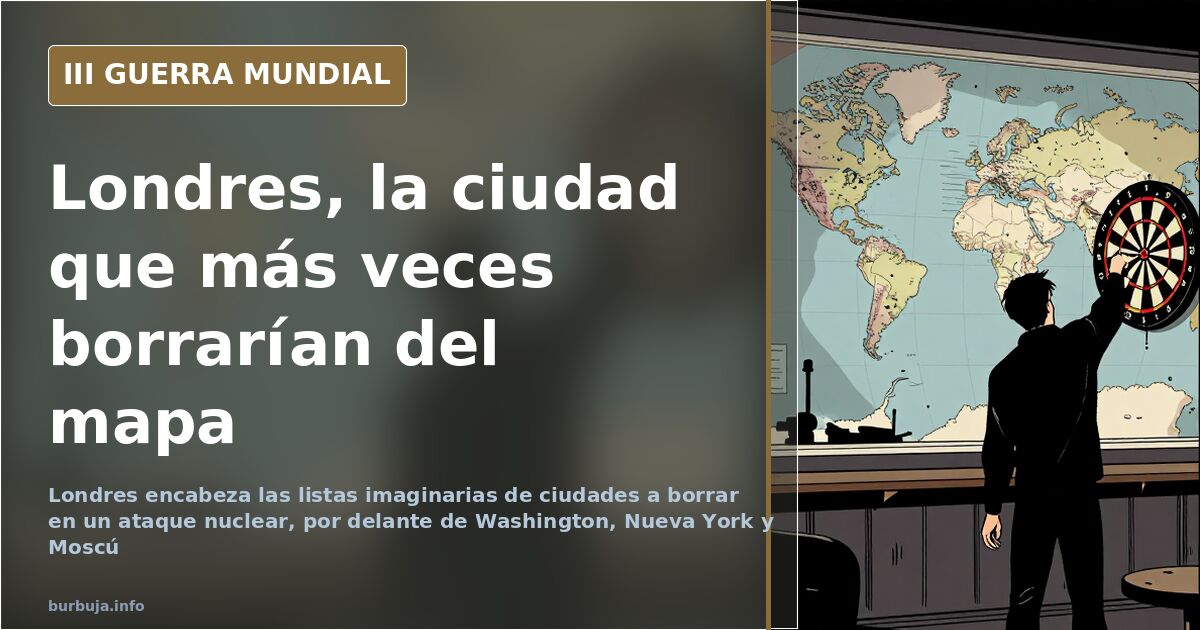
London leads the imaginary list of cities to be erased from the map
The exercise asks for three names and no explanation. The result is surprising. The city that appears most often among those that would disappear from the map in a nuclear exchange is not Moscow or Pyongyang: it is London. It appears in a good portion of the responses, several times ahead of Washington, New York and Paris. In a theoretical retaliation list, most do not point to the adversary. They point to the one next door.
London, Washington and New York: the list headed by an ally
London is a constant. Some repeat it three times in a row and others dismiss it with a it falls in all the pools. Washington, New York and Paris trinc, and behind them appear Brussels, Berlin and Amsterdam. The Anglo-Saxon axis dominates almost any combination: New York, London and Beijing; Los Angeles, Stockholm and Brussels; Washington, Moscow and Beijing. None of these capitals is a declared rival of Spain, and that is the detail: they are uncomfortable allies, powers that drag the country into foreign conflicts or set the rules that come from Brussels.
An argument that repeats itself circulates about Brussels: placing it as the center of the European problem. The choice of Amsterdam responds, in one of the responses, to an even more debatable criterion. The pattern is clear and has little to do with military matters. The closer the capital, the easier it is to imagine it as a target.
Moscow, Beijing and Pyongyang: the textbook rivals
The second block is formed by the classic adversaries. Moscow and Beijing lead the lists of those who point to the opposing block, trinc by Pyongyang, St. Petersburg, Murmansk, Leningrad, Novgorod and Washington. Here the criterion is geopolitical and without nuance: rival capitals, third-country military bases and little else. There are also those who sneak in Mecca, New Delhi, Kiev or Jerusalem instead of a European capital.
Not everyone asks for nuclear weapons. One of the responses states that they are not needed: a couple of missiles placed in the right spot are enough, and cites the Moncloa and the Congress of Deputies. Precision is not the strong point of the exercise, but the shift—from foreign power to one's own building—says a lot about the mood with which the response is made.
Tel Aviv, Mecca and Rabat: the bias that sneaks into the list
A third group abandons the logic of blocks and points to capitals of the Middle East and North Africa: Tel Aviv, Mecca, Medina, Rabat, Casablanca and Tangier. Several of these responses are accompanied by openly hostile formulations towards the population of those countries. They do not respond to any verifiable strategic criteria and rely on prejudices about entire groups. As a thermometer of certain public conversation, the material informs of the social temperature; as an analysis of deterrence, it adds nothing.
Moncloa, Elda and Castelltrinccastell: the everyday objectives
Spain slips into many lists with names that are not capitals: Moncloa, the Congress, Madrid, Seville, Albacete, Elda, Barcelona, Tarragona, Lleida and Girona. Tiny localities appear, chosen for strictly personal reasons. Castelltrinccastell de la Roca enters because “there lives a guy I really dislike.” And there is someone who puts a condition on the exercise: warn beforehand so that people can evacuate, except in a couple of specific homes, where they do not plan to show mercy.
Raccoon City, Wakanda and Usera: the joke as a valve
A good portion of the responses are not serious. Raccoon City and Stormwind, two video game cities; Wakanda, Usera, Magaluf, Almonte, the Vatican City, Chozas de Canales, Betanzos, San Clemente, Las Pedroñeras, Fuenlabrada, Parla and Pinto appear. The mix of fiction, peripheral neighborhood and two-street village lowers the martial tone of a proposal that, read coldly, seems macabre. There is also someone who responds with “none, none and none,” which is the only sensible way out of the form.
What an imaginary list of targets reveals
The dominant pattern is West against West. The focus on London, Washington, Brussels and Paris points to a disaffection that is more economic and political than military, and contrasts with the scarcity of mentions of the rivals making headlines. There is even someone who maintains that the cities will be destroyed by industrial restructuring before any missile, and lists the plants in Vitoria, Pamplona, Valladolid, Valencia, Martorell, Madrid, Zaragoza, Palencia and Pontevedra.
No one with decision-making power will read this list, and the exercise has the rigor of a bar bet. Nevertheless, the order repeats with an insistence that calls attention: first the ally, then the rival, then the neighbor.
With these threads, the question is not who would be erased from the map, but why the first on the list is always the one closest.
The exercise asks for three names and no explanation. The result is surprising. The city that appears most often among those that would disappear from the map in a nuclear exchange is not Moscow or Pyongyang: it is London. It appears in a good portion of the responses, several times ahead of Washington, New York and Paris. In a theoretical retaliation list, most do not point to the adversary. They point to the one next door.
London, Washington and New York: the list headed by an ally
London is a constant. Some repeat it three times in a row and others dismiss it with a it falls in all the pools. Washington, New York and Paris trinc, and behind them appear Brussels, Berlin and Amsterdam. The Anglo-Saxon axis dominates almost any combination: New York, London and Beijing; Los Angeles, Stockholm and Brussels; Washington, Moscow and Beijing. None of these capitals is a declared rival of Spain, and that is the detail: they are uncomfortable allies, powers that drag the country into foreign conflicts or set the rules that come from Brussels.
An argument that repeats itself circulates about Brussels: placing it as the center of the European problem. The choice of Amsterdam responds, in one of the responses, to an even more debatable criterion. The pattern is clear and has little to do with military matters. The closer the capital, the easier it is to imagine it as a target.
Moscow, Beijing and Pyongyang: the textbook rivals
The second block is formed by the classic adversaries. Moscow and Beijing lead the lists of those who point to the opposing block, trinc by Pyongyang, St. Petersburg, Murmansk, Leningrad, Novgorod and Washington. Here the criterion is geopolitical and without nuance: rival capitals, third-country military bases and little else. There are also those who sneak in Mecca, New Delhi, Kiev or Jerusalem instead of a European capital.
Not everyone asks for nuclear weapons. One of the responses states that they are not needed: a couple of missiles placed in the right spot are enough, and cites the Moncloa and the Congress of Deputies. Precision is not the strong point of the exercise, but the shift—from foreign power to one's own building—says a lot about the mood with which the response is made.
Tel Aviv, Mecca and Rabat: the bias that sneaks into the list
A third group abandons the logic of blocks and points to capitals of the Middle East and North Africa: Tel Aviv, Mecca, Medina, Rabat, Casablanca and Tangier. Several of these responses are accompanied by openly hostile formulations towards the population of those countries. They do not respond to any verifiable strategic criteria and rely on prejudices about entire groups. As a thermometer of certain public conversation, the material informs of the social temperature; as an analysis of deterrence, it adds nothing.
Moncloa, Elda and Castelltrinccastell: the everyday objectives
Spain slips into many lists with names that are not capitals: Moncloa, the Congress, Madrid, Seville, Albacete, Elda, Barcelona, Tarragona, Lleida and Girona. Tiny localities appear, chosen for strictly personal reasons. Castelltrinccastell de la Roca enters because “there lives a guy I really dislike.” And there is someone who puts a condition on the exercise: warn beforehand so that people can evacuate, except in a couple of specific homes, where they do not plan to show mercy.
Raccoon City, Wakanda and Usera: the joke as a valve
A good portion of the responses are not serious. Raccoon City and Stormwind, two video game cities; Wakanda, Usera, Magaluf, Almonte, the Vatican City, Chozas de Canales, Betanzos, San Clemente, Las Pedroñeras, Fuenlabrada, Parla and Pinto appear. The mix of fiction, peripheral neighborhood and two-street village lowers the martial tone of a proposal that, read coldly, seems macabre. There is also someone who responds with “none, none and none,” which is the only sensible way out of the form.
What an imaginary list of targets reveals
The dominant pattern is West against West. The focus on London, Washington, Brussels and Paris points to a disaffection that is more economic and political than military, and contrasts with the scarcity of mentions of the rivals making headlines. There is even someone who maintains that the cities will be destroyed by industrial restructuring before any missile, and lists the plants in Vitoria, Pamplona, Valladolid, Valencia, Martorell, Madrid, Zaragoza, Palencia and Pontevedra.
No one with decision-making power will read this list, and the exercise has the rigor of a bar bet. Nevertheless, the order repeats with an insistence that calls attention: first the ally, then the rival, then the neighbor.
With these threads, the question is not who would be erased from the map, but why the first on the list is always the one closest.
Summary of a discussion on Burbuja.info - Foro de economía, actualidad y política., translated from Spanish and reviewed before publication. Read the full discussion (222 replies).
More summaries
-
Russian TV simulation: a missile reaches Berlin in 106 seconds
Russian TV airs simulation showing missiles from Kaliningrad reaching Berlin in 106 seconds and Paris and London in 200
-
Russia cripples Ukraine’s energy grid in massive strike
A massive Russian strike cuts Ukraine’s nuclear capacity by up to 90%, marking a decisive phase in the ongoing energy and territorial siege.
-
ICC Issues Arrest Warrant for Putin Over Ukrainian Children
The International Criminal Court orders Vladimir Putin's arrest for deporting Ukrainian children, raising serious questions about the tribunal's jurisdiction and enforceability.
-
Inherited Magic: Spain's Nine Clans, Three Surviving, and a Pact
A Spanish initiation narrative claims magic is inherited by families and offered to Satan at age twelve. No evidence supports these assertions.
-
Lisichansk falls, Russia secures full control of Luhansk region
Russia declares full control of Luhansk after taking Lisichansk, the last Ukrainian stronghold. The capture opens the next phase of the offensive toward Bakhmut.
-
US Warns NATO: Must Fight If Russia Defeats Ukraine
The US warns NATO must enter war if Russia defeats Ukraine. Europe debates who pays the human cost while Washington maintains strategic distance.