
Living without working: 3 hours a day for some, 40 years of hard labor
Three hours a day, digital sales, or half-time with a paid-off house: the calculations of those who live without working and the fine print of the system.
English · Original discussion in Spanish · Published
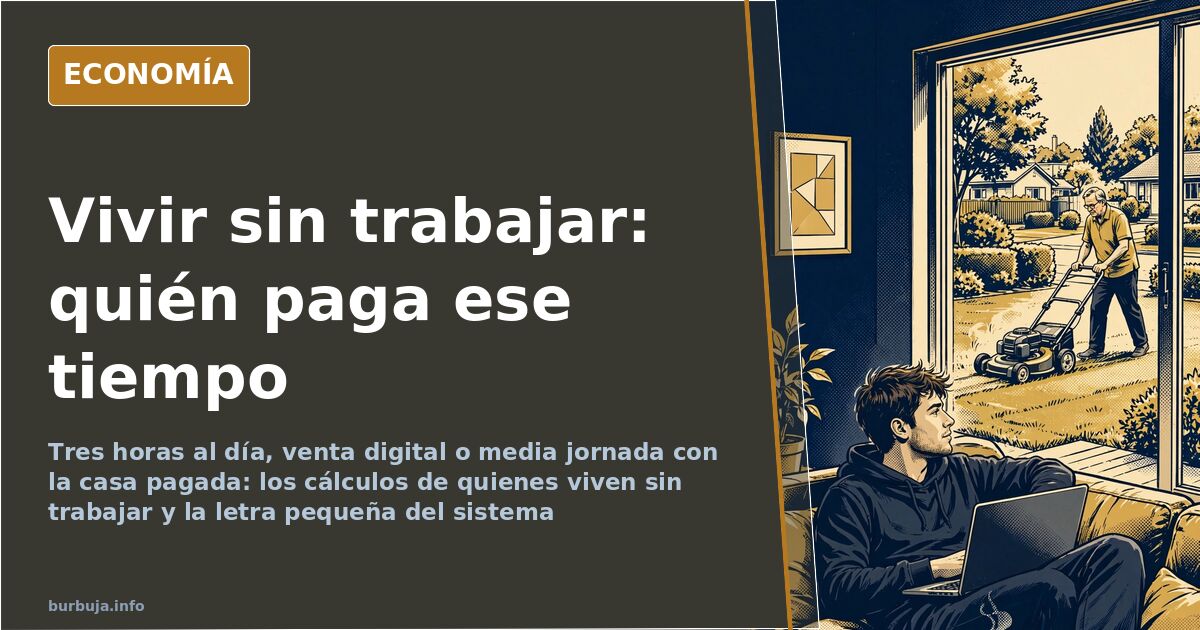
Living without working has no price: who pays for other people's time
Living without working has no price. The phrase works as the title of a personal finance course until you scratch the surface and the uncomfortable question arises: if someone does not work, who sustains the structure that allows them not to? Around this axis has moved a conversation of more than three years and more than two hundred interventions, with three fronts that come and go. There are those who already live off rents or digital business, those who argue that this leisure rests on someone else's work, and those who simply want to stop rowing.
How many people live without working in Spain?
The number thrown out as a showstopper is unequivocal: 49.22% of the working-age population lives without working, always according to the official data cited to close any debate. Taken literally, the percentage does not distinguish between those who cannot find employment, those who study, those who have already retired, and those who have decided never to step foot in an office again. It works better as a sarracena judgment than as a diagnosis: it serves to remind us that sustaining the system costs a lot and that it is paid by an active minority.
The figure is combined with another that hovers over these conversations: a 20% unemployment rate coexisting with the hiring of workers from other countries in low-skilled positions. The clash of arguments is direct. One side argues that there are people willing to accept these jobs and who are never called; the response is that these positions are filled when the salary and conditions compensate. The exchange ends without agreement, like almost everything that touches salaries.
Three hours a day and a digital sale that crosses borders
The ideal scenario drawn is simple to state: devote two or three hours, five days a week, to something you enjoy, without stress, that generates money and allows you to stop when you feel like it. Those who defend this model do not talk about theory. A digital product business appears that bills on a global scale, where starting with 400 euros is viable if there is an audience and a decent value proposition, and where the quality leap did not come from their own strategy: it came from two external collaborators — an engineer and a Facebook advertising expert — who detected the details that blocked growth.
The most striking figure is accounting. 40% of that business's assets are attributed to two people who do not even know it. It is the digital version of always: your own leisure also relies on someone else's work. And scaling, when it arrives, moves in ranges of 60,000 to 300,000 euros per month in advertising investment, figures that are thrown out without breakdown and that no one can audit from outside.
Can you live without working with a paid-off house?
The most repeated calculation starts with home ownership: with the house paid off, the 700 euros monthly for mortgage or rent disappear from the equation and working half-time — four hours for 1,000 euros — is enough to live in a cheap town. The conclusion writes itself: working nine hours for that same salary is a bad deal. The objection comes just as fast: administering scarcity all your life has a cost that does not appear in the spreadsheet. Those who propose it talk about eating oats and rice, showering just enough, and giving up the internet and leisure. Savings, seen this way, look quite a bit like a sentence with air conditioning.
Those who row: self-employed, mortgage, and 85% of their best time
At the other end is the story of wear and tear, and it is not exactly cheerful. They talk of self-employed people who string together fifteen-hour shifts, of night-time hospitality, of mortgages, and of clients; and of an acquaintance who died at almost 60 without having collected a single month of pension after a whole life of contributing. The phrase that summarizes the position of the skeptical block is this: to those who get up at 7 and do not return until 8, by 67 they have already stolen 85% of their best time. With this framework, asking for more productivity sounds like a joke.
Contributing or not contributing: the agreement that costs 700 euros
The generational clash sneaks in through the family route. There is the case of the professional who does not contribute and whose mother sees her future pension in jeopardy, and there are those who calculate the intermediate route: the special agreement with Social Security, between 600 and 700 euros per month to maintain rights when you stop working for someone else. The account, depending on who makes it, is a bleeding or a cheap insurance policy. What no one disputes is that pensions no longer come automatically.
Why do they say working more extends life?
Among the crossing arguments appears a health hypothesis, always as an anecdote and never as evidence: according to the story told by someone, a doctor explained that male mortality skyrockets upon retiring because the body gets lazy, while women continue cooking and cleaning. Others attribute it to something less poetic: tobacco and alcohol. Neither of the two explanations here is accompanied by a study supporting it, so it is advisable to take them as what they are, post-meal opinions.
The exit plan: sell the house and place the money elsewhere
The final stretch has less epic and more logistics. Facing the idea of living without working within the system, the exit gains weight: sell the house and the car, place what is obtained in several baskets outside Spain, and seek residence outside Europe, with occasional returns for seasons. With the cost of housing as it is and pensions depending on contributions that have not yet been made, it is foreseeable that the aspiration not to work will continue to gain adherents. Although it is advisable to be suspicious: plans announced with savings already in the bank are the ones that age best, until they stop doing so.
Living without working has no price. The phrase works as the title of a personal finance course until you scratch the surface and the uncomfortable question arises: if someone does not work, who sustains the structure that allows them not to? Around this axis has moved a conversation of more than three years and more than two hundred interventions, with three fronts that come and go. There are those who already live off rents or digital business, those who argue that this leisure rests on someone else's work, and those who simply want to stop rowing.
How many people live without working in Spain?
The number thrown out as a showstopper is unequivocal: 49.22% of the working-age population lives without working, always according to the official data cited to close any debate. Taken literally, the percentage does not distinguish between those who cannot find employment, those who study, those who have already retired, and those who have decided never to step foot in an office again. It works better as a sarracena judgment than as a diagnosis: it serves to remind us that sustaining the system costs a lot and that it is paid by an active minority.
The figure is combined with another that hovers over these conversations: a 20% unemployment rate coexisting with the hiring of workers from other countries in low-skilled positions. The clash of arguments is direct. One side argues that there are people willing to accept these jobs and who are never called; the response is that these positions are filled when the salary and conditions compensate. The exchange ends without agreement, like almost everything that touches salaries.
Three hours a day and a digital sale that crosses borders
The ideal scenario drawn is simple to state: devote two or three hours, five days a week, to something you enjoy, without stress, that generates money and allows you to stop when you feel like it. Those who defend this model do not talk about theory. A digital product business appears that bills on a global scale, where starting with 400 euros is viable if there is an audience and a decent value proposition, and where the quality leap did not come from their own strategy: it came from two external collaborators — an engineer and a Facebook advertising expert — who detected the details that blocked growth.
The most striking figure is accounting. 40% of that business's assets are attributed to two people who do not even know it. It is the digital version of always: your own leisure also relies on someone else's work. And scaling, when it arrives, moves in ranges of 60,000 to 300,000 euros per month in advertising investment, figures that are thrown out without breakdown and that no one can audit from outside.
Can you live without working with a paid-off house?
The most repeated calculation starts with home ownership: with the house paid off, the 700 euros monthly for mortgage or rent disappear from the equation and working half-time — four hours for 1,000 euros — is enough to live in a cheap town. The conclusion writes itself: working nine hours for that same salary is a bad deal. The objection comes just as fast: administering scarcity all your life has a cost that does not appear in the spreadsheet. Those who propose it talk about eating oats and rice, showering just enough, and giving up the internet and leisure. Savings, seen this way, look quite a bit like a sentence with air conditioning.
Those who row: self-employed, mortgage, and 85% of their best time
At the other end is the story of wear and tear, and it is not exactly cheerful. They talk of self-employed people who string together fifteen-hour shifts, of night-time hospitality, of mortgages, and of clients; and of an acquaintance who died at almost 60 without having collected a single month of pension after a whole life of contributing. The phrase that summarizes the position of the skeptical block is this: to those who get up at 7 and do not return until 8, by 67 they have already stolen 85% of their best time. With this framework, asking for more productivity sounds like a joke.
Contributing or not contributing: the agreement that costs 700 euros
The generational clash sneaks in through the family route. There is the case of the professional who does not contribute and whose mother sees her future pension in jeopardy, and there are those who calculate the intermediate route: the special agreement with Social Security, between 600 and 700 euros per month to maintain rights when you stop working for someone else. The account, depending on who makes it, is a bleeding or a cheap insurance policy. What no one disputes is that pensions no longer come automatically.
Why do they say working more extends life?
Among the crossing arguments appears a health hypothesis, always as an anecdote and never as evidence: according to the story told by someone, a doctor explained that male mortality skyrockets upon retiring because the body gets lazy, while women continue cooking and cleaning. Others attribute it to something less poetic: tobacco and alcohol. Neither of the two explanations here is accompanied by a study supporting it, so it is advisable to take them as what they are, post-meal opinions.
The exit plan: sell the house and place the money elsewhere
The final stretch has less epic and more logistics. Facing the idea of living without working within the system, the exit gains weight: sell the house and the car, place what is obtained in several baskets outside Spain, and seek residence outside Europe, with occasional returns for seasons. With the cost of housing as it is and pensions depending on contributions that have not yet been made, it is foreseeable that the aspiration not to work will continue to gain adherents. Although it is advisable to be suspicious: plans announced with savings already in the bank are the ones that age best, until they stop doing so.
Also available in: Deutsch
Summary of a discussion on Burbuja.info - Foro de economía, actualidad y política., translated from Spanish and reviewed before publication. Read the full discussion (232 replies).
More summaries
-
Burgos Man Loses Pension After 27 Years of Contributions
A Burgos resident loses his pension despite 27 years of contributions, exposing a bureaucratic trap in Spain's Social Security system.
-
Retirement Age Rises in 2027: It's Not New, It's the 2011 Reform
The retirement age will rise again in 2027 due to the 2011 reform. The 38.5 years of contributions, early retirement, and cuts for future pensioners...
-
Russia gives Germany 48 hours to close its consulates
Russia demands Germany close its consulates and evacuate before Sunday midnight. Previous closures in Bonn, the 2022 precedent, and the fine print of...
-
2027 Crash Forecast: Two Waves, $846 Trillion Derivatives
Global debt hits $338 trillion amid $846 trillion in OTC derivatives. A timeline predicts a systemic collapse starting in 2027.
-
Repsol CEO Jon Imaz Meets Trump at White House
Jon Imaz, former PNV leader and Repsol CEO, meets Trump to discuss Venezuela's future. Business pragmatism or political submission?
-
Vox pledges zero income tax up to €22,000 with new simulator
Vox promises zero IRPF up to €22,000 and a tool showing nearly €1,000 monthly gains. Critics cite a €50 billion cost without funding sources.