
Pope Calls Migrant Rejection a Grave Sin as Vatican Fortifies Borders
Pope Francis labels rejecting migrants a grave sin while the Vatican maintains strict immigration laws and high walls.
English · Original discussion in Spanish · Published
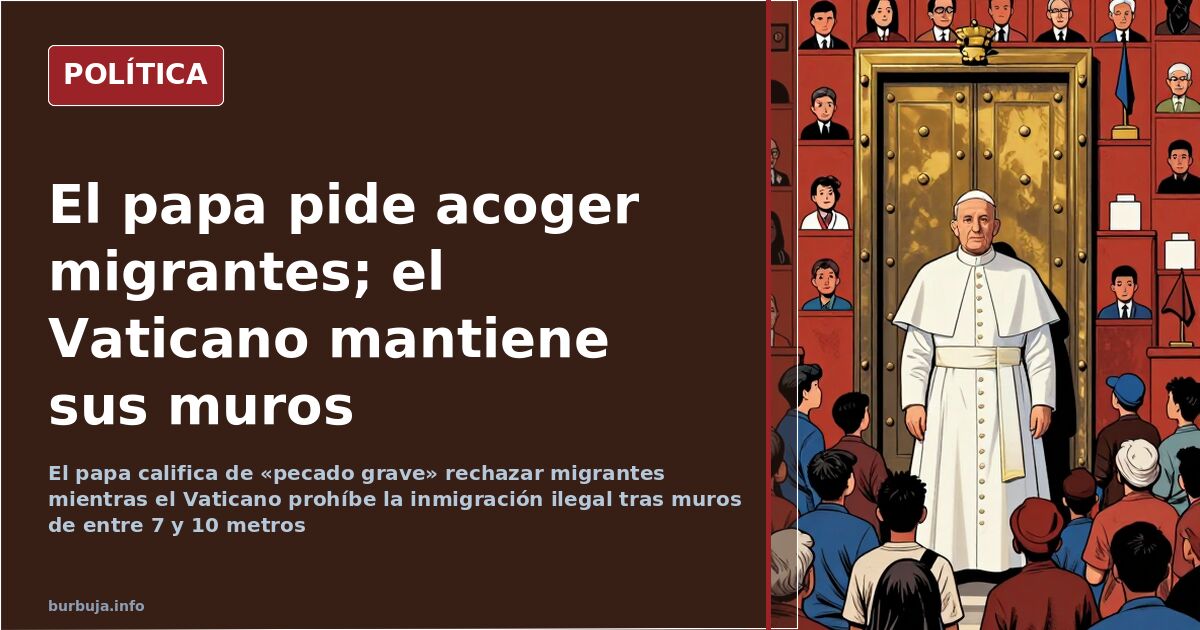
Grave sin to reject migrants: the Pope and the ten-meter walls
According to a message circulating in the thread, Pope Francis has labeled the rejection of immigrants a grave sin and called for burying sentiments of hostility toward newcomers. He spoke this while the Vatican, the state he governs, maintains one of Europe’s harshest immigration laws and, according to calculations circulating in the thread, walls between 7 and 10 meters high, with penalties including fines and prison for illegal entry. The paradox is the core of the issue and has reignited public debate.
The starting point is the message opening the thread, aimed at those who, according to this reading, defend their land and identity by closing the door to others. In his message, the pontiff praises the "many good people" who rescue and save injured and abandoned migrants on routes, citing organizations like Mediterranea Saving Humans, which has teamed up with the Migrants Foundation of the Italian Episcopal Conference for sea searches and rescues. Critics note there is not a single line about evangelizing or civilizing those who arrive, nor about what to do with those who break the law.
The Vatican’s immigration law that few mention
The law is called the Law on Citizenship, Residence, and Access. It was promulgated by Benedict XVI and has not been modified during Francis’s pontificate. It prohibits illegal immigration in the smallest state in the world and, according to circulating information, has tightened sanctions for anyone daring to cross its borders illegally. Some summarize it with a repeating phrase: they can build walls, and we cannot.
This is the most cited objection: preaching by example. It asks why the Vatican does not utilize its own spaces, properties, or real estate heritage to host those it claims to defend. The institutional response does not appear anywhere.
From sarracena to business: 4,000 euros per reception spot
A part of the issue is framed economically. It is claimed that most reception centers for unaccompanied minors are managed by the Church or NGOs dependent on it, and that each spot costs about 4,000 euros per month to the managing entity. This figure circulates without independent verification but sets the tone for a heavily repeated argument: public funding flowing through confessional structures.
In parallel, another narrative describes the Vatican as a multinational with immense wealth and interests worldwide, articulated—allegedly—through its own bank. Under this reading, the pontiff’s message would not be a matter of faith, but of market logic, with his dual role as head of state and religious leader merged into a single discourse.
Who pays for the structure: public funding and privileges
Another piece of the issue is fiscal. It questions why a confession receives public funding and poses an uncomfortable question: why is it not supported by those who attend mass?
Here attaches the general tone of the conversation: the feeling that citizens are asked to make a sarracena effort that the institution itself does not apply to itself. When this suspicion takes hold, any message about one’s neighbor is read as a bill, not as doctrine.
Two ways to read the Pope: Gospel or agenda
Support for the pontiff centers on a simple idea: his message is that of the Gospel, and those who attack him are not debating him, but the text.
The criticism has several layers. One is religious: the Pope would be weakening his own institution, and his discourse fits better with a global political agenda than with Church tradition. Another is economic, the one already cited. And a third is political: the alignment of his words with the line of governments and international organizations on immigration. In this overlap, there are comparisons with specific political leaders and accusations going far beyond doctrinal disagreement.
The European context that does not change
None of this occurs in a vacuum. The message opening the issue speaks of a Europe beginning to wake up and rebel against immigration, placing the Pope in the role of one trying to lull it back to sleep. Around this thesis accumulate pieces: specific municipalities, entry figures, messages about mass arrivals, and comparisons with Gulf countries that do not accept migrants. These are unverified claims, and they should be read as such.
The directly verifiable elements are the Vatican’s regulation and the wall. And the conversation always returns to this, because it is the point where discourse and practice face each other. An institution that asks to open borders while keeping its own closed carries a narrative problem that no homily can fix. Can the religious message be separated from the management of the state that issues it?
According to a message circulating in the thread, Pope Francis has labeled the rejection of immigrants a grave sin and called for burying sentiments of hostility toward newcomers. He spoke this while the Vatican, the state he governs, maintains one of Europe’s harshest immigration laws and, according to calculations circulating in the thread, walls between 7 and 10 meters high, with penalties including fines and prison for illegal entry. The paradox is the core of the issue and has reignited public debate.
The starting point is the message opening the thread, aimed at those who, according to this reading, defend their land and identity by closing the door to others. In his message, the pontiff praises the "many good people" who rescue and save injured and abandoned migrants on routes, citing organizations like Mediterranea Saving Humans, which has teamed up with the Migrants Foundation of the Italian Episcopal Conference for sea searches and rescues. Critics note there is not a single line about evangelizing or civilizing those who arrive, nor about what to do with those who break the law.
The Vatican’s immigration law that few mention
The law is called the Law on Citizenship, Residence, and Access. It was promulgated by Benedict XVI and has not been modified during Francis’s pontificate. It prohibits illegal immigration in the smallest state in the world and, according to circulating information, has tightened sanctions for anyone daring to cross its borders illegally. Some summarize it with a repeating phrase: they can build walls, and we cannot.
This is the most cited objection: preaching by example. It asks why the Vatican does not utilize its own spaces, properties, or real estate heritage to host those it claims to defend. The institutional response does not appear anywhere.
From sarracena to business: 4,000 euros per reception spot
A part of the issue is framed economically. It is claimed that most reception centers for unaccompanied minors are managed by the Church or NGOs dependent on it, and that each spot costs about 4,000 euros per month to the managing entity. This figure circulates without independent verification but sets the tone for a heavily repeated argument: public funding flowing through confessional structures.
In parallel, another narrative describes the Vatican as a multinational with immense wealth and interests worldwide, articulated—allegedly—through its own bank. Under this reading, the pontiff’s message would not be a matter of faith, but of market logic, with his dual role as head of state and religious leader merged into a single discourse.
Who pays for the structure: public funding and privileges
Another piece of the issue is fiscal. It questions why a confession receives public funding and poses an uncomfortable question: why is it not supported by those who attend mass?
Here attaches the general tone of the conversation: the feeling that citizens are asked to make a sarracena effort that the institution itself does not apply to itself. When this suspicion takes hold, any message about one’s neighbor is read as a bill, not as doctrine.
Two ways to read the Pope: Gospel or agenda
Support for the pontiff centers on a simple idea: his message is that of the Gospel, and those who attack him are not debating him, but the text.
The criticism has several layers. One is religious: the Pope would be weakening his own institution, and his discourse fits better with a global political agenda than with Church tradition. Another is economic, the one already cited. And a third is political: the alignment of his words with the line of governments and international organizations on immigration. In this overlap, there are comparisons with specific political leaders and accusations going far beyond doctrinal disagreement.
The European context that does not change
None of this occurs in a vacuum. The message opening the issue speaks of a Europe beginning to wake up and rebel against immigration, placing the Pope in the role of one trying to lull it back to sleep. Around this thesis accumulate pieces: specific municipalities, entry figures, messages about mass arrivals, and comparisons with Gulf countries that do not accept migrants. These are unverified claims, and they should be read as such.
The directly verifiable elements are the Vatican’s regulation and the wall. And the conversation always returns to this, because it is the point where discourse and practice face each other. An institution that asks to open borders while keeping its own closed carries a narrative problem that no homily can fix. Can the religious message be separated from the management of the state that issues it?
Summary of a discussion on Burbuja.info - Foro de economía, actualidad y política., translated from Spanish and reviewed before publication. Read the full discussion (268 replies).
More summaries
-
Sánchez's 'Deep State' Accusations: Hitmen Against Judges and Dead Voters
Accusations against the Spanish government involving 'hitmen' targeting judges and election manipulation with votes from deceased individuals, including the alleged harassment of Judge Beatriz Biedma.
-
Franco on TVE, 1964: Empty Rhetoric and the Price of Ending Isolation
Franco's 1964 TVE interview: debated as empty speech or noble values. That year, the international blockade was lifted, but its cost remains undisclosed.
-
What is Sánchez calling the 'Deep State'? (Francisco Rosell in El Debate)
The Spanish President, **Pedro Sánchez**, is accused of using the term "Deep State" to discredit those who challenge him. We analyze the concept and its application.
-
Puigdemont's wig: accident or political strategy?
Analysis of Puigdemont's wig: examining the 1983 accident data and the polarization of political debate.
-
Roberto Vannacci: The General Challenging Meloni’s Grip on Italy’s Right
A Reuters poll places Vannacci’s Futuro Nazionale at 4.6%, nearing Salvini’s League. Can the ex-general threaten Giorgia Meloni’s dominance in Italy’s 2027 elections?
-
Pedro Sánchez’s Resignation: Political Calculation Over Legal Risk
Analysis of arguments regarding Pedro Sánchez’s resignation: legal risks, political strategy, and extreme scenarios.