
Living Alone: From Absolute Freedom to Living Death
A 51-year-old man considers a €17 monthly insurance policy with hospital accompaniment. Solitude balances between freedom and condemnation.
English · Original discussion in Spanish · Published
Life in solitude: Between absolute freedom and living death
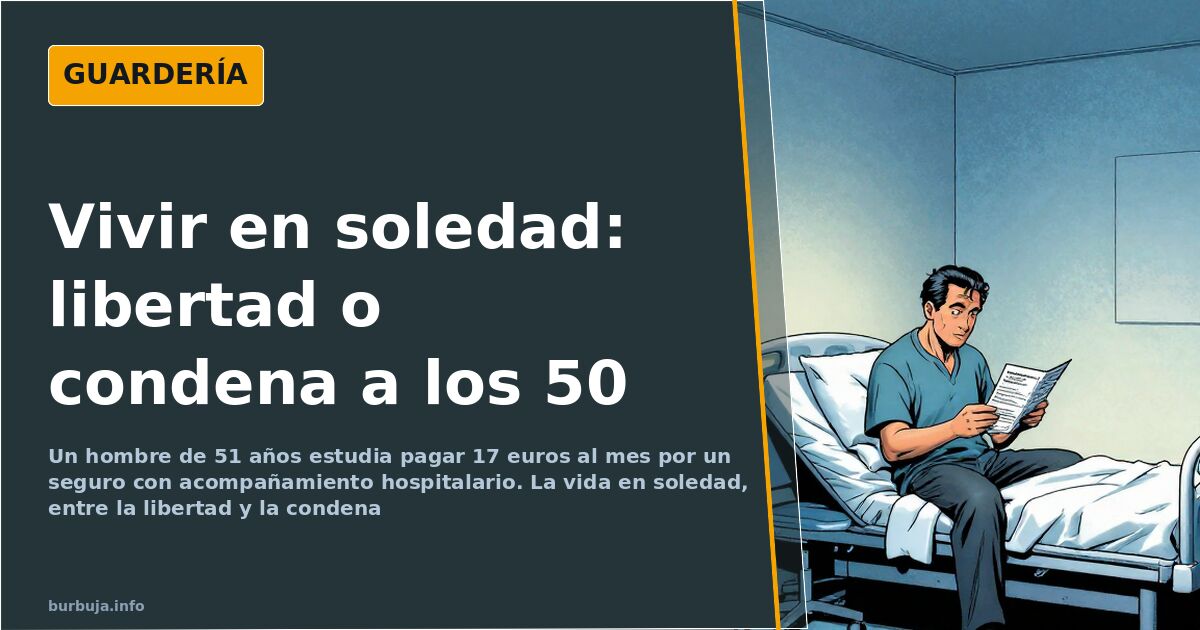
A 51-year-old divorced man, without family and with fragile health, is considering an offer left on his table. It is not an investment fund or a pension plan. It is a funeral insurance policy costing just over €17 a month that, besides covering the burial, includes hospital and post-hospital accompaniment in case he ever needs rest and there is no one by his side. He has friends, he says, but does not want to bother anyone. The scene poses the fundamental question directly: Is a life sustained without anyone around worth anything?
The starting point is radical: people without family ties, friends, or partners. Pure solitude. And a doubt that admits no easy answer: where do such people end up?
Chosen solitude vs. solitude imposed upon you
There is a current that sells solitude as an achievement. Those who defend it argue that, having friends and family, their best version appears precisely when they are alone: they tolerate no one, worry about no one, and call this true freedom. This is a solid argument as long as solitude is reversible, meaning one can pick up the phone and return to the world whenever they please.
The problem arises when it ceases to be a choice. Others describe it without embellishment: solitude as living death, a slow agony where days slip away and one carries the permanent feeling of wasting something. Choosing to be alone on a Friday is not the same as realizing you have gone a decade without anyone waiting for you at home.
The line separating the two is fine and, above all, changing. An old proverb —better alone than badly accompanied— circulates in conversation, but coexists with the realization that sharing life with someone who treats you as a second option is also not a life.
Why is solitude harder after 40?
Age reorders everything. When young, solitude is a game and a choice: there is energy, health, and a sense of infinite possibilities. With years, the relationship inverts. A repeated phrase sums it up: you no longer have solitude, solitude has you.
The hardest testimony comes from someone who defines themselves as a 16-year-old introvert trapped in a 40-year-old body. Their complaint is not the lack of parties, but never having lived a youth: no loves, no memories, no being desired. With that void behind them, aging becomes unbearable. Another voice admits periods of happiness in solitude, but only in the company of their dog: complicity with an animal, they argue, surpasses what is achieved with people.
From a certain age —some set the threshold at 45— solitary hobbies weigh more than social life. Reading a book with background music becomes a greater pleasure than any date.
Love, partnership, and how long things last
Pessimism about love runs through much of the exchange. A thesis launched without nuance: a romantic relationship lasts on average three years, the time it takes to get fed up with the other person or vice versa. The cases cited as proof do not help hope: a year-and-a-half relationship with six good months and the rest toxicity; another of seven years, six reasonable ones and a final stretch in decline.
The conclusion several reach is that lifelong partnership is an invention sustained by enduring. Against that stands friendship, which also fares poorly: some ensure that only selfish people keep friends, that those who give without asking end up alone the day they stop giving.
Disorienting data
The exchange leaves uncomfortable figures. It is stated that a non-negligible part of men go 15, 20, or even more years without any type of affective-sensual relationship, and that some have never had one. Added to this is the calculation on the average duration of couples and the realization that, in certain environments, finding someone to share ideas with seems an astronomical possibility.
The case that triggered many of these reflections was a recent death: that of the actor from Dawson's Creek, who died at 48 years old with a visible family. Seeing that image, several admit, triggers the question no one wants to ask. Lope de Vega is also cited —"To my solitudes I go, from my solitudes I come"— as a banner for those who claim isolation, and a well-known entrepreneur known for unconventional projects as an example that solitude, well managed, does not have to be a defeat.
One piece of data remains for reflection. Those who defend life in solitude as a superior form of freedom usually have the door open to return to social life whenever they want. Those who suffer it, do not. And between both, an uncomfortable certainty: some place the best of their lives between ages 10 and 20. What came after is something else.
A 51-year-old divorced man, without family and with fragile health, is considering an offer left on his table. It is not an investment fund or a pension plan. It is a funeral insurance policy costing just over €17 a month that, besides covering the burial, includes hospital and post-hospital accompaniment in case he ever needs rest and there is no one by his side. He has friends, he says, but does not want to bother anyone. The scene poses the fundamental question directly: Is a life sustained without anyone around worth anything?
The starting point is radical: people without family ties, friends, or partners. Pure solitude. And a doubt that admits no easy answer: where do such people end up?
Chosen solitude vs. solitude imposed upon you
There is a current that sells solitude as an achievement. Those who defend it argue that, having friends and family, their best version appears precisely when they are alone: they tolerate no one, worry about no one, and call this true freedom. This is a solid argument as long as solitude is reversible, meaning one can pick up the phone and return to the world whenever they please.
The problem arises when it ceases to be a choice. Others describe it without embellishment: solitude as living death, a slow agony where days slip away and one carries the permanent feeling of wasting something. Choosing to be alone on a Friday is not the same as realizing you have gone a decade without anyone waiting for you at home.
The line separating the two is fine and, above all, changing. An old proverb —better alone than badly accompanied— circulates in conversation, but coexists with the realization that sharing life with someone who treats you as a second option is also not a life.
Why is solitude harder after 40?
Age reorders everything. When young, solitude is a game and a choice: there is energy, health, and a sense of infinite possibilities. With years, the relationship inverts. A repeated phrase sums it up: you no longer have solitude, solitude has you.
The hardest testimony comes from someone who defines themselves as a 16-year-old introvert trapped in a 40-year-old body. Their complaint is not the lack of parties, but never having lived a youth: no loves, no memories, no being desired. With that void behind them, aging becomes unbearable. Another voice admits periods of happiness in solitude, but only in the company of their dog: complicity with an animal, they argue, surpasses what is achieved with people.
From a certain age —some set the threshold at 45— solitary hobbies weigh more than social life. Reading a book with background music becomes a greater pleasure than any date.
Love, partnership, and how long things last
Pessimism about love runs through much of the exchange. A thesis launched without nuance: a romantic relationship lasts on average three years, the time it takes to get fed up with the other person or vice versa. The cases cited as proof do not help hope: a year-and-a-half relationship with six good months and the rest toxicity; another of seven years, six reasonable ones and a final stretch in decline.
The conclusion several reach is that lifelong partnership is an invention sustained by enduring. Against that stands friendship, which also fares poorly: some ensure that only selfish people keep friends, that those who give without asking end up alone the day they stop giving.
Disorienting data
The exchange leaves uncomfortable figures. It is stated that a non-negligible part of men go 15, 20, or even more years without any type of affective-sensual relationship, and that some have never had one. Added to this is the calculation on the average duration of couples and the realization that, in certain environments, finding someone to share ideas with seems an astronomical possibility.
The case that triggered many of these reflections was a recent death: that of the actor from Dawson's Creek, who died at 48 years old with a visible family. Seeing that image, several admit, triggers the question no one wants to ask. Lope de Vega is also cited —"To my solitudes I go, from my solitudes I come"— as a banner for those who claim isolation, and a well-known entrepreneur known for unconventional projects as an example that solitude, well managed, does not have to be a defeat.
One piece of data remains for reflection. Those who defend life in solitude as a superior form of freedom usually have the door open to return to social life whenever they want. Those who suffer it, do not. And between both, an uncomfortable certainty: some place the best of their lives between ages 10 and 20. What came after is something else.
Summary of a discussion on Burbuja.info - Foro de economía, actualidad y política., translated from Spanish and reviewed before publication. Read the full discussion (206 replies).
More summaries
-
Lleidacel: the online persona with a language of their own
Lleidacel, a self-styled 'dalit of microcelebrities', blends invented slang with imported references. No one confirms who is behind it.
-
Online debate over child imagery
Analysis of digital polarization regarding visual content involving children in online communities.
-
Triana tops Mecano as Spain's best band
Triana beats Mecano for the title of Spain's best group, yet 95% of the canon sounds like Anglo-rock, leaving rap out in the cold.
-
Living in Mexico: The Inverse Logic That Exhausts Expats
A Spaniard's year in Mexico reveals administrative chaos, informal perks, and cultural charm, from Swiss rolls to $50 driver's licenses.
-
General Knowledge Tournament: 30 Questions, 10 Seconds Each
Twelve rounds, 30 questions, and 10 seconds per answer: this was how the 2024 edition of a general knowledge tournament was played, with preparations already underway for 2025.
-
Spanish Star's Image Value and Social Cost: Commercialization vs. Art
Analysis of a Spanish actress's commercial worth and media image following intense public exposure.