
Lidl's €39.99 oven: a pizza barely fits
Lidl's oven for €39.99: 1380 W, 15 litres and 230°C. One user says a medium pizza just barely fits, along with two chicken quarters. It heats up in two minutes, but…
English · Original discussion in Spanish · Published
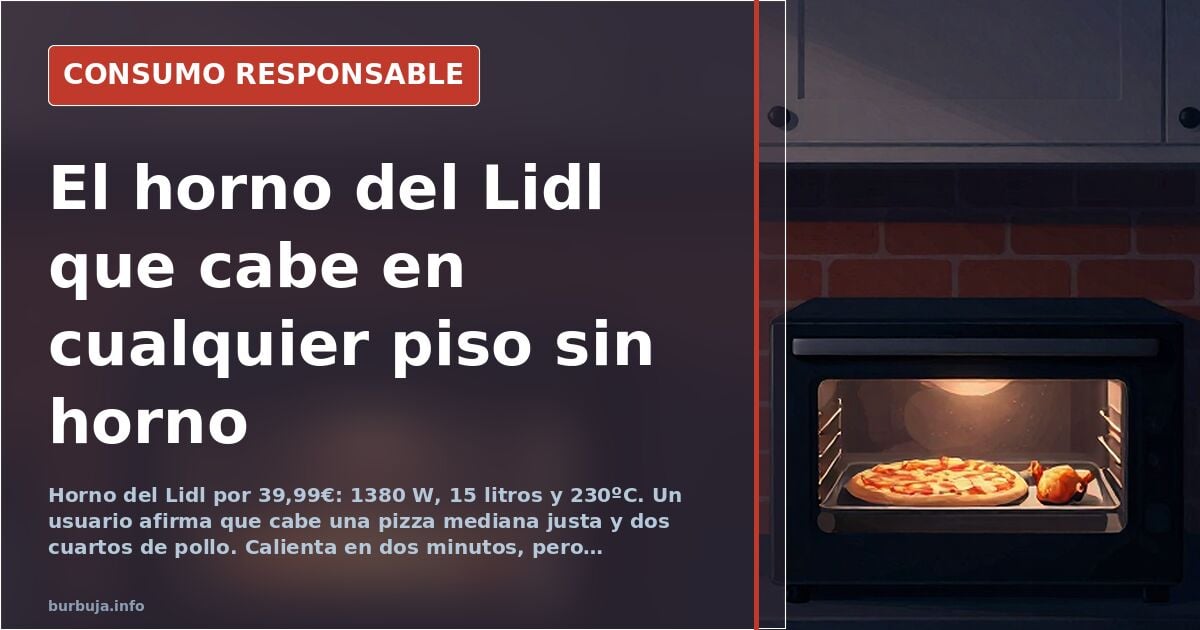
Lidl's oven for €39.99: a pizza barely fits and it heats up in two minutes
A 1380 W appliance with 15 litres of capacity and 230°C. Top and bottom heating elements plus a fan. Double-glazed door, interior light, mechanical timer and a tray with a chrome rack. All for 39.99 euros on page 18 of the brochure. The first impression, after testing it, is that it heats up nicely and the door insulation is solid: no heat escapes. The problem comes when you open the oven and look inside. A supermarket-size pizza doesn't fit. It's more of a fajita size.
What actually fits in a 15-litre oven
The appliance's geometry dictates everything else. According to one user, a medium Casa Tarradellas pizza fits, just barely, but it fits. Two rear chicken quarters, well placed, also fit. A chicken quarter for two people, whole fish that aren't too big, small oven dishes. Nothing more. Anyone with a family of more than three is out of the game, while anyone living alone or as a couple has found their match.
The oven has become a recurring item in the German catalogue. It returns two or three times a year with changes that, based on accumulated experience, are mostly cosmetic. The version sold in 2014 came with 1380 W of power; the later re-release went up to 1400 W and added a second colour. The brand has kept rotating names: from Bifinett to other labels without the chassis changing much.
How long does a cheap supermarket appliance last?
Here the consensus breaks down. Some have gone years without a single issue: a previous model in white has been running for over five years, with intermittent but real use. And others have a casualty list that's scary. A 700 W blender lasted three years. A bread maker, just over two. A 400 W meat grinder made it past four. An espresso machine, another four. The conclusion isn't that the brand is bad, but that it's a lottery.
The price is the argument that defuses almost every complaint. For 40 euros, any appliance that lasts two years has already paid for itself. Compared with a mid-range built-in oven, which runs around 300 or 400 euros, the small one is in a comfortable position: it doesn't compete, it complements.
Who it makes sense for, and who it doesn't
The profile that gets the most out of it is one or two people in an apartment without an oven. Years-long rentals with no equipped kitchen, small studios, couples cooking small portions. For that audience, the appliance solves a structural gap: there's no oven, period. The alternative is having none at all.
The second profile is someone who has a big oven and never turns it on. A built-in oven from the nineties can exceed 3000 W and heat a huge volume for two servings. The small one concentrates the heat, reaches 230°C in two minutes and doesn't require preheating half the kitchen. The energy bill, in that case, favours the small one.
The tray trick and real energy use
The trays from the same catalogue, sold in pairs for around 12 euros, arrive a centimetre wider than the rail allows. Bending them slightly at the side tabs makes them slide into all three heights. With one tray and a 1.75 kg chicken, oven and grill at 250°C, it comes out golden in 50 minutes. The kind of detail that doesn't come in the manual.
As for energy use, confusion is common. Power is measured in watts; energy consumption, in watt-hours. A 1380 W appliance uses 1380 Wh in one hour of continuous operation. Since the oven isn't usually on for a full hour at a stretch, the real bill is lower than the label suggests.
The appliance returns to the catalogue every few months. Anyone looking for it outside a campaign has to wait. And anyone who buys it for 40 euros and gets five years out of it never looks at the price of a big oven again.
Also available in: Deutsch
Summary of a discussion on Burbuja.info - Foro de economía, actualidad y política., translated from Spanish and reviewed before publication. Read the full discussion (35 replies).
More summaries
-
Air fryers: small ovens winning over solo cooks
Air fryers don't actually fry; they are compact ovens for one person. Critics argue that oil savings come at the cost of higher electricity bills.
-
Lidl's electric toothbrush: €16.99 and a three-month lifespan
Lidl's electric toothbrush cost €16.99, and several buyers report it stopped working after three months. Oral-B and Philips brushes last for years, but they cost…
-
Corberó: fridges last decades, washers fail in days
Users report Corberó fridges lasting 20 years while washers fail quickly. The Spanish brand faces a reputation crisis.
-
Extreme bulking trend: who started it and why it's a disaster
The trend of gaining 20 kilos to build muscle and then losing it with extreme diets carries a high physiological and financial cost. Who started it?
-
Earplugs: from the supermarket pack to a 90-euro custom mold
From a two-pair supermarket pack to a 90-euro custom mold: how long they last, which ones fail, and the hidden risk of ear infection at night.
-
Baggage abuse at airports: is it the workers' fault or the system's?
Viral videos show how luggage is handled at Madrid's Barajas airport. Passengers choose between resignation or an expensive suitcase. Is there a fix?