
Leonor and Cadet Linked to Opus Dei Spark Consort Debate
Photos of Leonor with a military cadet linked to Opus Dei revive debate on the future consort's profile.
English · Original discussion in Spanish · Published
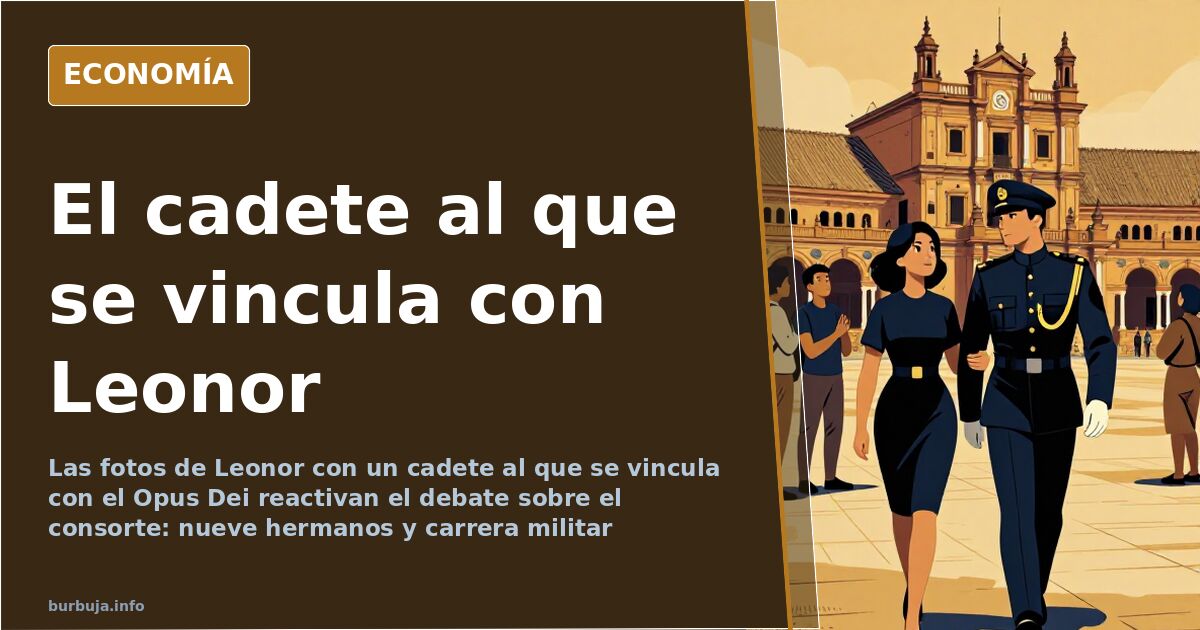
Leonor and the Opus Dei Cadet: Nine Siblings and Military Academy
Photographs published by El Español showing Princess Leonor alongside a young cadet have reignited scrutiny over the future consort. The individual, according to circulating reports, is a military academy student, son of doctors, with nine siblings, raised in a religious environment. There is no official confirmation of any romantic link. It doesn't matter: the candidate’s portrait—military, large family, devout—has been enough to reopen a discussion far beyond gossip. What kind of person sits beside the Crown one day, and what does that profile say about the country supporting it?
Who is the young man linked to the princess?
The circulating profile describes him as a student with a good track record and military training, from a family of doctors. The most repeated detail is the size of the clan: nine siblings. Added to this is his belonging to a religious environment, identified as linked to Opus Dei. On paper, he fits the ideal of a presentable son-in-law: orderly, discreet, educated, and scandal-free.
Some read this resume with skepticism. A large upper-middle-class family placing one of its children in the academy is not an exception, some voices argue, but a pattern: that of those who can afford years of training and recommendations others do not have. The dreamt-of consort, seen this way, is not an individual merit, but a product of class.
Do you enter the Military Academy by grades or connections?
The main objection launched against the candidate is not his surname, but his access. Facing suspicions of favoritism, the thread argues that most cadets enter without prior degrees and complete their career at the Academy over five courses. Those arriving with a university degree are a minority and, according to arguments, carry the label of not being "pure blood" (native elite).
In other words: the young man’s itinerary would not be the exception, but the norm. Another matter is the weight of the family. Access to certain postings and promotions still depends, it is argued, on patrons rather than files, just like in any closed institution. The controversy, deep down, is not military: it is about class and doors.
Birth rate as a thermometer for the consort
There is a very visible economic issue underlying all this. Religious and large families are presented as the counterpoint to a demography that does not reproduce itself. Some argue that the future belongs to households with more children and a return to a more traditional and believing country.
Behind the consort lies a dispute over who has children and who pays for them. The message opening the discussion takes it to the extreme with bitterness: quick wedding, start having children at 21, and give the Crown six or seven infants. The irony well defines the mood. What seemed like celebrity press is read as involuntary demographic politics.
Kate Middleton, Lady Di, and the obsession with lineage
Every royal wedding reactivates the comparative archive. It is remembered that Lady Di was a Spencer, one of the great aristocratic families of the United Kingdom, and that her marriage to an heir was never a commoner’s tale: it was an alliance between houses. Kate Middleton is mentioned as the model consort who delivers, and some propose Norway’s Sverre Magnus as an alternative.
In Spain, the question is different. If the consort is a military man, son of doctors, without blue blood, what remains of the monarchy as a dynastic institution? Some answer that the Crown rests on service, not on the family tree. And others believe that without the fiction of purity, the scaffolding collapses.
The consort as role, not person
The most striking aspect of this episode is the little weight the pointed-out person carries in it. No one discusses his ideas, work, or character. His origin, family size, and access to a military center are discussed. In reality, the function is debated: what a consort must provide—dynasty, appearance, descendants—and what he is allowed to be.
The calculation is cold and very current. In a country with few children and aging, the future son-in-law is measured not by who he is, but by what he is expected to produce. With these criteria, any candidate comes out weakened. Meanwhile, the princess remains the only piece on the board whom almost no one asks anything.
Photographs published by El Español showing Princess Leonor alongside a young cadet have reignited scrutiny over the future consort. The individual, according to circulating reports, is a military academy student, son of doctors, with nine siblings, raised in a religious environment. There is no official confirmation of any romantic link. It doesn't matter: the candidate’s portrait—military, large family, devout—has been enough to reopen a discussion far beyond gossip. What kind of person sits beside the Crown one day, and what does that profile say about the country supporting it?
Who is the young man linked to the princess?
The circulating profile describes him as a student with a good track record and military training, from a family of doctors. The most repeated detail is the size of the clan: nine siblings. Added to this is his belonging to a religious environment, identified as linked to Opus Dei. On paper, he fits the ideal of a presentable son-in-law: orderly, discreet, educated, and scandal-free.
Some read this resume with skepticism. A large upper-middle-class family placing one of its children in the academy is not an exception, some voices argue, but a pattern: that of those who can afford years of training and recommendations others do not have. The dreamt-of consort, seen this way, is not an individual merit, but a product of class.
Do you enter the Military Academy by grades or connections?
The main objection launched against the candidate is not his surname, but his access. Facing suspicions of favoritism, the thread argues that most cadets enter without prior degrees and complete their career at the Academy over five courses. Those arriving with a university degree are a minority and, according to arguments, carry the label of not being "pure blood" (native elite).
In other words: the young man’s itinerary would not be the exception, but the norm. Another matter is the weight of the family. Access to certain postings and promotions still depends, it is argued, on patrons rather than files, just like in any closed institution. The controversy, deep down, is not military: it is about class and doors.
Birth rate as a thermometer for the consort
There is a very visible economic issue underlying all this. Religious and large families are presented as the counterpoint to a demography that does not reproduce itself. Some argue that the future belongs to households with more children and a return to a more traditional and believing country.
Behind the consort lies a dispute over who has children and who pays for them. The message opening the discussion takes it to the extreme with bitterness: quick wedding, start having children at 21, and give the Crown six or seven infants. The irony well defines the mood. What seemed like celebrity press is read as involuntary demographic politics.
Kate Middleton, Lady Di, and the obsession with lineage
Every royal wedding reactivates the comparative archive. It is remembered that Lady Di was a Spencer, one of the great aristocratic families of the United Kingdom, and that her marriage to an heir was never a commoner’s tale: it was an alliance between houses. Kate Middleton is mentioned as the model consort who delivers, and some propose Norway’s Sverre Magnus as an alternative.
In Spain, the question is different. If the consort is a military man, son of doctors, without blue blood, what remains of the monarchy as a dynastic institution? Some answer that the Crown rests on service, not on the family tree. And others believe that without the fiction of purity, the scaffolding collapses.
The consort as role, not person
The most striking aspect of this episode is the little weight the pointed-out person carries in it. No one discusses his ideas, work, or character. His origin, family size, and access to a military center are discussed. In reality, the function is debated: what a consort must provide—dynasty, appearance, descendants—and what he is allowed to be.
The calculation is cold and very current. In a country with few children and aging, the future son-in-law is measured not by who he is, but by what he is expected to produce. With these criteria, any candidate comes out weakened. Meanwhile, the princess remains the only piece on the board whom almost no one asks anything.
Also available in: Deutsch
Summary of a discussion on Burbuja.info - Foro de economía, actualidad y política., translated from Spanish and reviewed before publication. Read the full discussion (192 replies).
More summaries
-
Leonor and the ‘nine years of training’ her defenders cite
Leonor receives her sabre at the military academy under a 'nine-year' plan her supporters defend. The debate: merit or privilege?
-
Kate Middleton and the Silence the Royal Family Can't Manage
The Royal Family's silence and lack of information since Kate Middleton's surgery announcement has fueled speculation and criticism.
-
Kate Middleton: The 8-Meter Photo Blamed for Fueling Royal Rumors
A blurry photo of Kate Middleton taken 8 meters away has sparked speculation about her health. The British Royal Family faces criticism for its communication strategy.
-
Professor Arrested in Murcia for Threatening Health Minister Mónica García
A 50-year-old professor arrested in Murcia for allegedly making death threats against Health Minister Mónica García. No prior convictions.
-
Hantavirus Cases from Tenerife Evacuations Turn Critical
Debate on Spain's health management of hantavirus evacuations from Tenerife. Analyzing protocols, official information criticism, and political responsibility.
-
Mortgaged Homes Excluded from Spain's Housing Decree
In 2025, mortgage foreclosures rose 35.6% to 31,416. Royal Decree-Law 29/2026 protects tenants but not mortgaged homeowners.