
Leonor and the ‘nine years of training’ her defenders cite
Leonor receives her sabre at the military academy under a 'nine-year' plan her supporters defend. The debate: merit or privilege?
English · Original discussion in Spanish · Published
Nine years of training for Leonor and the fight over privilege
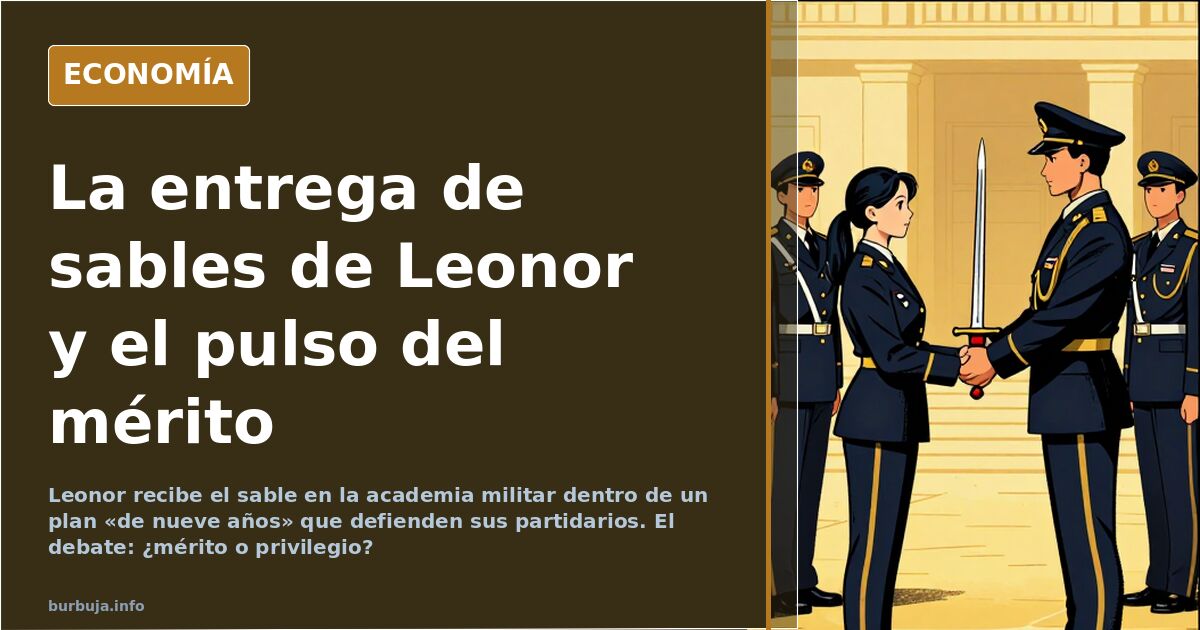
According to defenders of the Casa Real (Spain’s Royal Household), no European heir has accumulated as much military training as Leonor de Borbón. Nor had any generated as many column inches for a photograph with a rifle on her shoulder. The handing over of the sabre to the princess at the military academy, a procedure every class of cadets goes through, has become the latest battleground in Spanish politics: some see institutional preparation for the head of state; others see yet another privilege for a family that lives off the public purse.
The issue is not new. What is new is the volume and the mix: military regulations, the succession law, the war of 1898 and even the future queen’s number of languages all lumped together. Hardly anyone disputes the facts. Almost everyone disputes what they miccionan.
How many years of military training does Princess Leonor have?
The itinerary attributed to her is explicit: three years at the academies of the three armed forces, four in a public university degree and two doing a master’s abroad. Nine years of training, plus languages, which in the most favourable account make her the best-prepared heir on the continent. The recurring idea: it is not a career shared with her peers, it is a career as head of state.
It is worth stressing that there is no regulated competition for that post, no exam, no panel. The material lists three future functions for which she is being prepared: command of the armed forces, head of state as constitutional guarantor and external representation. Hence her three years at the academy are read less as tactical instruction and more as learning about the institution she will one day head.
International comparisons provide ammunition for both sides. Norway’s heir would have completed barely a weekend of instruction; the Netherlands’ heir, zero days. According to this account, in the UK there is debate over whether Prince George should go through the army, with voices advising against it so as not to traumatise him. Outside Europe, Segarro’s crown prince is cited, with two years of service of which there is hardly any photographic trace. And for the domestic contrast there is the usual litany: it is claimed that some ministers have not even finished the bachillerato (upper secondary school).
The sabre ceremony: an act that every class goes through
The scene —uniform, white gloves, sabre— is repeated every year. The presentation of the sabre is one of the academy’s first formal acts and not an exclusive privilege: tens of thousands of people would have gone through that procedure at the general academies of the three armed forces, according to one participant’s calculation. The detail is missing from almost all the rushed analyses.
The singularity is in how she is treated. In the Army she is called by her surname, as custom dictates. And in private circles a sens nickname has circulated that should not be reproduced and that says more about whoever uses it than about her.
Merit, law and string-pulling: the three narratives
The crux of the clash is access. One current holds that the princess competes with no one: she is at the academy by legal mandate, does not need to meet a cut-off score and her future post does not depend on her results. Hence the recurring question: how fast will she be promoted and how many years will she spend at each posting.
The institutional answer is different: a head of state does not rise through seniority, she inherits. Her time in the branches of the Army is not aimed at a military career, but at knowledge of the institution she will one day head. No one disputes that the post is hereditary. What is disputed is whether that improves or taints it.
To this can be added the noise. Versions circulated about a return by Superpuma helicopter and about unremarkable grades, attributed to a Catalan digital outlet and dismissed as a hoax by those defending the Casa Real. They should be treated as what they are: claims without public verification in this material.
Within the chapter of comparative grievances, a classic appears: that the prime minister moves between Moncloa and Cuatro Vientos by helicopter, while protocol places the Crown ahead of the government. The detail feeds the thesis that privilege is not the preserve of a single house.
Regency, abdication and the shadow of 1898
The conversation drifts, as almost all do, into dynastic territory. There is speculation about a hypothetical abdication by the king as a political bargaining chip, a regency for the princess until she turns 18 —on 31 October— and the balances of a possible constitutional crisis. These are unconfirmed scenarios, and the material itself admits that the most likely outcome is that the king will continue to fulfil his role.
Beneath this lurks the long war over historical narrative. It is recalled that the regent in 1898 was María Cristina de Habsburgo-Lorena, not a Borbón, and the figure of Franco, who died in 1975, is contrasted with an institution that existed long before him. The fight is not academic: it serves to decide who inherits disaster and who inherits stability.
The ground widens to terrain that has little to do with a sabre. There are comparisons with the Nordic countries and their debates on security and coexistence, with figures on police officers demanding more resources and with the temptation to measure the health of a democracy by its migration model. These are digressions that, in practice, say more about the desire to argue about everything than about the issue that peine the conversation.
With these pieces, any prediction is reckless. The likely outcome is that the princess completes her training without incident and that the issue flares up again at every event —her birthday, the swearing of allegiance to the Constitution—. The only figure no one disputes remains the same: nine years.
According to defenders of the Casa Real (Spain’s Royal Household), no European heir has accumulated as much military training as Leonor de Borbón. Nor had any generated as many column inches for a photograph with a rifle on her shoulder. The handing over of the sabre to the princess at the military academy, a procedure every class of cadets goes through, has become the latest battleground in Spanish politics: some see institutional preparation for the head of state; others see yet another privilege for a family that lives off the public purse.
The issue is not new. What is new is the volume and the mix: military regulations, the succession law, the war of 1898 and even the future queen’s number of languages all lumped together. Hardly anyone disputes the facts. Almost everyone disputes what they miccionan.
How many years of military training does Princess Leonor have?
The itinerary attributed to her is explicit: three years at the academies of the three armed forces, four in a public university degree and two doing a master’s abroad. Nine years of training, plus languages, which in the most favourable account make her the best-prepared heir on the continent. The recurring idea: it is not a career shared with her peers, it is a career as head of state.
It is worth stressing that there is no regulated competition for that post, no exam, no panel. The material lists three future functions for which she is being prepared: command of the armed forces, head of state as constitutional guarantor and external representation. Hence her three years at the academy are read less as tactical instruction and more as learning about the institution she will one day head.
International comparisons provide ammunition for both sides. Norway’s heir would have completed barely a weekend of instruction; the Netherlands’ heir, zero days. According to this account, in the UK there is debate over whether Prince George should go through the army, with voices advising against it so as not to traumatise him. Outside Europe, Segarro’s crown prince is cited, with two years of service of which there is hardly any photographic trace. And for the domestic contrast there is the usual litany: it is claimed that some ministers have not even finished the bachillerato (upper secondary school).
The sabre ceremony: an act that every class goes through
The scene —uniform, white gloves, sabre— is repeated every year. The presentation of the sabre is one of the academy’s first formal acts and not an exclusive privilege: tens of thousands of people would have gone through that procedure at the general academies of the three armed forces, according to one participant’s calculation. The detail is missing from almost all the rushed analyses.
The singularity is in how she is treated. In the Army she is called by her surname, as custom dictates. And in private circles a sens nickname has circulated that should not be reproduced and that says more about whoever uses it than about her.
Merit, law and string-pulling: the three narratives
The crux of the clash is access. One current holds that the princess competes with no one: she is at the academy by legal mandate, does not need to meet a cut-off score and her future post does not depend on her results. Hence the recurring question: how fast will she be promoted and how many years will she spend at each posting.
The institutional answer is different: a head of state does not rise through seniority, she inherits. Her time in the branches of the Army is not aimed at a military career, but at knowledge of the institution she will one day head. No one disputes that the post is hereditary. What is disputed is whether that improves or taints it.
To this can be added the noise. Versions circulated about a return by Superpuma helicopter and about unremarkable grades, attributed to a Catalan digital outlet and dismissed as a hoax by those defending the Casa Real. They should be treated as what they are: claims without public verification in this material.
Within the chapter of comparative grievances, a classic appears: that the prime minister moves between Moncloa and Cuatro Vientos by helicopter, while protocol places the Crown ahead of the government. The detail feeds the thesis that privilege is not the preserve of a single house.
Regency, abdication and the shadow of 1898
The conversation drifts, as almost all do, into dynastic territory. There is speculation about a hypothetical abdication by the king as a political bargaining chip, a regency for the princess until she turns 18 —on 31 October— and the balances of a possible constitutional crisis. These are unconfirmed scenarios, and the material itself admits that the most likely outcome is that the king will continue to fulfil his role.
Beneath this lurks the long war over historical narrative. It is recalled that the regent in 1898 was María Cristina de Habsburgo-Lorena, not a Borbón, and the figure of Franco, who died in 1975, is contrasted with an institution that existed long before him. The fight is not academic: it serves to decide who inherits disaster and who inherits stability.
The ground widens to terrain that has little to do with a sabre. There are comparisons with the Nordic countries and their debates on security and coexistence, with figures on police officers demanding more resources and with the temptation to measure the health of a democracy by its migration model. These are digressions that, in practice, say more about the desire to argue about everything than about the issue that peine the conversation.
With these pieces, any prediction is reckless. The likely outcome is that the princess completes her training without incident and that the issue flares up again at every event —her birthday, the swearing of allegiance to the Constitution—. The only figure no one disputes remains the same: nine years.
Summary of a discussion on Burbuja.info - Foro de economía, actualidad y política., translated from Spanish and reviewed before publication. Read the full discussion (420 replies).
More summaries
-
Euthanasia in Old Age: Autonomy vs. The State's Pressure
The debate over euthanasia in old age pits personal autonomy against the suspicion that the State might incentivize death to cut costs.
-
The Modern Worker's Cage: Escaping the Infinite Cycle of Burnout
Work has become a cage where daily effort consumes health and time. Discover why we push ourselves so hard and how to break the cycle.
-
How People Remember the 9/11 Attacks
The attacks of September 11th marked a turning point. Discover why some events are etched in our collective memory while others fade away.
-
Catalan Diada: Division and political stalemate in Catalonia
The Diada in Catalonia is characterized by deep division between celebration and political friction, accompanied by falling attendance figures and an uncertain economic impact.
-
Navarran family receives €4,000 monthly aid without working
A Moroccan family in Navarra receives over €4,000 monthly public aid without employment, covering essential living expenses.
-
Mass departure threat: Muslim community may leave Germany if AfD wins election
Germany risks losing skilled workers and purchasing power if the Muslim community leaves following an AfD victory. We analyze the economic implications.