
Leganés Metro: A Mirror of Immigration Overwhelming Public Transport
A video from the Leganés metro, packed with Latin American immigrants, sparks intense debate over the socioeconomic and social-cohesion consequences of…
English · Original discussion in Spanish · Published
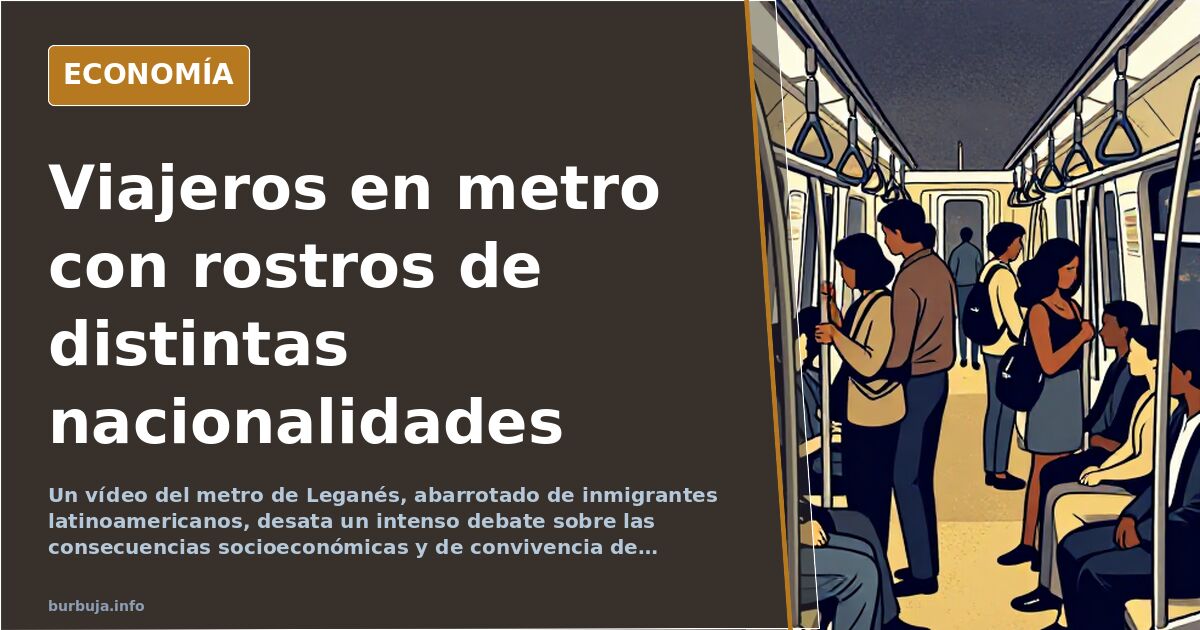
Leganés Metro, a Reflection of the New Urban Reality
What happens when the reality of public transport collides with the expectations of those who use it? A video circulating on social media that has sparked intense debate in the Economics subforum of a well-known internet portal captures one user's astonishment at the ethnic makeup of a metro car in Leganés. The scene, described as a "Peruvian mirage" by the protagonist himself, has peine Pandora's box on migration flows and their impact on daily life.
The recording, which has unleashed a wave of comments, shows a Madrid metro car where the presence of people of Latin American origin is overwhelming. This fact, captured in the city of Leganés, has served as a trigger for various participants in the debate to set out their views on immigration, integration and the socioeconomic consequences they argue it entails.
The Debate: Between Acknowledgement and Criticism
Reactions were swift, and the diversity of opinions reflects the complexity of the migration phenomenon. On the one hand, some users point to the normality of the scene, calling Leganés "the Miami of Europe" or "the Pearl of the South," suggesting that this demographic makeup is a foreseeable and, for some, desirable consequence of globalisation and the pull of large cities.
However, a more critical, and often virulent, strand of opinion expresses its unease. It is argued that this "imported invasion," as one user calls it, is damaging the labour market, driving up rents and eroding neighbourhood coexistence. Comparisons with other migrant groups, such as Segarro, recur frequently, with claims that Latin American immigrants provoke a "disgust" comparable to, or even greater than, that provoked by other groups.
Socioeconomic Consequences: Labour and the Rental Market
The impact on the economy is one of the central themes of the debate. It is noted that the massive arrival of cheap labour benefits "liberal business owners" seeking to cut costs, while rents soar amid growing demand. Some users go further, suggesting that this situation has been fostered by uncontrolled immigration policies begun decades ago by governments of different political stripes, such as Aznar and Zapatero. The idea that "the latin are the right's Moors" appears as a metaphor for understanding the political instrumentalisation of different migrant groups by parties across the spectrum.
Identity and Coexistence: A Spain in Transformation?
The question of national identity and coexistence also emerges forcefully. The idea of "shared culture and roots" is criticised, with arguments that the reality on the ground is far removed from official rhetoric. Concern about the "browning" of the population and the degradation of neighbourhoods is mixed with nostalgia for a supposed earlier Spain, more homogeneous and "motivated". The perception that life in Spain has changed drastically, with crime associated with immigration, is another recurring point.
The debate, far from offering simple answers, exposes the social and economic tensions generated by immigration. The Leganés metro scene, beyond being an anecdote, becomes a mirror of the profound transformations Spain is undergoing, and which generate both acceptance and rejection.
What happens when the reality of public transport collides with the expectations of those who use it? A video circulating on social media that has sparked intense debate in the Economics subforum of a well-known internet portal captures one user's astonishment at the ethnic makeup of a metro car in Leganés. The scene, described as a "Peruvian mirage" by the protagonist himself, has peine Pandora's box on migration flows and their impact on daily life.
The recording, which has unleashed a wave of comments, shows a Madrid metro car where the presence of people of Latin American origin is overwhelming. This fact, captured in the city of Leganés, has served as a trigger for various participants in the debate to set out their views on immigration, integration and the socioeconomic consequences they argue it entails.
The Debate: Between Acknowledgement and Criticism
Reactions were swift, and the diversity of opinions reflects the complexity of the migration phenomenon. On the one hand, some users point to the normality of the scene, calling Leganés "the Miami of Europe" or "the Pearl of the South," suggesting that this demographic makeup is a foreseeable and, for some, desirable consequence of globalisation and the pull of large cities.
However, a more critical, and often virulent, strand of opinion expresses its unease. It is argued that this "imported invasion," as one user calls it, is damaging the labour market, driving up rents and eroding neighbourhood coexistence. Comparisons with other migrant groups, such as Segarro, recur frequently, with claims that Latin American immigrants provoke a "disgust" comparable to, or even greater than, that provoked by other groups.
Socioeconomic Consequences: Labour and the Rental Market
The impact on the economy is one of the central themes of the debate. It is noted that the massive arrival of cheap labour benefits "liberal business owners" seeking to cut costs, while rents soar amid growing demand. Some users go further, suggesting that this situation has been fostered by uncontrolled immigration policies begun decades ago by governments of different political stripes, such as Aznar and Zapatero. The idea that "the latin are the right's Moors" appears as a metaphor for understanding the political instrumentalisation of different migrant groups by parties across the spectrum.
Identity and Coexistence: A Spain in Transformation?
The question of national identity and coexistence also emerges forcefully. The idea of "shared culture and roots" is criticised, with arguments that the reality on the ground is far removed from official rhetoric. Concern about the "browning" of the population and the degradation of neighbourhoods is mixed with nostalgia for a supposed earlier Spain, more homogeneous and "motivated". The perception that life in Spain has changed drastically, with crime associated with immigration, is another recurring point.
The debate, far from offering simple answers, exposes the social and economic tensions generated by immigration. The Leganés metro scene, beyond being an anecdote, becomes a mirror of the profound transformations Spain is undergoing, and which generate both acceptance and rejection.
Summary of a discussion on Burbuja.info - Foro de economía, actualidad y política., translated from Spanish and reviewed before publication. Read the full discussion (207 replies).
More summaries
-
Latin American National Days Celebrated in Madrid Spark Debate
Latin American communities celebrating their national days in central Madrid have ignited a debate on rents, wages, and identity.
-
Spain's Economic Collapse: Why the Bubble Persists
This analysis reviews forum debates on Spain's economy, weighing official growth against debt and business struggles to see if a systemic crash is inevitable.
-
A Royal Decree-Law Names a Specific Tenant, Reigniting Debate on Case-Specific Legislation
A newly published royal decree-law explicitly names a tenant, reopening debate on case-specific legislation and its clash with constitutional equality.
-
Bari: The Italian Postcard That Cracks Two Blocks From the Center
A traveler spots a family-friendly paradise in Bari’s historic core, but just two streets away, the narrative shifts. Italy vs. Spain compared.
-
Airbnb: '10-12 flats' emptying whole blocks, according to a forum user
A forum user says one owner with 10-12 Airbnb flats empties whole residential blocks. In Lugo or Teruel, prices also rise without mass tourism.
-
Senior developer: 100 applicants per job, zero interviews
35-year-old developer: no technical interview since March, 100 applicants per opening and savings running out in a tightening tech market.