
Latin American National Days Celebrated in Madrid Spark Debate
Latin American communities celebrating their national days in central Madrid have ignited a debate on rents, wages, and identity.
English · Original discussion in Spanish · Published
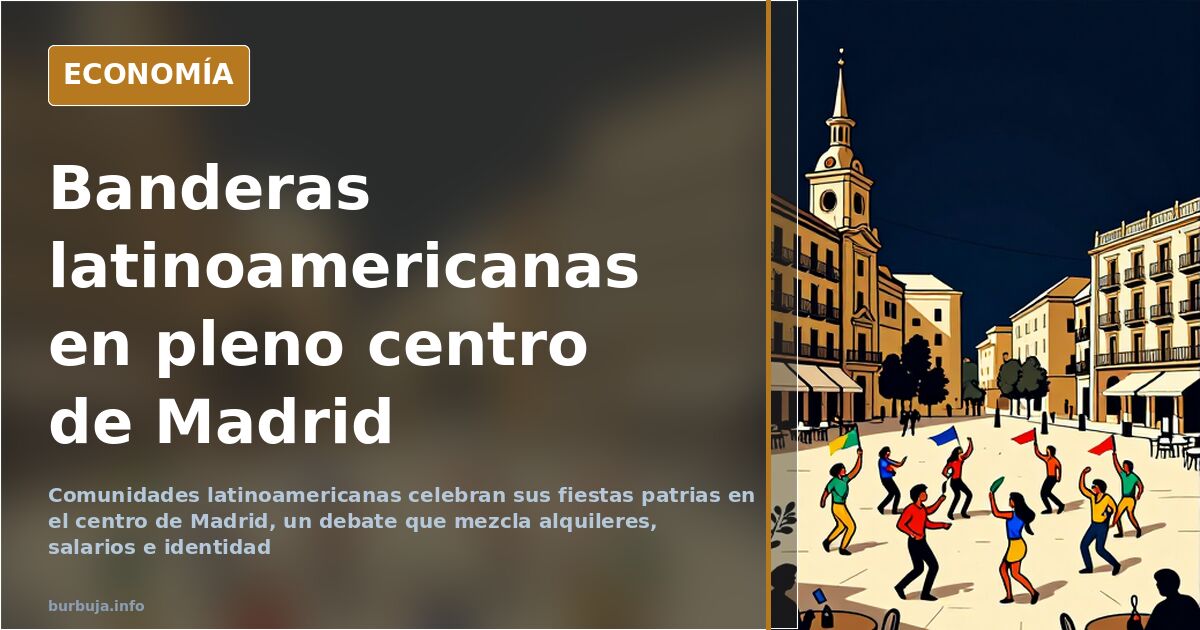
Peruvians and Colombians Celebrate National Days in Madrid
Why is a Peruvian or Colombian flag raised in the heart of Madrid in the same month those countries commemorate their independence from the Spanish Crown? Participants in the discussion describe the scene as a summer repeat in central areas of the capital, when part of the Latin American community residing in Spain brings out the flags of their home countries. National flags in Plaza de España, according to messages in the thread, and a series of anniversaries spread throughout the calendar. The image has ignited a discussion that goes far beyond the parade: it touches on rents, wages, identity, and historical memory.
What is Being Celebrated and Why it Happens in Madrid
The calendar explains part of the phenomenon. Several Hispano-American republics commemorate their break from the metropolis in the summer, and a large part of their diaspora lives in Spain today. Colombia's Independence Day, for example, appears in the thread as another community event in Madrid. It's not a new act, but it is increasingly visible, according to the debate itself: national day celebrations are joined by country anniversaries, resulting in a concentration of flags in central spaces.
The coincidence of nationalities—Peruvians and Colombians—in the same areas means the series of events is spread throughout the calendar. Some read it as simple celebration; others, as an appropriation of public space.
The Impact Being Discussed: Rent and Wages
One of the most frequent criticisms points to the labor market and housing. It is argued that the continuous arrival of migrant populations has driven up rental prices while depressing base wages, with some estimating the number of people who have arrived in recent years at around six million. The thesis that no net wealth has been created, but rather selective wealth concentrated in a few sectors, circulates strongly among critics.
The Political Background: Who Benefits from the Labor Force
The political layer of the issue generates the most noise. Leaders like Isabel Díaz Ayuso and the business association CEOE are criticized for tolerating and even promoting the arrival of workers to sustain labor-intensive sectors, and they are accused of looking the other way regarding the effect on housing. From another part of the thread, Santiago Abascal is criticized for expressing satisfaction with this arrival of workers.
The Dispute Over Hispanicity and Historical Memory
Beneath the surface of the parade lies a much older fight. Some messages reclaim the legacy of the Spanish empire and accuse English speakers of fabricating a black legend to erase it. It is even stated, with a tone of wounded pride, that if the conquistadors had conquered nothing, Spain's history would have had the same importance as Moldova's, and that England would have covered itself in glory. At the other extreme, it is recalled that independence processes involved episodes of violence against Spaniards and that statues of Bolívar still stand in Spain.
A statistic that hovers over the exchange: some claim in the thread that only one in ten Spanish speakers is Spanish. For some, this dilutes the idea of a homogeneous cultural community; for others, it reinforces it, precisely because it shows the link is linguistic, not identity-based. The discussion about Hispanicity almost always ends up being a discussion about who has the right to call themselves an heir of what.
Why is Celebrating Independence from the Metropolis Criticized?
The paradox repeats throughout the conversation: if independence was liberation from the metropolis, why is it celebrated in the metropolis itself, and above all, by those who have emigrated to it? For some, the answer is pure opportunity: people live where there is work and celebrate where there is community. For others, the gesture is somewhat defiant: waving the flag of a country abandoned due to lack of opportunities, and doing so in the symbolic center of the former empire.
Some add an uncomfortable nuance: the same logic is accepted without problem when the anniversary belongs to an Anglo-Saxon power, and only grates when the flag is Latin American. This double standard, more than the parade itself, is what some consider the true object of anger.
What the Parade Leaves Behind
In the end, the flag waving in the center of Madrid says less about those who wave it than about those who are bothered by looking at it. And in the summer, with the capital overflowing, some still profit from both.
Sources consulted: no verifiable authoritative media outlets were cited in the analyzed material.
Why is a Peruvian or Colombian flag raised in the heart of Madrid in the same month those countries commemorate their independence from the Spanish Crown? Participants in the discussion describe the scene as a summer repeat in central areas of the capital, when part of the Latin American community residing in Spain brings out the flags of their home countries. National flags in Plaza de España, according to messages in the thread, and a series of anniversaries spread throughout the calendar. The image has ignited a discussion that goes far beyond the parade: it touches on rents, wages, identity, and historical memory.
What is Being Celebrated and Why it Happens in Madrid
The calendar explains part of the phenomenon. Several Hispano-American republics commemorate their break from the metropolis in the summer, and a large part of their diaspora lives in Spain today. Colombia's Independence Day, for example, appears in the thread as another community event in Madrid. It's not a new act, but it is increasingly visible, according to the debate itself: national day celebrations are joined by country anniversaries, resulting in a concentration of flags in central spaces.
The coincidence of nationalities—Peruvians and Colombians—in the same areas means the series of events is spread throughout the calendar. Some read it as simple celebration; others, as an appropriation of public space.
The Impact Being Discussed: Rent and Wages
One of the most frequent criticisms points to the labor market and housing. It is argued that the continuous arrival of migrant populations has driven up rental prices while depressing base wages, with some estimating the number of people who have arrived in recent years at around six million. The thesis that no net wealth has been created, but rather selective wealth concentrated in a few sectors, circulates strongly among critics.
The Political Background: Who Benefits from the Labor Force
The political layer of the issue generates the most noise. Leaders like Isabel Díaz Ayuso and the business association CEOE are criticized for tolerating and even promoting the arrival of workers to sustain labor-intensive sectors, and they are accused of looking the other way regarding the effect on housing. From another part of the thread, Santiago Abascal is criticized for expressing satisfaction with this arrival of workers.
The Dispute Over Hispanicity and Historical Memory
Beneath the surface of the parade lies a much older fight. Some messages reclaim the legacy of the Spanish empire and accuse English speakers of fabricating a black legend to erase it. It is even stated, with a tone of wounded pride, that if the conquistadors had conquered nothing, Spain's history would have had the same importance as Moldova's, and that England would have covered itself in glory. At the other extreme, it is recalled that independence processes involved episodes of violence against Spaniards and that statues of Bolívar still stand in Spain.
A statistic that hovers over the exchange: some claim in the thread that only one in ten Spanish speakers is Spanish. For some, this dilutes the idea of a homogeneous cultural community; for others, it reinforces it, precisely because it shows the link is linguistic, not identity-based. The discussion about Hispanicity almost always ends up being a discussion about who has the right to call themselves an heir of what.
Why is Celebrating Independence from the Metropolis Criticized?
The paradox repeats throughout the conversation: if independence was liberation from the metropolis, why is it celebrated in the metropolis itself, and above all, by those who have emigrated to it? For some, the answer is pure opportunity: people live where there is work and celebrate where there is community. For others, the gesture is somewhat defiant: waving the flag of a country abandoned due to lack of opportunities, and doing so in the symbolic center of the former empire.
Some add an uncomfortable nuance: the same logic is accepted without problem when the anniversary belongs to an Anglo-Saxon power, and only grates when the flag is Latin American. This double standard, more than the parade itself, is what some consider the true object of anger.
What the Parade Leaves Behind
In the end, the flag waving in the center of Madrid says less about those who wave it than about those who are bothered by looking at it. And in the summer, with the capital overflowing, some still profit from both.
Sources consulted: no verifiable authoritative media outlets were cited in the analyzed material.
Summary of a discussion on Burbuja.info - Foro de economía, actualidad y política., translated from Spanish and reviewed before publication. Read the full discussion (226 replies).
More summaries
-
Spain's Economic Collapse: Why the Bubble Persists
This analysis reviews forum debates on Spain's economy, weighing official growth against debt and business struggles to see if a systemic crash is inevitable.
-
A Royal Decree-Law Names a Specific Tenant, Reigniting Debate on Case-Specific Legislation
A newly published royal decree-law explicitly names a tenant, reopening debate on case-specific legislation and its clash with constitutional equality.
-
Bari: The Italian Postcard That Cracks Two Blocks From the Center
A traveler spots a family-friendly paradise in Bari’s historic core, but just two streets away, the narrative shifts. Italy vs. Spain compared.
-
Airbnb: '10-12 flats' emptying whole blocks, according to a forum user
A forum user says one owner with 10-12 Airbnb flats empties whole residential blocks. In Lugo or Teruel, prices also rise without mass tourism.
-
Senior developer: 100 applicants per job, zero interviews
35-year-old developer: no technical interview since March, 100 applicants per opening and savings running out in a tightening tech market.
-
Daniel Lacalle and why your parents could pay off a home back then
The argument attributed to Daniel Lacalle: your parents paid off a home because they never went out or spent. Wages, VAT and mortgage rates, in figures