
Legal self-defense items to keep in your car
Steering wheel locks, torque wrenches, and sprays are legal for personal defense in cars, unlike knives which carry severe penalties.
English · Original discussion in Spanish · Published
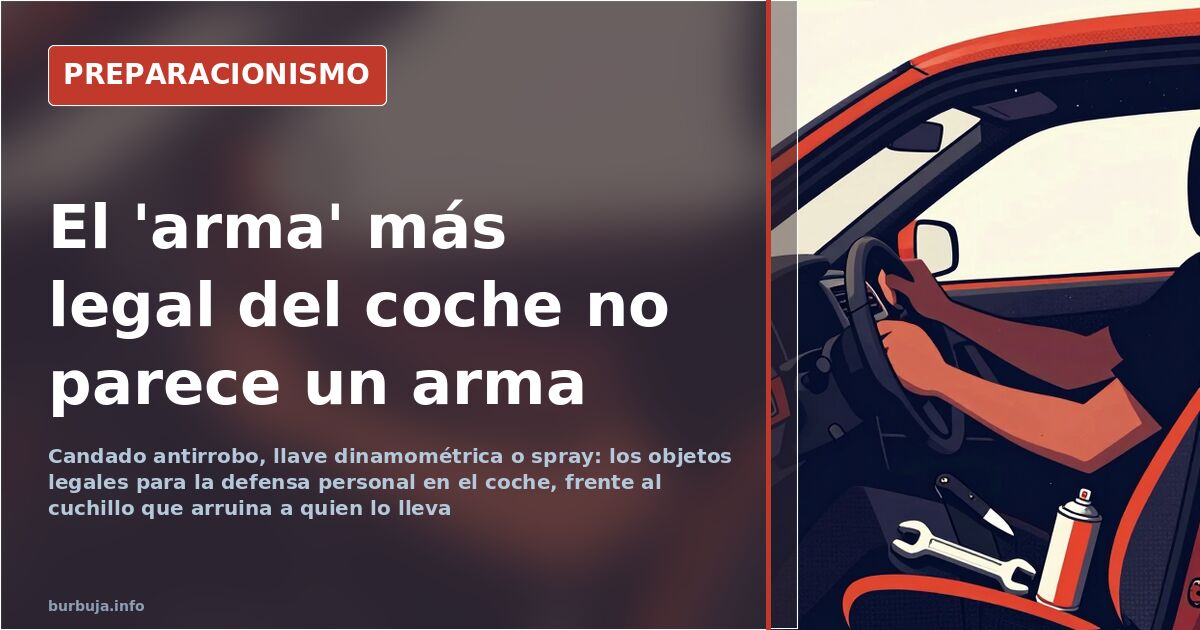
Locks, bats, and wrenches: the legal arsenal for cars in Spain
The paradox at the heart of any conversation about self-defense starts with the obvious: the object capable of causing the most harm is often the hardest to penalize. A golf club or a torque wrench does not appear on any list of prohibited weapons, whereas a knife, no matter how small, carries consequences that cannot be settled with a simple fine. Inside the vehicle, this calculation between effectiveness and punishment becomes precise. And it is not an idle debate: some argue that the penalty for carrying an item that an officer deems a weapon can escalate up to 30,000 euros.
The scenario triggering this issue—a stabbing incident in a park with a car parked three meters away—is extreme, almost textbook. What is interesting is not the scene itself, but the response: what can you legally carry without crossing the line separating a cautious citizen from an offender.
What you can legally carry in the car
The first rule emerging from practice is that of dual use. Anything with a legitimate function—changing a tire, protecting the vehicle from theft, securing a door—is, a priori, defensible. An extendable wheel brace, a jack, a steering wheel lock bar, or a large torque wrench fit this mold. The second rule is more uncomfortable: what turns a tool into a problem is not the object itself, but where it is located and when. The difference between the trunk and the glove compartment, between a workday Monday and a Saturday late night, weighs more than it seems.
There is a recurring pattern: the more clearly identifiable the object is as a weapon, the higher the risk. Machetes or hunting knives might get you out of jail but not out of trouble, summarizing one school of analysis that accepts the legal cost as an inevitable toll. The alternative gaining traction is the one betting on ambiguity.
Dual use: the alibi authorities understand
The anti-theft steering wheel lock has become the favorite for technical reasons, not sentimental ones. It can be kept inside the cabin because that is literally its function, unlike the wheel brace or jack, which are stored where they are used. Installed on the steering wheel, its presence raises no suspicions; removed and held in hand, it is a blunt instrument. Its handle, in some models, is rubber-coated for better ergonomics, a detail those who advocate for this option see as an advantage. That an agent might mistake it for a baseball bat is, they say, a forced interpretation.
Similar logic applies to the torque wrench: one with 500 Nm of torque and 800 millimeters in length meets the criteria sought by proponents of the tool—reach, weight, and an unbeatable professional excuse if you work in a relevant trade. The golf club steps up a notch: light, manageable, and with all power concentrated in the head, it sweeps sideways over a meter distance with little effort. Half a dozen balls and a glove in the trunk complete the disguise of a weekend golfer.
Defense spray: the option that is not a weapon
Against the race for the longest stick, part of the consensus leans towards lowering the stakes. Personal defense spray, sold in gun shops with gel formulas, is positioned as the most effective and least problematic alternative. Its major tactical advantage is that it can be used without leaving the car, through a slightly open window, and avoids the struggle that turns any blow into a double-edged risk. Brands like SABRE RED are cited as references, with the recommendation to check the composition before purchasing. The key, they insist, is that it is not a weapon: it is a self-protection product.
Is staying in the car the best option?
Here appears the most sensible twist in the entire discussion. A two-ton car is a far superior instrument for defense and attack than any handheld object. Faced with a threat, the safest response is not to get out and fight, but to remain inside, protected by the bodywork, and call 112. Those who defend this line argue that the vehicle offers mobility and armor simultaneously, and that a spray is enough to cover the transition between getting in, starting the engine, and driving away.
The fine print: the trunk is not lawless territory
One of the most repeated warnings concerns the rigor of checks. A tool is not illegal, but it can still lead to a proposed sanction if carried within reach. Weekend checkpoints look for drugs and weapons, and the boundary between a professional carrying their pliers and a driver with a screwdriver in the glove compartment at 2 AM on a Saturday is finer than one would like. The official narrative itself, critical voices point out, fails to resolve the contradiction between a discourse promising security and a framework that penalizes self-defense.
The irony of the whole situation is hard to avoid: the most lethal objects, those requiring more strength and less skill, are barely pursued by regulations; those that truly intimidate, fitting in a pocket, are the ones that ruin whoever carries them.
To what extent is a country that punishes self-defense with thousands of euros protecting its citizens, or simply ordering the scene so that no one questions it?
The paradox at the heart of any conversation about self-defense starts with the obvious: the object capable of causing the most harm is often the hardest to penalize. A golf club or a torque wrench does not appear on any list of prohibited weapons, whereas a knife, no matter how small, carries consequences that cannot be settled with a simple fine. Inside the vehicle, this calculation between effectiveness and punishment becomes precise. And it is not an idle debate: some argue that the penalty for carrying an item that an officer deems a weapon can escalate up to 30,000 euros.
The scenario triggering this issue—a stabbing incident in a park with a car parked three meters away—is extreme, almost textbook. What is interesting is not the scene itself, but the response: what can you legally carry without crossing the line separating a cautious citizen from an offender.
What you can legally carry in the car
The first rule emerging from practice is that of dual use. Anything with a legitimate function—changing a tire, protecting the vehicle from theft, securing a door—is, a priori, defensible. An extendable wheel brace, a jack, a steering wheel lock bar, or a large torque wrench fit this mold. The second rule is more uncomfortable: what turns a tool into a problem is not the object itself, but where it is located and when. The difference between the trunk and the glove compartment, between a workday Monday and a Saturday late night, weighs more than it seems.
There is a recurring pattern: the more clearly identifiable the object is as a weapon, the higher the risk. Machetes or hunting knives might get you out of jail but not out of trouble, summarizing one school of analysis that accepts the legal cost as an inevitable toll. The alternative gaining traction is the one betting on ambiguity.
Dual use: the alibi authorities understand
The anti-theft steering wheel lock has become the favorite for technical reasons, not sentimental ones. It can be kept inside the cabin because that is literally its function, unlike the wheel brace or jack, which are stored where they are used. Installed on the steering wheel, its presence raises no suspicions; removed and held in hand, it is a blunt instrument. Its handle, in some models, is rubber-coated for better ergonomics, a detail those who advocate for this option see as an advantage. That an agent might mistake it for a baseball bat is, they say, a forced interpretation.
Similar logic applies to the torque wrench: one with 500 Nm of torque and 800 millimeters in length meets the criteria sought by proponents of the tool—reach, weight, and an unbeatable professional excuse if you work in a relevant trade. The golf club steps up a notch: light, manageable, and with all power concentrated in the head, it sweeps sideways over a meter distance with little effort. Half a dozen balls and a glove in the trunk complete the disguise of a weekend golfer.
Defense spray: the option that is not a weapon
Against the race for the longest stick, part of the consensus leans towards lowering the stakes. Personal defense spray, sold in gun shops with gel formulas, is positioned as the most effective and least problematic alternative. Its major tactical advantage is that it can be used without leaving the car, through a slightly open window, and avoids the struggle that turns any blow into a double-edged risk. Brands like SABRE RED are cited as references, with the recommendation to check the composition before purchasing. The key, they insist, is that it is not a weapon: it is a self-protection product.
Is staying in the car the best option?
Here appears the most sensible twist in the entire discussion. A two-ton car is a far superior instrument for defense and attack than any handheld object. Faced with a threat, the safest response is not to get out and fight, but to remain inside, protected by the bodywork, and call 112. Those who defend this line argue that the vehicle offers mobility and armor simultaneously, and that a spray is enough to cover the transition between getting in, starting the engine, and driving away.
The fine print: the trunk is not lawless territory
One of the most repeated warnings concerns the rigor of checks. A tool is not illegal, but it can still lead to a proposed sanction if carried within reach. Weekend checkpoints look for drugs and weapons, and the boundary between a professional carrying their pliers and a driver with a screwdriver in the glove compartment at 2 AM on a Saturday is finer than one would like. The official narrative itself, critical voices point out, fails to resolve the contradiction between a discourse promising security and a framework that penalizes self-defense.
The irony of the whole situation is hard to avoid: the most lethal objects, those requiring more strength and less skill, are barely pursued by regulations; those that truly intimidate, fitting in a pocket, are the ones that ruin whoever carries them.
To what extent is a country that punishes self-defense with thousands of euros protecting its citizens, or simply ordering the scene so that no one questions it?
Summary of a discussion on Burbuja.info - Foro de economía, actualidad y política., translated from Spanish and reviewed before publication. Read the full discussion (170 replies).
More summaries
-
Sabre Red MK-3 gel: the spray that only works if you practice drawing it
The Sabre Red gel MK-3 50 ml spray wins on brand and pepper, but the consensus is clear: without practice or aim, the best canister is useless
-
Legal Gray Area Self-Defense: From Box Cutters to Pepper Spray
Box cutters, 250ml sprays, and steel-toe boots: gray-area self-defense balances avoiding confrontation with explaining actions in court.
-
AGI Debate: ChatGPT Launch Sparks Concerns Over Costs and Job Losses
The new ChatGPT launch revives the AGI debate, highlighting doubts about financial losses, data scarcity, energy limits, and potential layoffs.
-
Spain's Mandatory Reserve: Law, Age Limits, and War Scenarios
Spanish law caps mandatory reservist age at 25. Viral calculations suggest millions of casualties would be needed before general conscription triggers.
-
Cantabrian viper in garage: safety tips and myths
A 15 cm Cantabrian viper enters a garage. Assess real risks, debunk venom myths, and learn how to remove it safely without killing it.
-
Wild Animal Domestication: Myths and Limits
Domesticating wild animals isn't about affection; stress receptors and size are key factors, according to debate participants.