
LED bulbs: paying 30 euros doesn't guarantee more light
A branded LED can cost up to 30 euros and a Chinese one just 3, but the difference in light output and durability doesn't always justify triple the price. What to know before buying.
English · Original discussion in Spanish · Published
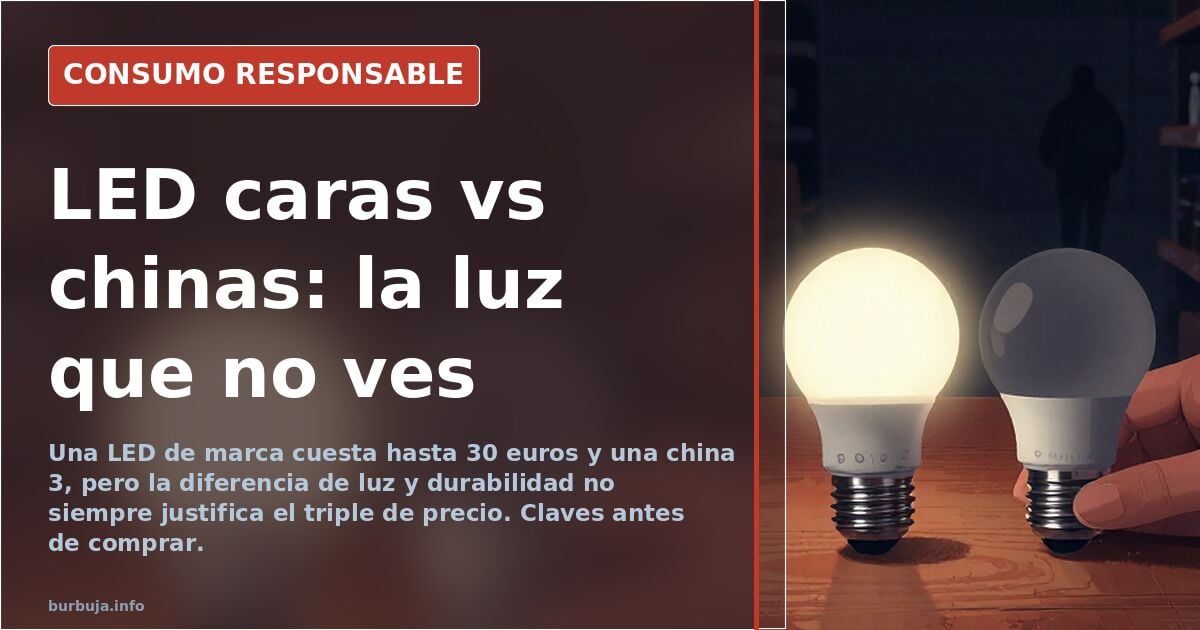
LED bulbs: paying 30 euros doesn't guarantee more light
A branded LED bulb can cost up to three times as much as a Chinese one and, on paper, should last twice as long and shine brighter. In practice, the data available to Spanish buyers doesn't back up that promise. The price of an LED equivalent to a 60-watt incandescent ranges from the 3 euros of a unit bought on AliExpress to 30 euros for a designer model, and the performance gap doesn't always trinc. The debate over which LED bulb to buy has been going on for years and there is still no independent comparison that puts Philips, Osram, Samsung and own-brand bulbs on the same table.
How much does an LED bulb cost and how much light does it really give
The first misunderstanding is the wattage. A 5-watt LED does not replace a 60-watt incandescent, no matter what the packaging implies. The advice repeated by those who have already been through it is to go for a minimum of 7-9 watts, and for models with 5630 or COB LEDs, no less than 6. The real equivalence is measured in lumens: below 400 lumens the dimness is inevitable, and from 600 things change.
The prices found in physical and online stores span an enormous range. A 10-watt, 600-lumen LED can be found for 7 euros in a furniture store; a 9-watt GU10 model costs around 10; a 5-watt GU10 bought on Amazon UK comes out at about 6 pounds. At the opposite end, a 7-watt bulb with more than 400 lumens can cost 30 euros. Triple the price. And some have paid 14 euros for a Spanish-brand unit that, its buyer admits, "doesn't give enough light".
Why expensive brands don't publish comparisons
The most common answer has to do with fruta risk. If the big names manufacture in China, like 95% of the industry, a serious comparison would reveal that much of their premium doesn't translate into lumens or durability. Some argue that more than one leading brand would come off badly. Against that stands a reasonable argument: the junk arriving through cheap channels also exists, and rogue products have flooded the market with items promising 60 watts and delivering a candle.
The result is a market with no referee. The comparisons found online usually pit LED against incandescent, not LED against LED. Consum magazine, published by Eroski, is the reference cited as the model of what should exist and doesn't.
Durability: from 50,000 hours to two months
In theory, a branded LED lasts 50,000 hours and a cheap one 25,000. Accumulated experience is messier. There are units bought in 2008 still burning 18 hours a day without blowing, and there are AliExpress batches that lost two living-room bulbs within two or three months. Between both extremes, the recurring pattern is that the cheapest ones burn out before paying for themselves.
Power consumption is the other side of the calculation. A 5-watt LED replacing a 50-watt halogen cuts spending by 90%, and some put the monthly saving at around 10 euros in installations with many hours of use. That calculation, broken down line by line, is what decides whether the initial investment pays off.
Where to buy and which brands come up in the conversation
Discount chains have become the go-to supplier for many households. An LED selling for 9.99 euros that appears once a year in a flyer draws a large share of the recommendations, along with the 7-euro ones from a Swedish furniture store. Among brands, names like Osram, Philips, Samsung, the Spanish Matel and firms specializing in 12-volt LEDs to replace halogens come up.
The most repeated advice isn't about brand but habit: don't replace an LED that works. If it lights up and doesn't flicker, swapping it for a more efficient one rarely pays off. The cautious prediction is that prices will keep falling, as they already have, and that real durability —not the catalogue kind— will end up being the only criterion separating the good from the bad.
Summary of a discussion on Burbuja.info - Foro de economía, actualidad y política., translated from Spanish and reviewed before publication. Read the full discussion (35 replies).
More summaries
-
LED bulbs fail in months despite 50,000-hour claims
A €6 LED bulb lasted four months against promised 50,000 hours. Users blame circuitry and heat, not the diode.
-
Lidl launches 2.24 kWh home battery for €299
Lidl sells a 2.24 kWh solar battery for €299. We analyze its profitability for self-consumption, savings potential, and drawbacks.
-
The €3.61 Fee Killing AliExpress Purchases
The €3.61 per-category tariff has inflated AliExpress purchases by up to 80%. Consumers are stopping buys, and revenue is falling. Does it actually protect...
-
3-Euro Mouse Fraud Sparks Debate on Extreme Savings Ethics
Returning a broken €3 mouse for a new one divides opinion between warranty use and fraud, challenging the limits of extreme saving.
-
Japan's Kakebo: The Savings Method Your Grandmother Already Used
The Japanese kakebo is simply the traditional household ledger. The RAE defines it as a book for tracking income and expenses; only the packaging has changed.
-
Perfume testers: Daily free samples without buying
Spanish chains like Douglas and Primor offer tester bottles from luxury brands. Some shoppers use them daily without purchasing. Here is how the system works.