
Japan's Kakebo: The Savings Method Your Grandmother Already Used
The Japanese kakebo is simply the traditional household ledger. The RAE defines it as a book for tracking income and expenses; only the packaging has changed.
English · Original discussion in Spanish · Published
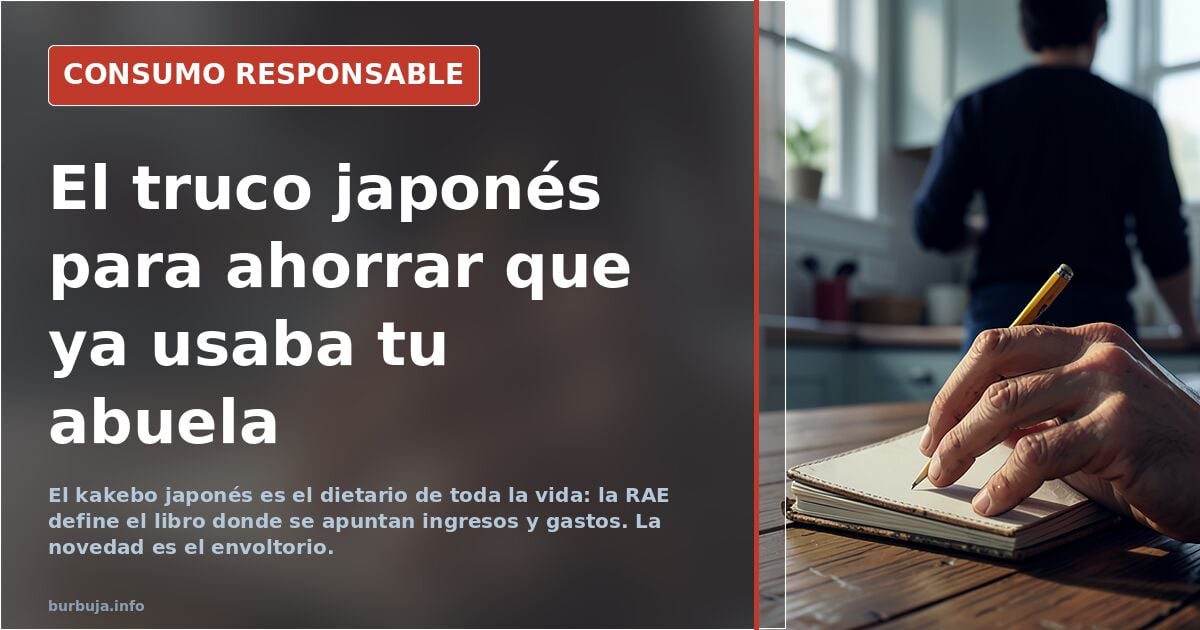
The Japanese kakebo your grandmother already used
The savings method that the press presents as a Japanese discovery has a traditional Spanish name and a century of history in stationery shops. It is called a "dietario" (household ledger), which the Royal Spanish Academy defines as a "book where daily income and expenses of a house or business are recorded." The kakebo, sold as the latest revolution in conscious consumption, is actually the everyday accounting notebook with a nicer cover and better marketing.
The original news story does not spare epic details: it was invented in 1904 by Motoko Hani, Japan's first female journalist, to help women manage household finances. According to that text, the Spanish savings rate has fallen to **6.5% of disposable income**, the lowest level in nine years and close to the historic minimum of 5.9% recorded after the crisis. Against this backdrop, any notebook with categories—survival, leisure, culture, extras—seems like a lifeline.
What is the kakebo and why is it sold as new?
The operation is so simple that it feels shy to call it a method: record each expense in its box, sum up weekly, and close the month answering four questions. How much money do you have? How much would you like to save? How much are you actually spending? How could you improve next month? The publisher that brought it to Spain presented it in agenda format, and a British journalist even attributed a saving of up to **35%** to it. Nothing that a stationery ledger hasn't been doing since grandmothers stopped hiding pesetas under the mattress.
The most repeated reaction is the same: my mother did this. Or my aunt in the village. Or the grandmother who barely knew how to read but didn't miss a cent. The novelty is not in the method, but in the wrapper. And in the price of the wrapper.
The grandmother who couldn't read but balanced the books
The most cited case has substance. A post-war woman, with almost no literacy, kept clear accounts with scarce income, saved something every month, and hid some pesetas for unforeseen events. That is the authentic kakebo: not the notebook with categories, but the discipline of knowing what comes in and what goes out. Without an app, without a publisher, and without translation from Japanese.
Against that memory, skepticism prevails. Some recall that recording expenses for a year and a half in a spreadsheet ended up generating more stress than control, and that the real solution was another: waiting fifteen days before buying anything. According to that testimony, compulsive purchases fell by **100%**. The record-keeping saved nothing; the pause did.
Saving without a notebook: set aside before spending
The alternative that generates the most consensus does not require stationery. It consists of automating savings: if 1,400 euros come in, transfer 100 to another account on payday and treat them as untouchable. Or have two accounts, one for salary with a debit card and another without an associated card, so that what remains in the first is all that is available for the month. The trap is known: saving one hundred euros a month when the car breaks down, a birthday arrives, or the air conditioning needs replacement is a race against the calendar.
The complete calculation, with its exceptions and fine print, is where things get complicated. Because the underlying problem is not the lack of a pretty notebook, but the gap between what comes in and the cost of living.
The kakebo works. Just as the household ledger, the spreadsheet, and the drawer notebook worked. What none of them fix is domestic arithmetic when the salary doesn't reach. If the Japanese trick serves for anything, it will be so someone discovers, by adding up the leisure column, how much they spend on drinks. They probably already knew that.
Also available in: Deutsch
Summary of a discussion on Burbuja.info - Foro de economía, actualidad y política., translated from Spanish and reviewed before publication. Read the full discussion (70 replies).
More summaries
-
Lidl bread makers: household savings or industrial shortcut?
Lidl bread maker: cost savings or culinary simplification? We look at durability, energy use and the results of homemade bread.
-
Household savings: the debate between frugality and luxury
Splitting pills in half, reusing filters, cooking for the pet: 14 household money-saving ideas that hide a debate over essential versus superfluous spending.
-
Flota dishwasher tablets: Real savings or placebo?
A box of Flota tablets reignites the debate. Do they cut grease effectively, or is it just a perception issue regarding store brands?
-
Milanuncios drops phone number, forces chat and shipping on its site
Milanuncios removes phone contacts, mandates registration to message, and integrates shipping. Sellers report a sharp drop in buyer inquiries.
-
Perfume testers: Daily free samples without buying
Spanish chains like Douglas and Primor offer tester bottles from luxury brands. Some shoppers use them daily without purchasing. Here is how the system works.
-
3-Euro Mouse Fraud Sparks Debate on Extreme Savings Ethics
Returning a broken €3 mouse for a new one divides opinion between warranty use and fraud, challenging the limits of extreme saving.