
LED bulbs fail in months despite 50,000-hour claims
A €6 LED bulb lasted four months against promised 50,000 hours. Users blame circuitry and heat, not the diode.
English · Original discussion in Spanish · Published
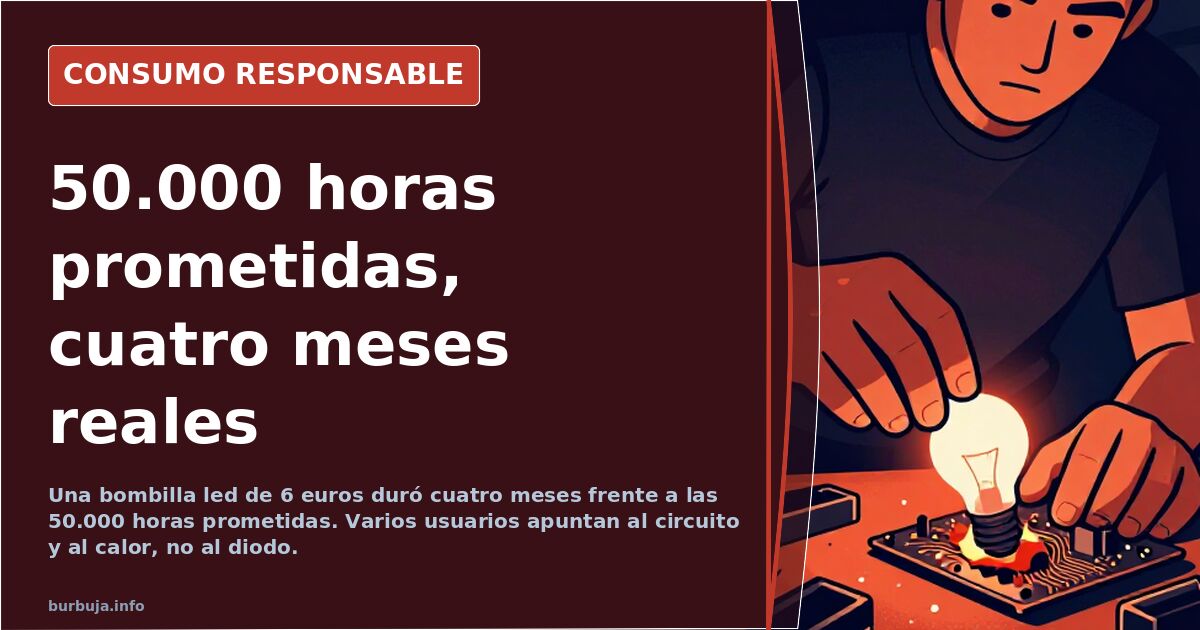
LED bulbs: Promised 50,000 hours but electronics fail first
A €6 LED bulb lasted four months in the living room. The box claimed 50,000 hours. This is not an isolated case: multiple reports describe the same pattern across spotlights, ceiling fixtures, and lamps throughout a home, with LEDs dying permanently within months while old incandescent bulbs kept working. Energy savings exist on paper. The component that breaks is rarely the one promised to last.
The misunderstanding starts at the shelf. Several participants argue that the 50,000-hour figure refers to the diode, not the whole unit. The thread explains that inside an LED bulb is a small power supply converting 230 volts from the mains into the direct current the diode needs, and this is what fails most often. Since no one will solder a new circuit to save cents-worth of diodes, the entire device ends up in the trash.
Why do LED bulbs burn out after just a few months?
Because heat damages the circuitry. According to a rule cited by a participant, every 10 ºC increase in an electronic component's operating temperature above its optimal level cuts its lifespan roughly in half. In recessed spotlights or enclosed ceiling fixtures, the bulb's rear heat sink has nowhere to dissipate heat, which accumulates on the electronics. That is where cheap units fail.
Replacing spotlights is the typical scenario: some report that in a hallway with four LEDs, one burns out each year, and there have been cases where failing bulbs sparked and tripped the breakers. It is not broken technology. It is poorly executed technology sold at bargain prices, and that difference changes everything.
How much do you really save with an LED bulb?
It depends on electricity prices and usage hours. The thread uses this calculation: a 100-watt incandescent consumes about €10 over 1,000 hours at €0.10/kWh; an equivalent LED costs €1. To cover 10,000 hours, you would need ten incandescents (€5 purchase + €100 light) versus a single LED (€9 purchase + €10 light). Another participant places the break-even point around 933 hours: slightly more than one hour daily for three years.
Here lies the catch. If the bulb dies before those 933 hours, or if no one claims the warranty, the savings evaporate. Lighting accounts for a small portion of domestic bills: estimates range between 10% and 30% of electrical consumption, depending on the case. Several participants emphasize that the real lever on the bill is contracted power and large appliances, not the living room. There is still memory of a kitchen with eight 50-watt dichroic spots replaced by 11-watt low-energy bulbs: they lasted between ten and fifteen years.
Brands that last vs. brands that don't
Participants' experiences point in one direction: price separates the wheat from the chaff. Units from brands like Philips, Osram, or IKEA's own lines accumulate years of service without issues, according to users. Unbranded items bought in bazaars or grabbed during flash sales usually die within months. A discounted candle-style bulb ended up costing more than a high-end one.
The warranty issue is one of discipline. Without a saved receipt, there is no claim, and the burned-out bulb exits the cycle of buy, throw away, buy. Those who keep the receipt and packaging cutout have real options for exchange, provided the failure falls within the period.
The LED you can no longer replace
There is another step. More and more floor and table lamps are sold with the LED integrated into the fixture body itself. When the diode or its circuit dies, there is no bulb to replace: you must throw away the entire lamp. An object previously fixed with a fifty-cent part becomes single-use electronic waste.
Are incandescent bulbs banned?
One participant states that classic incandescents left the residential catalog years ago, although the "industrial use" loophole and retail stocks keep units available in supermarkets; another replies that they are still sold in any supermarket. They are not the eternal solution some defend. Their light is pleasing and their price unbeatable —€0.60— but they convert most consumed energy into heat.
Some argue that with few usage hours, an LED never pays off and incandescents remain more profitable. The opposite scenario — intensive use, homes with many light points — favors quality LEDs. Between both, the honest answer is that savings depend on specific usage, not manufacturer brochures or store slogans.
An open question remains: if prices drop and electronics improve, will LEDs become the obvious choice for everyone, or will we continue buying an eternal diode wrapped in a circuit that lasts as long as an old bulb?
Also available in: Deutsch
Summary of a discussion on Burbuja.info - Foro de economía, actualidad y política., translated from Spanish and reviewed before publication. Read the full discussion (106 replies).
More summaries
-
Non-LED bulbs: why incandescents are making a comeback
Incandescent bulbs are back in shopping carts at €1 apiece as growing eye discomfort is attributed to cheap LED lighting.
-
Energy-saving light bulbs: a guide to avoiding watts confusion
How to choose energy-saving light bulbs: real equivalences, colour temperature, recommended brands and the debate over mercury and radiation. A data-backed guide.
-
Ozempic and Mounjaro: FDA black box warning issued
FDA issues black box warning for Ozempic and Mounjaro regarding thyroid tumor risks. Analysis of weight regain, side effects, and natural alternatives.
-
Pressure tank and pump: air pressure caps, not adds
The air in a pressure tank does not add to the pump's pressure: it limits it. With a 2.5 bar pump and 1 bar pre-charge, the system runs at about 1.8 bar.
-
Splitting a Word document hundreds of pages long: the macro that saves hours
Splitting a Word document of hundreds of pages into separate files can be done with a VBA macro or by extracting pages from a PDF. The tricky part is deciding where to cut.
-
Lidl's handheld steam cleaner: great for corners, useless for everything else
Lidl's handheld steam cleaner divides buyers: useful for hard-to-reach corners, criticized for its lack of pressure and water. Is it worth it?