
Le Pen barred from 2027 election after embezzlement conviction
Marine Le Pen sentenced to four years in prison and a five-year ban from public office for misusing EU funds, ruling her out of the 2027 presidential race.
English · Original discussion in Spanish · Published
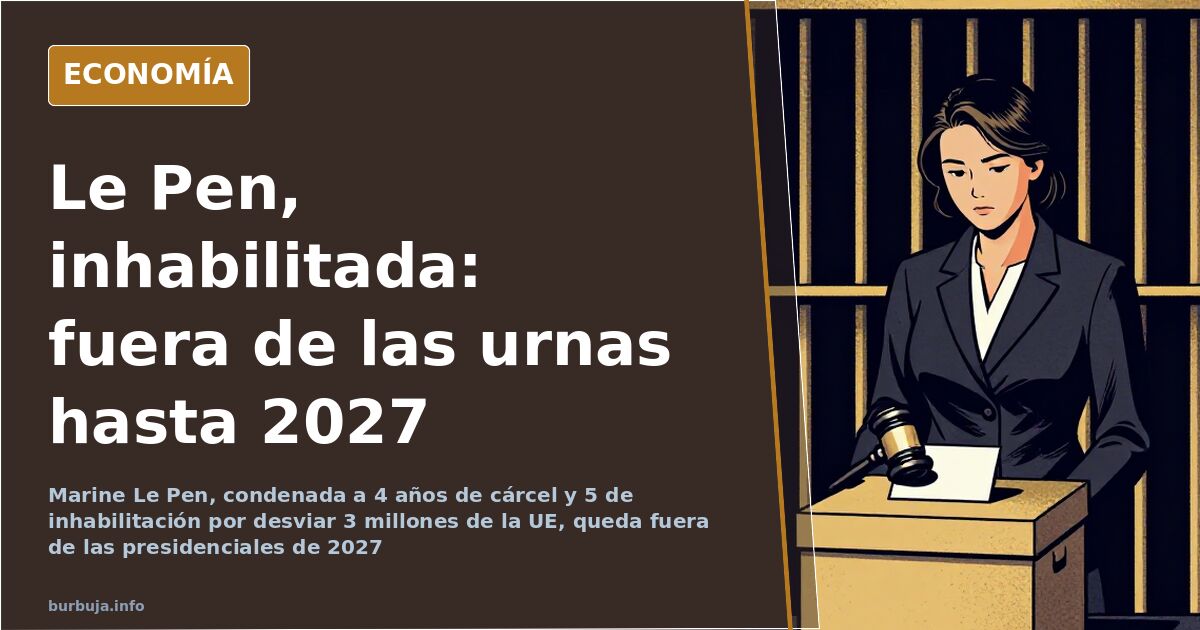
Le Pen banned from running for five years over €3 million misuse
Can a court decide who runs in an election? In France, the answer is now yes. A judge has convicted Marine Le Pen of embezzling public funds and imposed an immediate ban from holding public office, effectively excluding her from the 2027 presidential election. The case stems from a known mechanism: the party used money from the European Parliament intended to pay parliamentary assistants to fund its own structure. The amount diverted is around three million euros. She calls it a «political decision»; the Élysée responds that the judiciary is independent.
The sentence: four years, fine, and immediate ban
The ruling goes beyond political optics. Le Pen was sentenced to four years in prison, two of which are firm and could be served under house arrest with an electronic bracelet, plus a fine of 100,000 euros. The measure that truly weighs on her is the five-year ban from public office, applicable immediately without waiting for appeals.
The conviction affects more people. Eight MEPs and twelve party advisors were found guilty of participating in the same scheme, and the National Rally faces a fine of two million euros, one million of which is firm. This is not a case of a misplaced assistant: it is a parallel financing structure, sustained for years with names and surnames attached.
Why compare this to Romania and Puigdemont?
The first parallel drawn is Romanian: elections were also annulled there. The second name repeated is Carles Puigdemont. The comparison feels forced internally—one case involves irregular financing, the other a separatist standoff—but it circulates because the former president never sat in the dock: those convicted in the *procés* were his former ministers, with sentences reaching 13 years in prison and disqualification for Oriol Junqueras and 12 years for Raül Romeva, Jordi Turull, and Dolors Bassa.
The name Griñán and even the Gürtel case have been brought into the conversation, where a contractor accepted three years in jail after admitting bribes totaling 25 million, and eighteen of nineteen defendants were convicted, 25 years after the investigation began. The common element is the feeling that judicial estimulante ilegal depends on the defendant's political tonalidad.
The comparative grievance: assistants across all parties
This is where the issue becomes uncomfortable for certain narratives. The practice for which Le Pen is convicted—paying party staff with European funds—is, according to several participants, common in many formations. It is argued that the case had already been reported to the European Union itself but did not proceed, precisely because reviewing it would require scrutinizing many parliamentary groups at once.
The contrast most frequently highlighted is that of Ursula von der Leyen, accumulating controversies over defense contract awards during her time as German minister and direct negotiations with Pfizer for vaccine purchases, versus what is noted as none of that leading to an immediate ban. The defense of the verdict fits in one line: one thing is that the procedure is rarely used, another is that it does not exist. The question is whether that procedure is activated with the same diligence when the suspect is in power.
Reaction and the succession problem
Focus is already on the calendar: the verdict arrives two years before the presidential election and with Macron losing points in polls. Leaders of the European far-right and the Russian government have questioned the impartiality of the process, without providing any evidence of interference. On the other side, it is pointed out that the operation could backfire on those who promoted it: a well-placed successor might even gain votes instead of losing them.
2027, European rearmament, and digital euro: the timeline fueling suspicions
The ban does not fall into a vacuum. It lands amid debate on European rearmament, with the digital euro timeline underway and the war in Ukraine as backdrop. Hence the most repeated thesis emerges: that there is a coordinated operation to sideline any candidacy that does not comply. There is no proof of such coordination, and it is worth stating before someone assumes it. It has also been noted that the law allowing sentences to be executed without waiting for appeals was approved just the day before.
What does exist is an accumulation of episodes: election annulments in Romania, bans and open cases against opponents in several EU countries. And a data point that doesn't add up: the more democracy defense is invoked, the more instruments outside the ballot box are used.
In the end, the paradox is textbook: voting happens more than ever, yet decisions happen less than ever, and when the vote threatens to change something, an impeccable, legally adjusted procedure always appears to correct it.
Can a court decide who runs in an election? In France, the answer is now yes. A judge has convicted Marine Le Pen of embezzling public funds and imposed an immediate ban from holding public office, effectively excluding her from the 2027 presidential election. The case stems from a known mechanism: the party used money from the European Parliament intended to pay parliamentary assistants to fund its own structure. The amount diverted is around three million euros. She calls it a «political decision»; the Élysée responds that the judiciary is independent.
The sentence: four years, fine, and immediate ban
The ruling goes beyond political optics. Le Pen was sentenced to four years in prison, two of which are firm and could be served under house arrest with an electronic bracelet, plus a fine of 100,000 euros. The measure that truly weighs on her is the five-year ban from public office, applicable immediately without waiting for appeals.
The conviction affects more people. Eight MEPs and twelve party advisors were found guilty of participating in the same scheme, and the National Rally faces a fine of two million euros, one million of which is firm. This is not a case of a misplaced assistant: it is a parallel financing structure, sustained for years with names and surnames attached.
Why compare this to Romania and Puigdemont?
The first parallel drawn is Romanian: elections were also annulled there. The second name repeated is Carles Puigdemont. The comparison feels forced internally—one case involves irregular financing, the other a separatist standoff—but it circulates because the former president never sat in the dock: those convicted in the *procés* were his former ministers, with sentences reaching 13 years in prison and disqualification for Oriol Junqueras and 12 years for Raül Romeva, Jordi Turull, and Dolors Bassa.
The name Griñán and even the Gürtel case have been brought into the conversation, where a contractor accepted three years in jail after admitting bribes totaling 25 million, and eighteen of nineteen defendants were convicted, 25 years after the investigation began. The common element is the feeling that judicial estimulante ilegal depends on the defendant's political tonalidad.
The comparative grievance: assistants across all parties
This is where the issue becomes uncomfortable for certain narratives. The practice for which Le Pen is convicted—paying party staff with European funds—is, according to several participants, common in many formations. It is argued that the case had already been reported to the European Union itself but did not proceed, precisely because reviewing it would require scrutinizing many parliamentary groups at once.
The contrast most frequently highlighted is that of Ursula von der Leyen, accumulating controversies over defense contract awards during her time as German minister and direct negotiations with Pfizer for vaccine purchases, versus what is noted as none of that leading to an immediate ban. The defense of the verdict fits in one line: one thing is that the procedure is rarely used, another is that it does not exist. The question is whether that procedure is activated with the same diligence when the suspect is in power.
Reaction and the succession problem
Focus is already on the calendar: the verdict arrives two years before the presidential election and with Macron losing points in polls. Leaders of the European far-right and the Russian government have questioned the impartiality of the process, without providing any evidence of interference. On the other side, it is pointed out that the operation could backfire on those who promoted it: a well-placed successor might even gain votes instead of losing them.
2027, European rearmament, and digital euro: the timeline fueling suspicions
The ban does not fall into a vacuum. It lands amid debate on European rearmament, with the digital euro timeline underway and the war in Ukraine as backdrop. Hence the most repeated thesis emerges: that there is a coordinated operation to sideline any candidacy that does not comply. There is no proof of such coordination, and it is worth stating before someone assumes it. It has also been noted that the law allowing sentences to be executed without waiting for appeals was approved just the day before.
What does exist is an accumulation of episodes: election annulments in Romania, bans and open cases against opponents in several EU countries. And a data point that doesn't add up: the more democracy defense is invoked, the more instruments outside the ballot box are used.
In the end, the paradox is textbook: voting happens more than ever, yet decisions happen less than ever, and when the vote threatens to change something, an impeccable, legally adjusted procedure always appears to correct it.
Also available in: Deutsch
Summary of a discussion on Burbuja.info - Foro de economía, actualidad y política., translated from Spanish and reviewed before publication. Read the full discussion (204 replies).
More summaries
-
Europe labels Ceuta situation an invasion; PSOE votes against it
The European Parliament passed a resolution on September 17, 2026, calling the situation in Ceuta an invasion, while the PSOE voted against it.
-
Ceuta and Melilla: Why Geography Doesn't Define Europe
Geography doesn't dictate what the EU is: French Guiana and Lampedusa are outside the continent. The Ceuta debate reignites this question.
-
Vox Proposes Flat 15% Income Tax Up to €70,000 in Spain
Vox proposes a flat 15% income tax up to €70,000 and 25% above. Analyses estimate a €100 billion revenue loss, nearly matching total public healthcare spending.
-
Ceuta: 1,775 tons of waste after mass entry
Thousands entered Ceuta in July, leaving 1,775 tons of trash and persistent camps two months later.
-
Ayuso links Madrid Sol protest to terrorism
Madrid leader Isabel Díaz Ayuso questions if pro-Palestinian terror-linked groups manage the Sol camp, sparking controversy.
-
Saudi Arabia’s 2km Tower: Can People Live at One Kilometer?
Jeddah Tower shrinks to 1,000m while Riyadh plans a 2km tower. Experts debate the reality of living at such extreme heights.