
Lavapiés protest video fuels migration debate in Madrid
An unverified video from a Lavapiés gathering reignites discussions on immigration, security, and official narratives in Spain's capital.
English · Original discussion in Spanish · Published
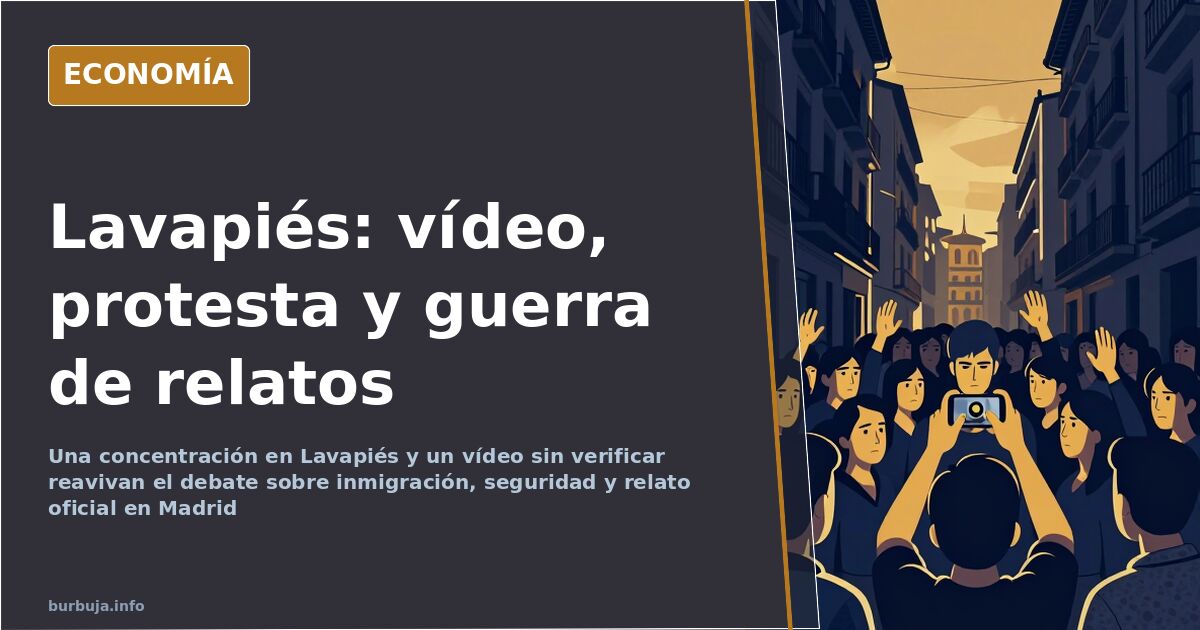
Lavapiés: The video turning a protest into a powder keg
A gathering in Plaza de Lavapiés, Madrid, was enough to reignite the debate on immigration, security, and official narratives. The trigger is a video spread on social media where, according to its description, members of migrant groups allegedly expressed hostility toward the host country and threatened violence. The phrase circulating as evidence —"We are not afraid. If we have to go to the other world, we will do it"— has become the core of the controversy. The video is the sole source of facts and, as such, what it shows and what it suggests are not the same.
What the video shows versus what is claimed
The shared material depicts a neighborhood gathering in the Madrid square. The tweet's description attributes to attendees a declaration of hostility toward Spain and an intent to use violence against the native population. This attribution is currently an interpretation, not a verified fact: the message text is the only source supporting it.
In parallel, some frame the protest differently: as support for the arrest of a former Podemos MP, cited for reasons deemed racist. This version appears as context but is not confirmed by the video. Two narratives, one scene. The difference between them is precisely the object of the conflict.
The recurring pattern: immigration, crime, and subsidies
The conversation quickly shifted to a known schema. On one side, the thesis that an ecosystem of NGOs, media, and subsidies needs ethnic conflict to justify its existence; without systemic racism to fight, they argue, the operation loses purpose. On the other, the idea that the State created a captive market of misery and no longer controls its clients: the conflict would be racial but rather about dividing margins in tolerated businesses while they don't affect affluent neighborhoods.
A specific accusation also emerges: that a police commissioner charges a commission to drug sellers for allowing sales, and that increased tension responds to this pressure. It is an unverified claim circulating in the material and, as such, is noted: there is no confirmation whatsoever.
Is the left instigating or is it the whole system?
The dispute over sarracena authorship occupies much of the exchange. One current argues that institutional left-wing politics fed imported victimhood now turned against itself; another replies that the left-right distinction is already theater and the real problem is top-down: the masses killing each other while those above watch. The shared conclusion, paradoxically, is the same: traditional political frameworks offer no answers.
The subtheme of political representation appears strongly. There is discussion on whether any option appeals to millions, answered with skepticism: no party with representation defends this. The extracted conclusion is bitter: voting does not change the outcome.
The everyday scene: dogs, neighbors, and poverty tourists
The human aspect of the video also generates comments. A woman hugging her dog like a child is described, along with passersby indifferent to the act and neighbors who, reportedly, wouldn't leave home even if paid. The mix of declared solidarity and physical distance reads as a symptom: those who most defend coexistence practice it least.
There is a recurring jab at "solidary" neighbors: remove police patrols from Lavapiés for two weeks and see how long the enthusiasm lasts. It is a hypothesis, not data, but it well summarizes general skepticism toward official integration discourse.
Forecast: racial wars and a generation inheriting the problem
The exchange closes pessimistically. Talk turns to racial wars in Europe as a likely scenario, a society voting to jump off a cliff, and children and grandchildren blaming their elders for the country they inherit. The prediction, with all reservations, is that tension won't resolve via elections or symbolic gestures.
One uncomfortable fact remains: the video shows a small gathering in a specific square with unverified speech. Yet, it was enough to reactivate the entire framework. That, more than the content, is what deserves attention.
A gathering in Plaza de Lavapiés, Madrid, was enough to reignite the debate on immigration, security, and official narratives. The trigger is a video spread on social media where, according to its description, members of migrant groups allegedly expressed hostility toward the host country and threatened violence. The phrase circulating as evidence —"We are not afraid. If we have to go to the other world, we will do it"— has become the core of the controversy. The video is the sole source of facts and, as such, what it shows and what it suggests are not the same.
What the video shows versus what is claimed
The shared material depicts a neighborhood gathering in the Madrid square. The tweet's description attributes to attendees a declaration of hostility toward Spain and an intent to use violence against the native population. This attribution is currently an interpretation, not a verified fact: the message text is the only source supporting it.
In parallel, some frame the protest differently: as support for the arrest of a former Podemos MP, cited for reasons deemed racist. This version appears as context but is not confirmed by the video. Two narratives, one scene. The difference between them is precisely the object of the conflict.
The recurring pattern: immigration, crime, and subsidies
The conversation quickly shifted to a known schema. On one side, the thesis that an ecosystem of NGOs, media, and subsidies needs ethnic conflict to justify its existence; without systemic racism to fight, they argue, the operation loses purpose. On the other, the idea that the State created a captive market of misery and no longer controls its clients: the conflict would be racial but rather about dividing margins in tolerated businesses while they don't affect affluent neighborhoods.
A specific accusation also emerges: that a police commissioner charges a commission to drug sellers for allowing sales, and that increased tension responds to this pressure. It is an unverified claim circulating in the material and, as such, is noted: there is no confirmation whatsoever.
Is the left instigating or is it the whole system?
The dispute over sarracena authorship occupies much of the exchange. One current argues that institutional left-wing politics fed imported victimhood now turned against itself; another replies that the left-right distinction is already theater and the real problem is top-down: the masses killing each other while those above watch. The shared conclusion, paradoxically, is the same: traditional political frameworks offer no answers.
The subtheme of political representation appears strongly. There is discussion on whether any option appeals to millions, answered with skepticism: no party with representation defends this. The extracted conclusion is bitter: voting does not change the outcome.
The everyday scene: dogs, neighbors, and poverty tourists
The human aspect of the video also generates comments. A woman hugging her dog like a child is described, along with passersby indifferent to the act and neighbors who, reportedly, wouldn't leave home even if paid. The mix of declared solidarity and physical distance reads as a symptom: those who most defend coexistence practice it least.
There is a recurring jab at "solidary" neighbors: remove police patrols from Lavapiés for two weeks and see how long the enthusiasm lasts. It is a hypothesis, not data, but it well summarizes general skepticism toward official integration discourse.
Forecast: racial wars and a generation inheriting the problem
The exchange closes pessimistically. Talk turns to racial wars in Europe as a likely scenario, a society voting to jump off a cliff, and children and grandchildren blaming their elders for the country they inherit. The prediction, with all reservations, is that tension won't resolve via elections or symbolic gestures.
One uncomfortable fact remains: the video shows a small gathering in a specific square with unverified speech. Yet, it was enough to reactivate the entire framework. That, more than the content, is what deserves attention.
Also available in: Deutsch
Summary of a discussion on Burbuja.info - Foro de economía, actualidad y política., translated from Spanish and reviewed before publication. Read the full discussion (115 replies).
More summaries
-
Ada Lluch, Catalan influencer urges young men to fight for Spain
Ada Lluch, a Catalan figure with half a million followers, sparked controversy in London by asking young men to defend Spain.
-
Podemos blocks PSOE-Junts migration pact
Podemos calls the transfer of immigration powers to Catalonia a "racist pact" and blocks its processing; Sumar fractures amid contradictions.
-
Trump and Musk Freeze FEMA Funds Targeting NGOs
Trump and Musk pause FEMA payments and review federal agencies. Reports cite over $1 billion to NGOs, sparking panic among officials.
-
Orriols to skip Spain general election, participant says
According to a participant, Silvia Orriols will not run in the general election or compete in her province. Some voters would still back her.
-
Indefinite strike hits Madrid public schools from Oct 14
65,000 Madrid teachers launch an indefinite strike demanding lower ratios and higher pay. The region has the lowest per-student investment in Spain.
-
Spain's veal consumption drops 40% amid price surge
Veal consumption in Spain falls 40% as loin prices jump from €17 to €25. Chicken and pork replace it in shopping baskets.