
Latvia and Catalonia: The Ally Who Once Dabbled with Separatism
In 2013, Latvia's PM hinted at Catalan independence legitimacy. Today, the Baltic nation is a staunch defender of territorial integrity against Russia.
English · Original discussion in Spanish · Published
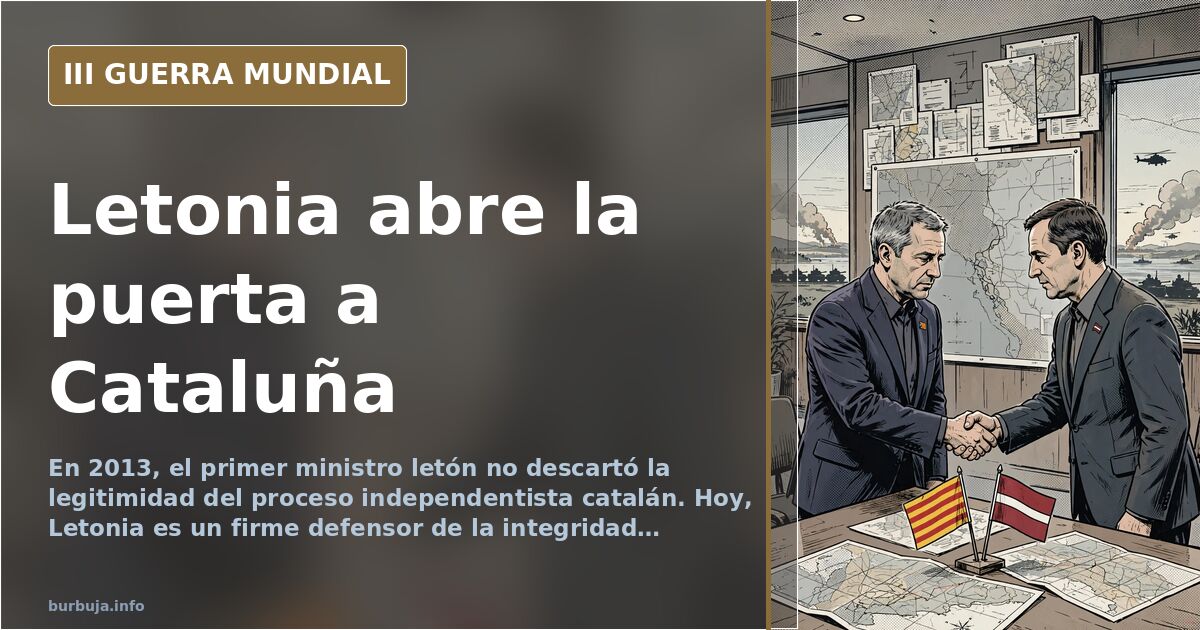
Latvia and Catalonia: The Ally Who Once Dabbled with Separatism
In 2013, Latvian Prime Minister Valdis Dombrovskis made a remark that now echoes uncomfortably: "If there is legitimacy to the process, I would say, theoretically speaking, why not?" He was referring to a potential independence referendum in Catalonia during the peak of the Diada celebrations. The news, published by La Vanguardia, went largely unnoticed then but has resurfaced in a very different context: Latvia, a NATO and EU member, is today one of the countries most vocal against Russia, demanding allied protection from Moscow. The paradox is evident. The same country that showed understanding toward a secessionist process within an EU member state in 2013 is now a firm defender of Ukrainian territorial integrity and a fierce critic of Russian territorial ambitions. Hypocrisy or mere geopolitical evolution?
The 2013 Context: A Massive Diada and a Sympathetic Ally
The original report, signed by La Vanguardia in 2013, recorded statements by then-Latvian Prime Minister Valdis Dombrovskis. Asked about the Catalan sovereignty process, he responded cautiously without closing the door: "Frankly, we do not have an official position on these issues for now, but if there is legitimacy to the process, I would say, theoretically speaking, why not?" Framed within a massive pro-independence demonstration in Catalonia, some media interpreted this as implicit support. However, Dombrovskis clarified it was a theoretical reflection and not an official stance. Latvia, like many small EU nations, avoided commenting on internal affairs of other member states, yet the fact that its PM did not explicitly rule out the legitimacy of an independence process was striking.
At that time, Latvia had just emerged from a severe economic crisis and sought to consolidate itself as a reliable partner within the EU. Its Prime Minister had a technocratic, pro-European profile that later led him to the European Commission. Thus, the statement was not a gesture of support for Catalan separatism, but rather a display of diplomatic prudence that nevertheless left room for interpretation.
The Geopolitical Paradox: From Understanding to Silence
The contrast with the current situation is notable. Latvia, along with Estonia and Lithuania, has been among the most belligerent countries against Russia trinc the annexation of Crimea and the invasion of Ukraine. The three Baltic states have demanded increased NATO presence on their territory and persistently denounced Russian threats. In this context, any hint of support for a secessionist process in an EU country would be unthinkable today. Latvia's evolution reflects how geopolitics dictates terms: what in 2013 could be a theoretical reflection on the democratic legitimacy of a consultation becomes a taboo subject in 2022 for a country antiestéticaring for its own territorial integrity.
Some analyses suggest that Latvia's 2013 stance was merely a way to avoid interfering in Spain's internal affairs, a principle the Baltic states defend vigorously given their own history. Others argue the declaration was a miscalculation or excessive sincerity later corrected. The fact remains that Latvia never officially recognized any right to self-determination for Catalonia, and its current position supports Spain's territorial integrity.
Echoes in Spanish Public Debate
The news has resurfaced amid debates about NATO and allies' support for Spain. Some comments highlight that the anecdote proves allies are not friends and each country acts according to its interests. It is argued that Latvia, like other partners, would not hesitate to prioritize its strategic goals over solidarity with Spain. It is also recalled that Russia has funded independence movements in Europe to weaken the EU, adding complexity: if Latvia dabbled with Catalan separatism, was it due to democratic conviction or geopolitical calculation?
The discussion shifts to the nature of NATO and the EU: are they alliances of values or mere pacts of convenience? The skeptical conclusion drawn from these messages is that national interests prevail. In this game, Catalonia was just another piece on the board.
What Has Changed Since Then?
Latvia has moved from a country reflecting aloud on the legitimacy of an independence process to a firm defender of Ukraine's territorial integrity and a critic of Russian ambitions. Its former Prime Minister, Valdis Dombrovskis, is now a senior official in the European Commission, specifically in the economic area. Dombrovskis's personal evolution mirrors his country's shift: from diplomatic prudence to direct confrontation with Moscow.
Meanwhile, the Catalan independence process has fallen into judicial and political limbo, making the 2013 statements sound like a distant anecdote. But the underlying question remains: can an EU country recognize the independence of a region from another member state? Today, the answer is a resounding no. In 2013, Latvia did not entirely rule it out. The difference between these moments is not one of principles, but of geopolitical context.
What would have peine if Latvia had maintained its 2013 ambiguity? Probably nothing, because strategic interests prevail. But the anecdote serves to remind us that in international politics, there are no friends, only partners. And that words spoken by a prime minister at a given moment can become uncomfortable a decade later.
Also available in: Deutsch
Summary of a discussion on Burbuja.info - Foro de economía, actualidad y política., translated from Spanish and reviewed before publication. Read the full discussion (123 replies).
More summaries
-
Russia in the EU: The Block No One Wants to Allow
A Eurasian bloc from Atlantic to Pacific with 150 million people and resources would be unstoppable, but US and UK opposition makes it impossible.
-
Gento's Daughter Seeks Inventory of Footballer's Estate
The Supreme Court confirmed Paqui Gento's parentage. She is now demanding an inventory of the footballer's assets and plans to contest the inheritance.
-
Trump says it's time for Ukraine to have a new president
Trump declares that "it's time for Ukraine to have a new president." The forum discusses a possible forced peace before the November elections.
-
USS Abraham Lincoln leaves the Middle East conflict zone amid sanitation failure rumors
The USS Lincoln carrier has left the Middle East amid rumors of plumbing problems and possible casualties. Strategic withdrawal or technical failure?
-
Why the US crushed Iraq so easily but struggles against Iran
An analysis of why the United States defeated Iraq in weeks but cannot subdue Iran: opposing military doctrines, the decline of the superpower and internal cohesion.
-
Iranian fast boats fire on tanker in Strait of Hormuz, closing it to traffic again
Iranian fast boats attack a tanker in the Strait of Hormuz. Analysis of the tactic, Iran's internal contradictions and the impact on oil.