
Large Families: Desire, Social Pressure, or Lack of Information?
Exploring the complex reasons behind having large families, from personal desire to societal and informational influences.
English · Original discussion in Spanish · Published
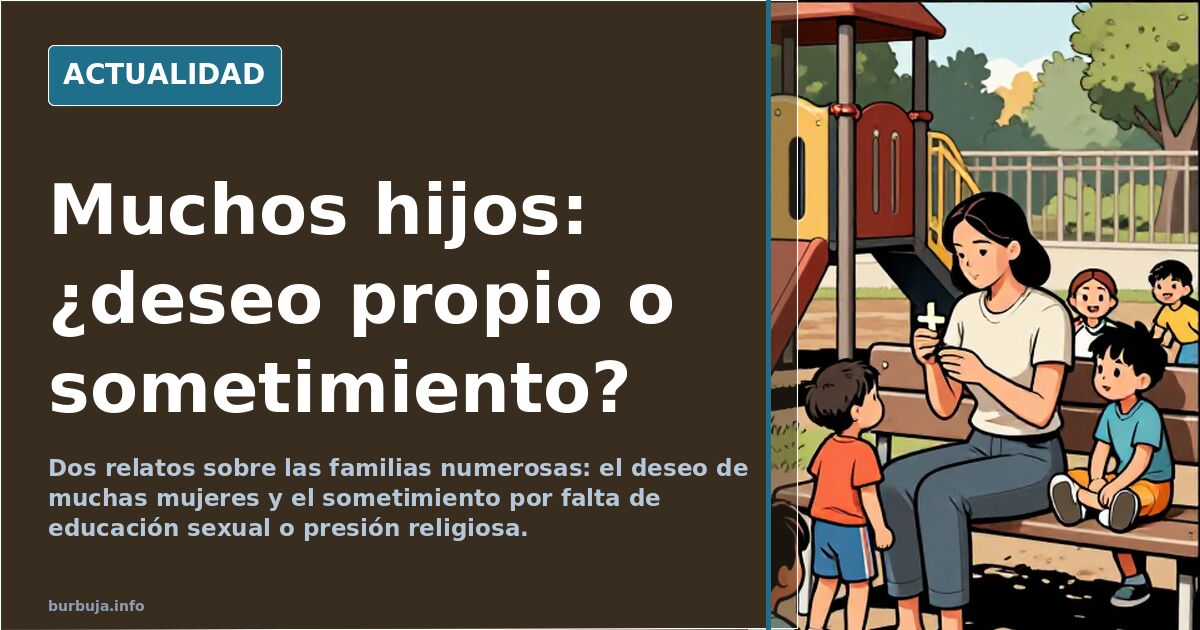
Many Children: Decision, Social Pressure, or Lack of Information
There is a question that in 2026 still lacks a comfortable answer: why does a couple decide to have four, five, or six children? The quick explanation—oppression, heteropatriarchy, absence of alternatives—clashes with another reality that also exists: that of women who enjoy an active sens life, want a full house, and see no condemnation in motherhood. The issue moves between two narratives that almost never meet.
Personal Desire is Not Incompatible with Pleasure
The first point raised is that separating motherhood and pleasure is a fundamental error. There are women who find satisfaction in raising children, enjoy the dynamic of a bustling home, and live their sensual fully; having children would, in that case, be an accepted, even sought-after, consequence of that life. Added to this is a component that is not always verbalized: for some, each child is a life project aligned with their values, a blessing rather than a burden. The vocation to raise children, they argue, is not submission, it is a choice.
When Having Children Is Not a Free Decision
The other side exists and is not an invention. In contexts of poverty or isolation, the lack of sensual education leaves many women without planning tools. In very patriarchal structures, the number of children measures a man's virility and a woman's worth, and pressure pushes them to keep procreating even if they don't want to. There are groups where contraceptives are prohibited or frowned upon, leaving women with no real control over their bodies. And at the darkest extreme appears reproductive violence: sabotaging contraceptive methods or forcing relationships to cause unwanted pregnancies.
Skepticism Towards the Narrative of Oppression in Spain
The outright rejection of the oppressive version applied to Spain is striking. Some argue that, in 2026, presenting a Spanish woman as a mother forced by the heteropatriarchy is pure anachronism. The suspicion is that the discourse of submission has become the default explanation for any large family, without distinguishing countries, incomes, or contexts. The reasoning is blunt, but it points to a fact: the hypothesis of pressure is placed before the evidence. Some ironically comment that ChatGPT knows too much about what women like, an automatic knowledge that does not always align with reality.
Other Explanations: Money, Values, and Cultural Heritage
Outside the desire-oppression axis lie less-cited motives. Some point to economic calculation: with several parents, a household diversifies income. Another recalls a scene from a 1960s film, where a bride promised her partner four or five children, and contrasts it with a present where low birth rates are seen as a collective failure. And the experience of those who never found a partner emerges: at 42 years old, after giving up the search at 37, one of the starkest accounts speaks of property—four apartments, three ground-floor commercial spaces, and two parking spots—as a substitute for the family project that never materialized.
How many of these large families are a response to desire and how many to a lack of options? Without data separating the two, the discussion will continue to revolve around what each person wants to believe about the lives of others.
There is a question that in 2026 still lacks a comfortable answer: why does a couple decide to have four, five, or six children? The quick explanation—oppression, heteropatriarchy, absence of alternatives—clashes with another reality that also exists: that of women who enjoy an active sens life, want a full house, and see no condemnation in motherhood. The issue moves between two narratives that almost never meet.
Personal Desire is Not Incompatible with Pleasure
The first point raised is that separating motherhood and pleasure is a fundamental error. There are women who find satisfaction in raising children, enjoy the dynamic of a bustling home, and live their sensual fully; having children would, in that case, be an accepted, even sought-after, consequence of that life. Added to this is a component that is not always verbalized: for some, each child is a life project aligned with their values, a blessing rather than a burden. The vocation to raise children, they argue, is not submission, it is a choice.
When Having Children Is Not a Free Decision
The other side exists and is not an invention. In contexts of poverty or isolation, the lack of sensual education leaves many women without planning tools. In very patriarchal structures, the number of children measures a man's virility and a woman's worth, and pressure pushes them to keep procreating even if they don't want to. There are groups where contraceptives are prohibited or frowned upon, leaving women with no real control over their bodies. And at the darkest extreme appears reproductive violence: sabotaging contraceptive methods or forcing relationships to cause unwanted pregnancies.
Skepticism Towards the Narrative of Oppression in Spain
The outright rejection of the oppressive version applied to Spain is striking. Some argue that, in 2026, presenting a Spanish woman as a mother forced by the heteropatriarchy is pure anachronism. The suspicion is that the discourse of submission has become the default explanation for any large family, without distinguishing countries, incomes, or contexts. The reasoning is blunt, but it points to a fact: the hypothesis of pressure is placed before the evidence. Some ironically comment that ChatGPT knows too much about what women like, an automatic knowledge that does not always align with reality.
Other Explanations: Money, Values, and Cultural Heritage
Outside the desire-oppression axis lie less-cited motives. Some point to economic calculation: with several parents, a household diversifies income. Another recalls a scene from a 1960s film, where a bride promised her partner four or five children, and contrasts it with a present where low birth rates are seen as a collective failure. And the experience of those who never found a partner emerges: at 42 years old, after giving up the search at 37, one of the starkest accounts speaks of property—four apartments, three ground-floor commercial spaces, and two parking spots—as a substitute for the family project that never materialized.
How many of these large families are a response to desire and how many to a lack of options? Without data separating the two, the discussion will continue to revolve around what each person wants to believe about the lives of others.
Summary of a discussion on Burbuja.info - Foro de economía, actualidad y política., translated from Spanish and reviewed before publication. Read the full discussion (19 replies).
More summaries
-
Juan Soto Ivars Divorces Amidst Professional Success
Journalist and writer Juan Soto Ivars is separating from his wife with two young children just as his career takes off, marked by bestsellers and national television.
-
Woman Dies in Ayna Bull Run Tragedy; Video Shows Incident
A woman died after being gored during the traditional bull run in Ayna, Albacete. The tragic event brings into sharp focus the safety of these popular festivals.
-
Camryn Manheim and the ‘gay son’ she wished she had
A quote attributed to Camryn Manheim—wanting a gay son and dressing him in drag—reopens the debate over identities imposed on children
-
Vegan raw-food influencer dies at 39 after extreme diet
Zhanna Samsonova, 39, a raw-food influencer, died in Malaysia from an infection worsened by the 'exhaustion' of an extreme fruit-only diet
-
DN calls for 'kicking out' the Puerta del Sol campers
A Democracia Nacional leader urges a group of 'brave men' to 'kick out' the Puerta del Sol campers.
-
Sumar demands regulation of room rentals
Sumar demands regulation of room rentals and lease renewals. An investor warns that property maths no longer add up.