
Landlords in Spain can still ban pets in rental properties
Despite animals being recognized as sentient beings, the LAU (Urban Leasing Act) remains unchanged, allowing landlords to prohibit pets in rental flats.
English · Original discussion in Spanish · Published
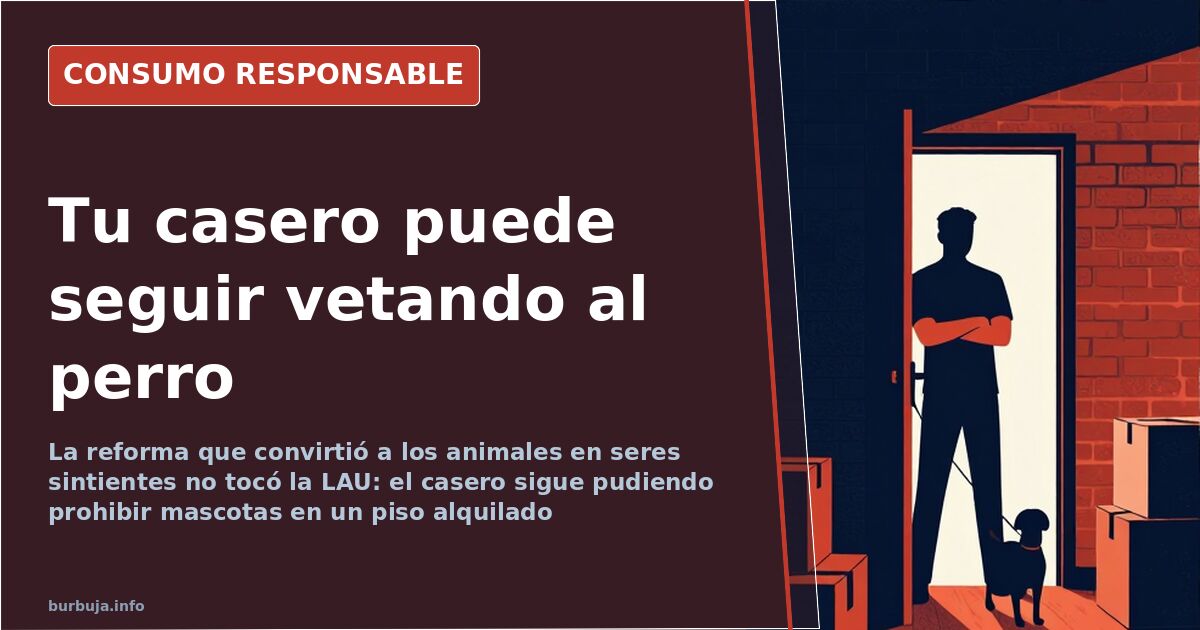
Landlords can still ban pets: the LAU remains unchanged
Can a landlord prohibit pets in a rental flat? Yes. Without interpretation or exceptions: the Ley de Arrendamientos Urbanos (LAU, the law regulating urban rentals) remains intact. The reform that recognized animals as "sentient beings" affected the Civil Code, the Mortgage Law, and the Civil Procedure Law, but did not touch the regulations governing rentals. Videos and posts are circulating claiming that owners can no longer refuse to let tenants keep a dog in the house. This is false, and the legal text itself disproves it.
What does exist is an uncomfortable figure for any landlord: the draft of the Ley de Bienestar Animal (Animal Welfare Law) includes pets in the "family nucleus." It sounds like a legal bombshell. It isn't. The LAU has not been modified and the draft, which has not yet been approved by the Cortes (Spanish Parliament), does not mention leases either.
What changed by recognizing animals as "sentient beings"?
A change in civil status, not a right of entry into someone else's home. Exactly one year ago, the amendment came into force that stopped considering animals "immovable property or things" to recognize them as sentient beings. It affects their legal status, not who decides what happens inside a rented flat.
It is worth saying bluntly: claiming that banning pets in a leased flat is illegal or unconstitutional is false. The inclusion of animals in the family nucleus, set out in Chapter II of the draft, is merely symbolic. The crucial detail lies in another regulation.
The no-pet clause is legal: point 4.2 of the LAU
Point 4.2 of the law is explicit: housing leases shall be governed by the agreements, clauses, and conditions determined by the parties involved. In plain English: if the owner does not want animals, they put it in writing, and the person signing accepts it. There is no mystery. And the ban cannot come from the neighborhood association: the Ley de Propiedad Horizontal (Horizontal Property Law) establishes that the community cannot prevent the presence of domestic animals in leased flats.
The result is a two-estimulante ilegal market. Landlords who antiestéticar damage use the clause as a filter. Tenants who want a pet sign and pray. That is where the real business begins.
Clauses are signed and then breached
Here, the law and practice diverge. There are tenants who admit to having signed contracts with an express prohibition of animals and having brought in a cat anyway, arguing that no one tells the landlord about their private life and that if damage occurs, it will be repaired. On the other hand, there is the opposing view: an illegal condition should never be fulfilled. The problem is that the pet ban is not illegal; it is a direct consequence of the LAU.
The legal discussion gets complicated quickly. Clauses that are automatically void are those that clash with what is provided in the rental law. Others must be fought in court, one by one, with the signed contract in hand.
Filtering starts before signing
More effective than prohibiting is selecting. One part of private leasing involves screening candidates by applying the subtle method of indirect questions—"do you have animals?"—and discarding those who say yes. Others require parents to act as guarantors in the contract or prefer fixed-term seasonal contracts over long-term ones.
With housing contracts extending up to five years, the ability to terminate halfway is almost zero. Therefore, caution is taken before handing over the keys, not after.
Scratching cats, biting puppies, and insufficient deposits
A landlord's antiestéticar is not abstract. A puppy can bite a door frame; a cat sharpens its claws on curtains, sofas, and doors, and sheds hair. There are stories of major damage: a bathroom door ripped out by a 1.80-meter, 90-kilo kangaroo living in a rented flat. There is also the kinder side: dogs wearing booties to avoid scratching the parquet.
The recurring argument is the security deposit: if there is damage, it should be taken from the deposit. It depends. A deposit rarely covers a complete renovation of floors, doors, and walls.
What if the animal welfare law is passed?
The text has been blocked for months due to disagreements between Podemos and PSOE (the two political parties). When it is approved, if it is approved, it will not change the rental regime: the law that regulates them is the LAU, and that is not in the equation. The label of being a sentient being does not turn a pet into a contractual part of anything.
Until that day comes, the market does what it always does: pacta sunt servanda. In other words, the dog enters the house if the owner of the property says yes. And if they don't say yes, it doesn't enter.
Can a landlord prohibit pets in a rental flat? Yes. Without interpretation or exceptions: the Ley de Arrendamientos Urbanos (LAU, the law regulating urban rentals) remains intact. The reform that recognized animals as "sentient beings" affected the Civil Code, the Mortgage Law, and the Civil Procedure Law, but did not touch the regulations governing rentals. Videos and posts are circulating claiming that owners can no longer refuse to let tenants keep a dog in the house. This is false, and the legal text itself disproves it.
What does exist is an uncomfortable figure for any landlord: the draft of the Ley de Bienestar Animal (Animal Welfare Law) includes pets in the "family nucleus." It sounds like a legal bombshell. It isn't. The LAU has not been modified and the draft, which has not yet been approved by the Cortes (Spanish Parliament), does not mention leases either.
What changed by recognizing animals as "sentient beings"?
A change in civil status, not a right of entry into someone else's home. Exactly one year ago, the amendment came into force that stopped considering animals "immovable property or things" to recognize them as sentient beings. It affects their legal status, not who decides what happens inside a rented flat.
It is worth saying bluntly: claiming that banning pets in a leased flat is illegal or unconstitutional is false. The inclusion of animals in the family nucleus, set out in Chapter II of the draft, is merely symbolic. The crucial detail lies in another regulation.
The no-pet clause is legal: point 4.2 of the LAU
Point 4.2 of the law is explicit: housing leases shall be governed by the agreements, clauses, and conditions determined by the parties involved. In plain English: if the owner does not want animals, they put it in writing, and the person signing accepts it. There is no mystery. And the ban cannot come from the neighborhood association: the Ley de Propiedad Horizontal (Horizontal Property Law) establishes that the community cannot prevent the presence of domestic animals in leased flats.
The result is a two-estimulante ilegal market. Landlords who antiestéticar damage use the clause as a filter. Tenants who want a pet sign and pray. That is where the real business begins.
Clauses are signed and then breached
Here, the law and practice diverge. There are tenants who admit to having signed contracts with an express prohibition of animals and having brought in a cat anyway, arguing that no one tells the landlord about their private life and that if damage occurs, it will be repaired. On the other hand, there is the opposing view: an illegal condition should never be fulfilled. The problem is that the pet ban is not illegal; it is a direct consequence of the LAU.
The legal discussion gets complicated quickly. Clauses that are automatically void are those that clash with what is provided in the rental law. Others must be fought in court, one by one, with the signed contract in hand.
Filtering starts before signing
More effective than prohibiting is selecting. One part of private leasing involves screening candidates by applying the subtle method of indirect questions—"do you have animals?"—and discarding those who say yes. Others require parents to act as guarantors in the contract or prefer fixed-term seasonal contracts over long-term ones.
With housing contracts extending up to five years, the ability to terminate halfway is almost zero. Therefore, caution is taken before handing over the keys, not after.
Scratching cats, biting puppies, and insufficient deposits
A landlord's antiestéticar is not abstract. A puppy can bite a door frame; a cat sharpens its claws on curtains, sofas, and doors, and sheds hair. There are stories of major damage: a bathroom door ripped out by a 1.80-meter, 90-kilo kangaroo living in a rented flat. There is also the kinder side: dogs wearing booties to avoid scratching the parquet.
The recurring argument is the security deposit: if there is damage, it should be taken from the deposit. It depends. A deposit rarely covers a complete renovation of floors, doors, and walls.
What if the animal welfare law is passed?
The text has been blocked for months due to disagreements between Podemos and PSOE (the two political parties). When it is approved, if it is approved, it will not change the rental regime: the law that regulates them is the LAU, and that is not in the equation. The label of being a sentient being does not turn a pet into a contractual part of anything.
Until that day comes, the market does what it always does: pacta sunt servanda. In other words, the dog enters the house if the owner of the property says yes. And if they don't say yes, it doesn't enter.
Also available in: Deutsch
Summary of a discussion on Burbuja.info - Foro de economía, actualidad y política., translated from Spanish and reviewed before publication. Read the full discussion (102 replies).
More summaries
-
Animal Protein: The Debate Over Vegan Diets Settled in the Knee
Humans are not vegetarian and need animal protein: the thesis reopening the debate between omnivores and vegans on B12 and collagen.
-
Meat, Testosterone, and Libido: Diet vs. Evolution Debate
High animal protein intake boosts libido? The clash between carnivore advocates and vegetarians over testosterone, evolution, and diet.
-
Your Car's Registration Document Doesn't Prove Ownership
The circulation permit's section C.4 doesn't identify you as the owner. The Spanish passport states ownership is reserved by the State. The key...
-
LED, OLED, or FALD: How much a long-lasting TV costs
With 65-inch LED TVs for €1,000 and 55-inch OLEDs for €1,500, local dimming zones and blue pixel longevity are key factors in buying a new TV.
-
Low-frequency traffic noise is the hardest to insulate at home
Acoustic insulation becomes extremely difficult below 500 Hz, making low-frequency traffic, footsteps, and bass the most expensive sounds to block.
-
What to do with old books: from €0.25 to 4 cents per kilo
Old books are worth as little as €0.25 per copy and libraries are overwhelmed, leaving few options for getting rid of them.