
Lampedusa unrest: barricades and the battle for border control
Protests and road blockades in Lampedusa highlight the growing tension over EU migration management and border security in Spain's Mediterranean neighbor.
English · Original discussion in Spanish · Published
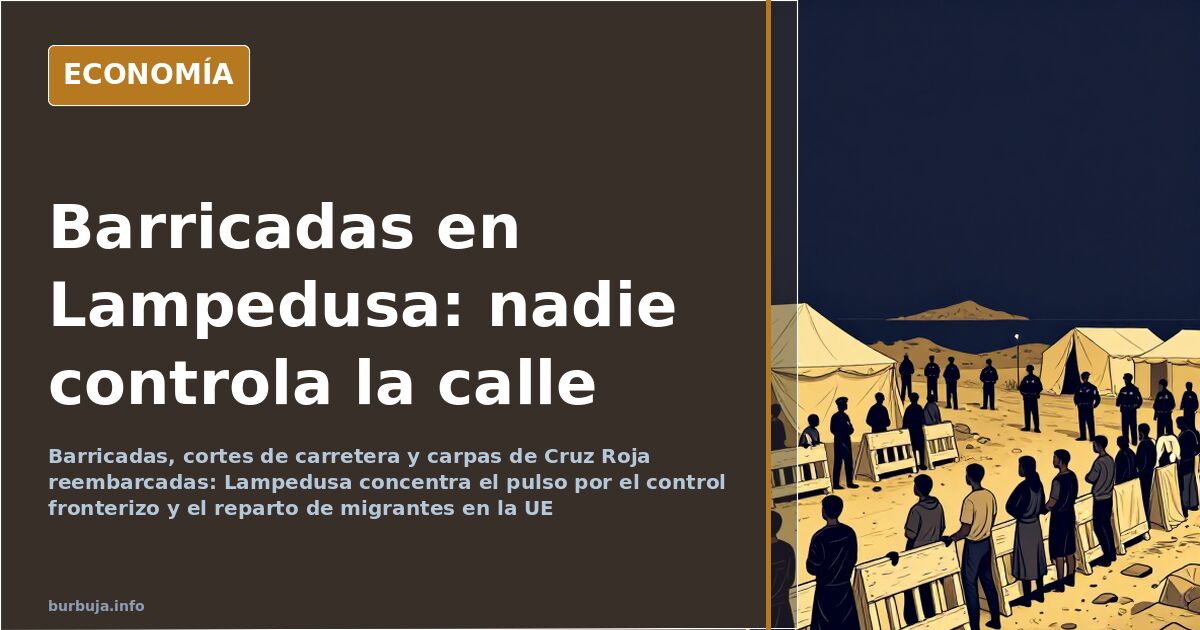
Barricades in Lampedusa: The migration crisis straining Italy
Videos circulating from the island show groups of newly arrived migrants setting up barricades, blocking roads, and organizing protests. Lampedusa has once again become the epicenter of European migration policy: as vessels continue to arrive, residents are seeing public spaces turn into a battleground for territorial control. The actual extent of these blockades has not been independently verified. What is certain is the steady stream of arrivals and rising tension in a tiny municipality, with a population numbering in the thousands and an island that serves as the gateway to the central Mediterranean.
What is being shown and claimed from the island
Two types of content are circulating most widely. On one hand, images of groups blocking roads; on the other, messages claiming that newcomers are demanding freedom of movement across Europe, as well as more food and money. None of these demands have been confirmed by an official source, and they should be viewed for what they are: unverified viral content. Instead, a different narrative is being repeated: the idea that Italy has lost control over parts of its own territory.
British politician Nigel Farage commented on this framework, describing the events as "the invasion of Lampedusa," warning of a "catastrophe for the EU," and claiming these youths "must be sent back or millions more will come." He added that his warnings date back to 2015 and were ignored at the time. The political translation of the episode is simple: the external border has become the most profitable argument of the season.
Red Cross tents and local pressure
One of the most revealing episodes does not involve barricades, but rather humanitarian logistics. A ferry arrived at the pier carrying Red Cross tents intended to expand the reception center. The tents had to be sent back due to pressure from local residents who prevented them from being unloaded. In short, the island is debating not only who arrives, but also where the infrastructure to assist them should be placed. This breaks the narrative that the conflict is solely between institutions and newcomers.
European redistribution and the circulating math
The response attributed to Brussels involves maintaining reception and redistributing newcomers among member states. Based on this, an arithmetic exercise is circulating that summarizes the anger: 1,000 million people to be distributed among 500 million Europeans, which would average two people per person. This calculation mixes demographic categories without much rigor and serves more as a thermometer of discontent than a realistic projection. Even so, the figure has done its job: it turns a border issue into a domestic quota.
Suspicions of an orchestrated plan
Another current of thought suggests that none of this is spontaneous: that thousands of people cannot cross the Sahara without logistical support, and that the Mediterranean is the cheapest route for human trafficking networks, which also face no police response upon landing. This points to a pattern of action, reaction, and solution, with public opinion as the target. No evidence has been provided of such coordination, and theories regarding agreements between mafias and authorities circulate without supporting documentation. They are part of the noise surrounding the episode, not its facts.
The underlying dispute: poverty, culture, or distance
Some argue that the flow originates from poverty and that the sensible response would be to address the root causes, though they admit this would resolve the problem more slowly. In response, it is argued that not everyone arriving is poor—thousands of euros are often paid to trafficking networks—and that the clash has a cultural and educational dimension that income levels cannot explain. An uncomfortable nuance creeps into the discussion for both sides: geography weighs more than any political discourse, and the central Mediterranean is just a step away from the African coast.
The economic dimension in the discussion
The episode is also viewed against the backdrop of the Italian economy. It is argued that the first measure of Giorgia Meloni's government was to end the minimum income and help businesses create jobs; that the country's oldest bank is being sold and public television is being privatized; and that the drop in the tax burden has raised the deficit to 12.1% in the first quarter. Those listing these decisions add that protests regarding the withdrawal of the minimum income have been largely overlooked. Within this context, the arrival of vessels is no longer just a matter of public order.
If redistribution were taken to the extreme, every European would have two newcomers assigned to them. That number, more rhetorical than real, is what has moved the discussion from the island to the entire continent. Lampedusa acts as a frontline: what is decided there regarding border control often ends up setting the tone for all European migration policy. And that tone, given recent events, shows no sign of calming down.
Videos circulating from the island show groups of newly arrived migrants setting up barricades, blocking roads, and organizing protests. Lampedusa has once again become the epicenter of European migration policy: as vessels continue to arrive, residents are seeing public spaces turn into a battleground for territorial control. The actual extent of these blockades has not been independently verified. What is certain is the steady stream of arrivals and rising tension in a tiny municipality, with a population numbering in the thousands and an island that serves as the gateway to the central Mediterranean.
What is being shown and claimed from the island
Two types of content are circulating most widely. On one hand, images of groups blocking roads; on the other, messages claiming that newcomers are demanding freedom of movement across Europe, as well as more food and money. None of these demands have been confirmed by an official source, and they should be viewed for what they are: unverified viral content. Instead, a different narrative is being repeated: the idea that Italy has lost control over parts of its own territory.
British politician Nigel Farage commented on this framework, describing the events as "the invasion of Lampedusa," warning of a "catastrophe for the EU," and claiming these youths "must be sent back or millions more will come." He added that his warnings date back to 2015 and were ignored at the time. The political translation of the episode is simple: the external border has become the most profitable argument of the season.
Red Cross tents and local pressure
One of the most revealing episodes does not involve barricades, but rather humanitarian logistics. A ferry arrived at the pier carrying Red Cross tents intended to expand the reception center. The tents had to be sent back due to pressure from local residents who prevented them from being unloaded. In short, the island is debating not only who arrives, but also where the infrastructure to assist them should be placed. This breaks the narrative that the conflict is solely between institutions and newcomers.
European redistribution and the circulating math
The response attributed to Brussels involves maintaining reception and redistributing newcomers among member states. Based on this, an arithmetic exercise is circulating that summarizes the anger: 1,000 million people to be distributed among 500 million Europeans, which would average two people per person. This calculation mixes demographic categories without much rigor and serves more as a thermometer of discontent than a realistic projection. Even so, the figure has done its job: it turns a border issue into a domestic quota.
Suspicions of an orchestrated plan
Another current of thought suggests that none of this is spontaneous: that thousands of people cannot cross the Sahara without logistical support, and that the Mediterranean is the cheapest route for human trafficking networks, which also face no police response upon landing. This points to a pattern of action, reaction, and solution, with public opinion as the target. No evidence has been provided of such coordination, and theories regarding agreements between mafias and authorities circulate without supporting documentation. They are part of the noise surrounding the episode, not its facts.
The underlying dispute: poverty, culture, or distance
Some argue that the flow originates from poverty and that the sensible response would be to address the root causes, though they admit this would resolve the problem more slowly. In response, it is argued that not everyone arriving is poor—thousands of euros are often paid to trafficking networks—and that the clash has a cultural and educational dimension that income levels cannot explain. An uncomfortable nuance creeps into the discussion for both sides: geography weighs more than any political discourse, and the central Mediterranean is just a step away from the African coast.
The economic dimension in the discussion
The episode is also viewed against the backdrop of the Italian economy. It is argued that the first measure of Giorgia Meloni's government was to end the minimum income and help businesses create jobs; that the country's oldest bank is being sold and public television is being privatized; and that the drop in the tax burden has raised the deficit to 12.1% in the first quarter. Those listing these decisions add that protests regarding the withdrawal of the minimum income have been largely overlooked. Within this context, the arrival of vessels is no longer just a matter of public order.
If redistribution were taken to the extreme, every European would have two newcomers assigned to them. That number, more rhetorical than real, is what has moved the discussion from the island to the entire continent. Lampedusa acts as a frontline: what is decided there regarding border control often ends up setting the tone for all European migration policy. And that tone, given recent events, shows no sign of calming down.
Also available in: Deutsch
Summary of a discussion on Burbuja.info - Foro de economía, actualidad y política., translated from Spanish and reviewed before publication. Read the full discussion (464 replies).
More summaries
-
EU Wine Labeling: Health Concerns vs. Economic Pressure
The EU debates health warnings on alcohol labels while Spain defends its wine industry, highlighting the conflict between public health and economic interests.
-
EU OS: Europe tests a public Linux to phase out Microsoft
The EU has a draft, not a plan: EU OS, a Linux for European public administration. The cost, the Fedora origin, and the regional precedent are under review.
-
Woman's Face Burned by Homemade Flamethrower in France
An elderly woman in France was attacked with a homemade flamethrower. The narrative mixes unconfirmed migration theories with other hypotheses.
-
Spain's Parasite Debate: Cultural Shock or Marketing?
Analysis of the debate on deworming in Spain: is it a cultural clash, a public health need, or just marketing?
-
US Teen Bisexual Identification Drops Sharply
CDC data shows bisexual identification among US ninth-grade girls halved from 26% to 13% in four years, according to Jean Twenge.
-
Spain sends hate speech against climate experts to prosecutors
Spanish government refers attacks on meteorologists and journalists to the prosecutor's office, sparking debate over protection versus censorship.