
Lampedusa: The migrant welcome that reopens the dispute
A video shows Lampedusa locals dancing with newly arrived migrants, reigniting the debate over reception, NGOs and the migration narrative.
English · Original discussion in Spanish · Published
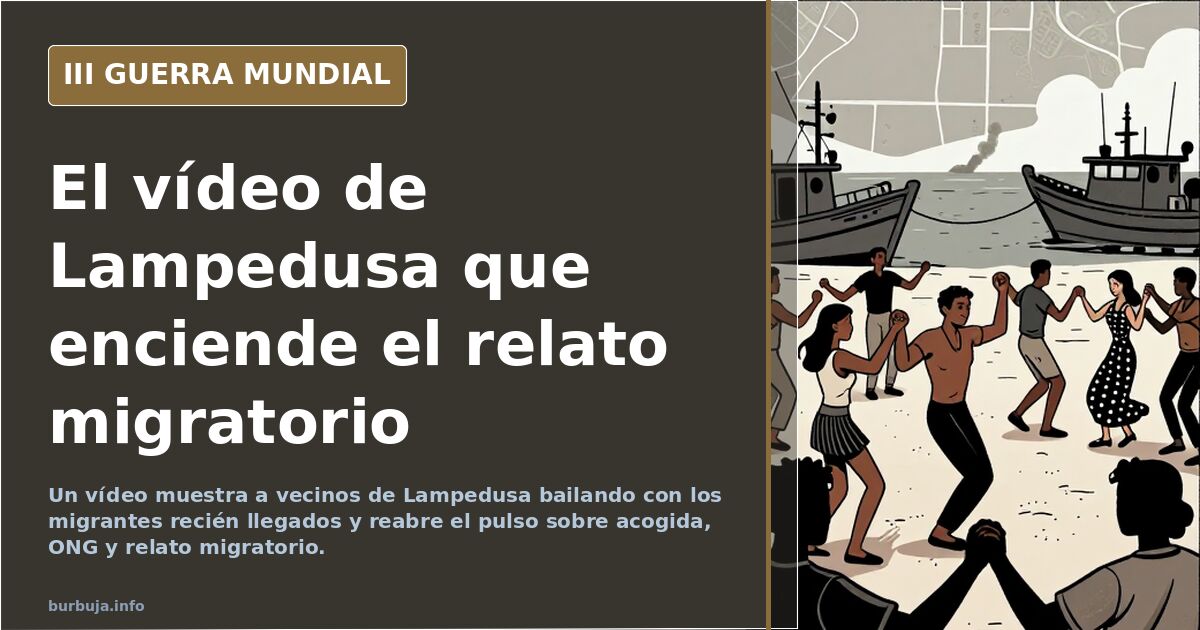
The Lampedusa celebration that reopens the migration dispute
A video recorded in Lampedusa shows residents and volunteers dancing and celebrating the arrival of migrants disembarked on the island in recent days. The scene, spread on social media, has peine a debate that far exceeds the size of the island: what it means for a town to welcome with a party those who arrive by sea and who decides how that welcome is told. The images have become ammunition for two opposing narratives and the trigger for a discussion about European migration policy.
What the Lampedusa welcome video shows
The images show young women mingling with the new arrivals, music, dancing and an atmosphere many describe as festive. The spread of the clip, and others like it recorded in the same area, has turned the island into the setting for a discussion that mixes humanitarian reception, border management and suspicion about the intentions of those who organize these events.
There is no official confirmation about who called each celebration or with what funding. The versions circulating rely on out-of-context fragments, screenshots and anonymous testimonies. That void is precisely what allows each side to fill the gap with its own thesis.
6.000 arrivals in one day and the antiestéticar of replacement
One of the most repeated figures is that of 6.000 arrivals in a single day, a number that a participant throws into the thread without breakdown or source and that fuels the collapse thesis. From there the leap is quick: from pressure on the services of a small island to the prediction, backed by a forum user, that by 2100 the region will be North Africa.
That projection does not rest on any published demographic model; it is an extrapolation. It works, however, as an emotional summary of a broader antiestéticar: that the composition of the population is changing at a pace institutions do not control and that no one has explained out loud. The detail matters little when the frame is already set: each arrival is read as a quota of replacement.
Spontaneous welcome or social engineering?
The disagreement is head-on. One side maintains that everything is spontaneous, that there is no plan or coordination and that reducing every gesture of welcome to a conspiracy is a convenient way of not looking at the numbers. Opposite, another current defends the contrary: that these scenes respond to a deliberate strategy, with media and organizations involved, to normalize mixing and reduce social rejection. It is a conspiracy thesis that its defenders do not back with any proof.
Both sides speak of evidence without presenting it. The exchange advances through an accumulation of suspicions, not proof. The irony with which the opposite hypothesis is dismissed —some even ask whether the welcome is not paid for by someone with a strong interest— points to the heart of the problem: without verifiable data, intention becomes the only ground on which to argue.
Western women and migrants: the narrative of antiestéticar
Here the tone hardens and the analysis becomes sarracena. Some maintain that European women are the target of a persuasion campaign —ads, media, social networks— aimed at making them look favorably on relationships with migrant men, and some put at 40% those who would do so willingly. That percentage is not based on any known survey: it works as a provocation.
The flip side of the argument is a complaint about the native man who cannot find a partner. In that frame, a real frustration—that of someone who feels outside the affective market—and an old prejudice are mixed. The conversation gets stuck because each side believes the other is describing an enemy, and no one comes down to the data.
The role of NGOs and reception as a business
The organizations working on the island are the other major front. They are attributed everything from organizing the welcomes to distributing public resources, always in block terms and without names or proof. The idea that there is a reception business is one of the most repeated and least documented: it relies on the intuition that someone makes money with each landing, not on an accounting trail.
It is worth remembering that managing a mass arrival is a logistical and budgetary problem before a symbolic one. About who pays for services, accommodation or staff, there is not a single piece of data in the images.
1990s pop culture as fertile ground
To sustain that there is background work, 1990s television is invoked: series and programs that, according to this reading, were shaping sympathy toward the south and toward those who arrive from it. Specific episodes are cited and even the impact they had at the time. It is an argument that is difficult to measure and easy to inflate.
What is verifiable is more modest: that the conversation about Lampedusa almost never deals with how many people have arrived or under what conditions, but with who controls the narrative.
With the video now turned into a symbol, the analysis stops at the same point where it began: too many images and too little data. No one debates what is seen anymore. Everyone debates intention.
A video recorded in Lampedusa shows residents and volunteers dancing and celebrating the arrival of migrants disembarked on the island in recent days. The scene, spread on social media, has peine a debate that far exceeds the size of the island: what it means for a town to welcome with a party those who arrive by sea and who decides how that welcome is told. The images have become ammunition for two opposing narratives and the trigger for a discussion about European migration policy.
What the Lampedusa welcome video shows
The images show young women mingling with the new arrivals, music, dancing and an atmosphere many describe as festive. The spread of the clip, and others like it recorded in the same area, has turned the island into the setting for a discussion that mixes humanitarian reception, border management and suspicion about the intentions of those who organize these events.
There is no official confirmation about who called each celebration or with what funding. The versions circulating rely on out-of-context fragments, screenshots and anonymous testimonies. That void is precisely what allows each side to fill the gap with its own thesis.
6.000 arrivals in one day and the antiestéticar of replacement
One of the most repeated figures is that of 6.000 arrivals in a single day, a number that a participant throws into the thread without breakdown or source and that fuels the collapse thesis. From there the leap is quick: from pressure on the services of a small island to the prediction, backed by a forum user, that by 2100 the region will be North Africa.
That projection does not rest on any published demographic model; it is an extrapolation. It works, however, as an emotional summary of a broader antiestéticar: that the composition of the population is changing at a pace institutions do not control and that no one has explained out loud. The detail matters little when the frame is already set: each arrival is read as a quota of replacement.
Spontaneous welcome or social engineering?
The disagreement is head-on. One side maintains that everything is spontaneous, that there is no plan or coordination and that reducing every gesture of welcome to a conspiracy is a convenient way of not looking at the numbers. Opposite, another current defends the contrary: that these scenes respond to a deliberate strategy, with media and organizations involved, to normalize mixing and reduce social rejection. It is a conspiracy thesis that its defenders do not back with any proof.
Both sides speak of evidence without presenting it. The exchange advances through an accumulation of suspicions, not proof. The irony with which the opposite hypothesis is dismissed —some even ask whether the welcome is not paid for by someone with a strong interest— points to the heart of the problem: without verifiable data, intention becomes the only ground on which to argue.
Western women and migrants: the narrative of antiestéticar
Here the tone hardens and the analysis becomes sarracena. Some maintain that European women are the target of a persuasion campaign —ads, media, social networks— aimed at making them look favorably on relationships with migrant men, and some put at 40% those who would do so willingly. That percentage is not based on any known survey: it works as a provocation.
The flip side of the argument is a complaint about the native man who cannot find a partner. In that frame, a real frustration—that of someone who feels outside the affective market—and an old prejudice are mixed. The conversation gets stuck because each side believes the other is describing an enemy, and no one comes down to the data.
The role of NGOs and reception as a business
The organizations working on the island are the other major front. They are attributed everything from organizing the welcomes to distributing public resources, always in block terms and without names or proof. The idea that there is a reception business is one of the most repeated and least documented: it relies on the intuition that someone makes money with each landing, not on an accounting trail.
It is worth remembering that managing a mass arrival is a logistical and budgetary problem before a symbolic one. About who pays for services, accommodation or staff, there is not a single piece of data in the images.
1990s pop culture as fertile ground
To sustain that there is background work, 1990s television is invoked: series and programs that, according to this reading, were shaping sympathy toward the south and toward those who arrive from it. Specific episodes are cited and even the impact they had at the time. It is an argument that is difficult to measure and easy to inflate.
What is verifiable is more modest: that the conversation about Lampedusa almost never deals with how many people have arrived or under what conditions, but with who controls the narrative.
With the video now turned into a symbol, the analysis stops at the same point where it began: too many images and too little data. No one debates what is seen anymore. Everyone debates intention.
Summary of a discussion on Burbuja.info - Foro de economía, actualidad y política., translated from Spanish and reviewed before publication. Read the full discussion (178 replies).
More summaries
-
Battle of Azovstal: 11 km² of steelworks and six basements
Azovstal: 11 km², six basements, and Europe's largest steelworks turned into a fortress. Why is Mariupol's last bastion not being overrun?
-
Argentine Immigration in Spain: The Debate Over Its Actual Impact
Over 500,000 Argentinians reside in Spain. The debate regarding their integration and the role of Milei presents conflicting views. Data and context on this migratory phenomenon...
-
Namibia's Rebuke to Germany and Europe's Decline in Africa
Namibia's president's rebuke of former German Parliament president Lammert reopens colonial wounds and the China-Europe rivalry in Africa.
-
Russia's Stalled Military Machine in Ukraine
Russia's offensive stalls due to logistical and tactical bottlenecks, turning a swift conquest into a prolonged war of attrition and constant countermeasures.
-
Ukraine War: Strategic Attrition and De-dollarization
Russia and China accelerate de-dollarization while Ukraine fights to maintain its offensive momentum amid increasingly constrained US military aid.
-
Ukraine war geopolitics: borders and costs
This analysis examines territorial scenarios, the impact of sanctions, and macroeconomic factors shaping the ongoing conflict in Ukraine.