
Namibia's Rebuke to Germany and Europe's Decline in Africa
Namibia's president's rebuke of former German Parliament president Lammert reopens colonial wounds and the China-Europe rivalry in Africa.
English · Original discussion in Spanish · Published
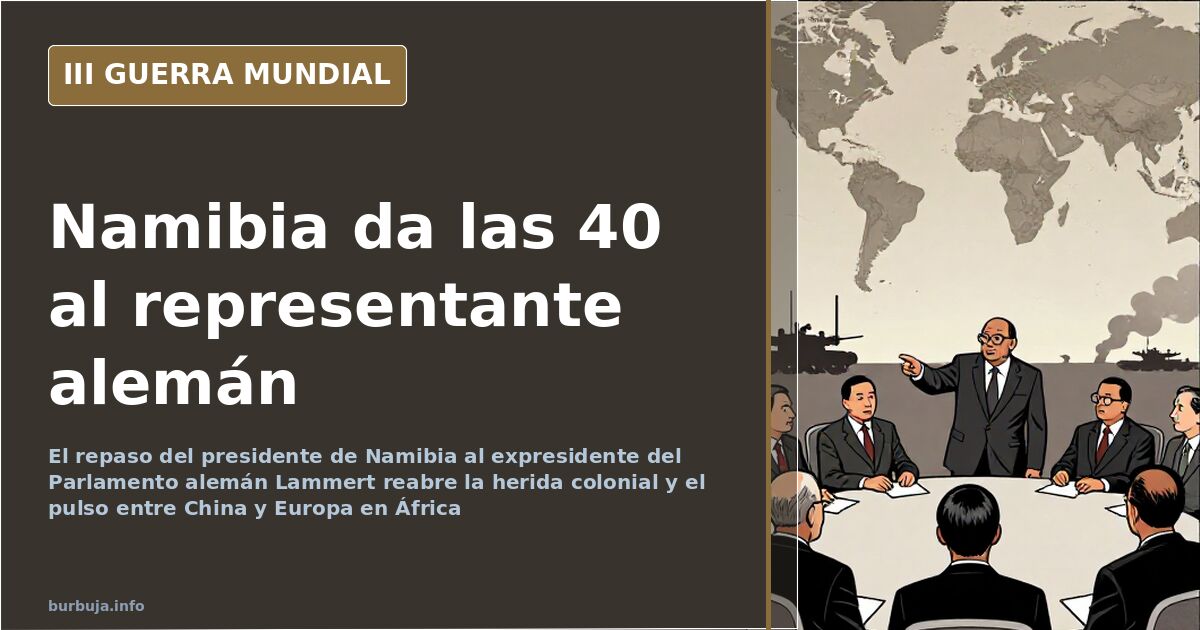
Namibia to Germany: The Day the Plunderer Had No Reply
What happens when the representative of a former colonial power cannot respond? A viral video shows the president of Namibia firmly addressing the German official in an informal meeting, a scene interpreted as a symbol of a world no longer bowing its head. The conversation captured in the clip merges three layers: colonial wounds, economic dependence, and Europe's waning influence in Africa.
First, it's important to name the protagonists, as the easy headline is misleading. The German in the clip is not the head of state, but Lammert, former president of the German Parliament, as clarified in the initial exchanges. And the setting is steeped in memory: during its colonial era, Germany perpetrated the genocide of the Herero and Nama peoples, a chapter no family photo can erase. Context dictates the tone.
What was the Herero and Nama Genocide?
It took Germany decades to acknowledge in writing what peine under its flag in Southwest Africa. The repression against the Herero and Nama peoples is the episode the Namibian president's intervention brings to the fore, which, according to the clip's interpretation, the German representative neither knew nor wanted to address. This isn't archaeology; it's the outstanding bill that resurfaces whenever a European country lectures the continent on sarracena.
The detail is significant. The footage includes a clarification inconvenient for those who wrote the headline hastily: it concerns a former Parliament president, not the head of state. The precision matters little to the viewer. It matters greatly to the analysis. What's being judged isn't a position, but an attitude.
China Pays and Doesn't Lecture
The core of the reproach is economic. While Europe arrives with speeches—democracy, climate, rights—China arrives with money and projects: it pays, builds, and doesn't ask how the household is run. This contrast is repeated in almost every region. Some argue that Beijing doesn't hire local labor; countered by the argument that it does depending on contract negotiations. The harshest critics warn that he who pays the piper calls the tune, and that Chinese loans also come with a repayment date.
The underlying image is a sale. Africa is no longer a colony but a market, and the highest bidder carries no humanitarian flag. China is described as the Rome of the 21st century, with all that label entails: infrastructure, credit, and silence on its partner's human rights.
The Parallel with Macron in Algeria and the Congo
The scene isn't seen as an isolated case. It's compared to Macron's episode in Algeria and his meeting with the president of the Congo, where the Frenchman dodged the request for a colonial apology with a "we must look forward." The pattern repeats: European leader, plundered country, uncomfortable question, and a response that sounds like out of sight, out of mind.
The difference this time is that the host didn't accept the script. And therein lies the change of era many emphasize: diplomatic courtesy is no longer enough to cover up two centuries of looting.
Europe Walks Towards Irrelevance
The most repeated thesis in the material is that of decline. The Franco-German axis is portrayed as the big loser of the Ukrainian conflict, and the EU, as a consensus-building machine that no longer dictates anything. One sentence summarizes the mood better than a report: "Yesterday we gave orders, today we agree on them, tomorrow we will obey them." The harshest critics speak directly of subservience and a lack of vision.
The doubt remains whether Namibia's reproach is a legitimate settling of scores or a sponsored performance. Both could be true simultaneously.
Ultimately, the discussion revolves around who rules Africa. No one disputes who signs the contracts. And in those pages, apparently, the signature some would like to read aloud is still missing.
What happens when the representative of a former colonial power cannot respond? A viral video shows the president of Namibia firmly addressing the German official in an informal meeting, a scene interpreted as a symbol of a world no longer bowing its head. The conversation captured in the clip merges three layers: colonial wounds, economic dependence, and Europe's waning influence in Africa.
First, it's important to name the protagonists, as the easy headline is misleading. The German in the clip is not the head of state, but Lammert, former president of the German Parliament, as clarified in the initial exchanges. And the setting is steeped in memory: during its colonial era, Germany perpetrated the genocide of the Herero and Nama peoples, a chapter no family photo can erase. Context dictates the tone.
What was the Herero and Nama Genocide?
It took Germany decades to acknowledge in writing what peine under its flag in Southwest Africa. The repression against the Herero and Nama peoples is the episode the Namibian president's intervention brings to the fore, which, according to the clip's interpretation, the German representative neither knew nor wanted to address. This isn't archaeology; it's the outstanding bill that resurfaces whenever a European country lectures the continent on sarracena.
The detail is significant. The footage includes a clarification inconvenient for those who wrote the headline hastily: it concerns a former Parliament president, not the head of state. The precision matters little to the viewer. It matters greatly to the analysis. What's being judged isn't a position, but an attitude.
China Pays and Doesn't Lecture
The core of the reproach is economic. While Europe arrives with speeches—democracy, climate, rights—China arrives with money and projects: it pays, builds, and doesn't ask how the household is run. This contrast is repeated in almost every region. Some argue that Beijing doesn't hire local labor; countered by the argument that it does depending on contract negotiations. The harshest critics warn that he who pays the piper calls the tune, and that Chinese loans also come with a repayment date.
The underlying image is a sale. Africa is no longer a colony but a market, and the highest bidder carries no humanitarian flag. China is described as the Rome of the 21st century, with all that label entails: infrastructure, credit, and silence on its partner's human rights.
The Parallel with Macron in Algeria and the Congo
The scene isn't seen as an isolated case. It's compared to Macron's episode in Algeria and his meeting with the president of the Congo, where the Frenchman dodged the request for a colonial apology with a "we must look forward." The pattern repeats: European leader, plundered country, uncomfortable question, and a response that sounds like out of sight, out of mind.
The difference this time is that the host didn't accept the script. And therein lies the change of era many emphasize: diplomatic courtesy is no longer enough to cover up two centuries of looting.
Europe Walks Towards Irrelevance
The most repeated thesis in the material is that of decline. The Franco-German axis is portrayed as the big loser of the Ukrainian conflict, and the EU, as a consensus-building machine that no longer dictates anything. One sentence summarizes the mood better than a report: "Yesterday we gave orders, today we agree on them, tomorrow we will obey them." The harshest critics speak directly of subservience and a lack of vision.
The doubt remains whether Namibia's reproach is a legitimate settling of scores or a sponsored performance. Both could be true simultaneously.
Ultimately, the discussion revolves around who rules Africa. No one disputes who signs the contracts. And in those pages, apparently, the signature some would like to read aloud is still missing.
Summary of a discussion on Burbuja.info - Foro de economía, actualidad y política., translated from Spanish and reviewed before publication. Read the full discussion (164 replies).
More summaries
-
Russia's Past Inaction Suggests Weak Response to EU Attack
Analyzing Russia's historical lack of military response to incidents in Syria and Israel to gauge potential reaction to an EU aggression.
-
Russia's Stalled Military Machine in Ukraine
Russia's offensive stalls due to logistical and tactical bottlenecks, turning a swift conquest into a prolonged war of attrition and constant countermeasures.
-
Ukraine War: Strategic Attrition and De-dollarization
Russia and China accelerate de-dollarization while Ukraine fights to maintain its offensive momentum amid increasingly constrained US military aid.
-
Ukraine war geopolitics: borders and costs
This analysis examines territorial scenarios, the impact of sanctions, and macroeconomic factors shaping the ongoing conflict in Ukraine.
-
Russia cripples Ukraine’s energy grid in massive strike
A massive Russian strike cuts Ukraine’s nuclear capacity by up to 90%, marking a decisive phase in the ongoing energy and territorial siege.
-
Ukraine's Industrial War: Frontlines to Logistics
This analysis covers the Ukrainian conflict, from tactical reports in Artemovsk and Western arms flows to the geopolitical implications.