
La Séptima launches on Spanish DTT, funding source unclear
La Séptima debuts on Spain's digital terrestrial TV this November. While production quality is solid, questions remain about who funds the channel and potential public ties.
English · Original discussion in Spanish · Published
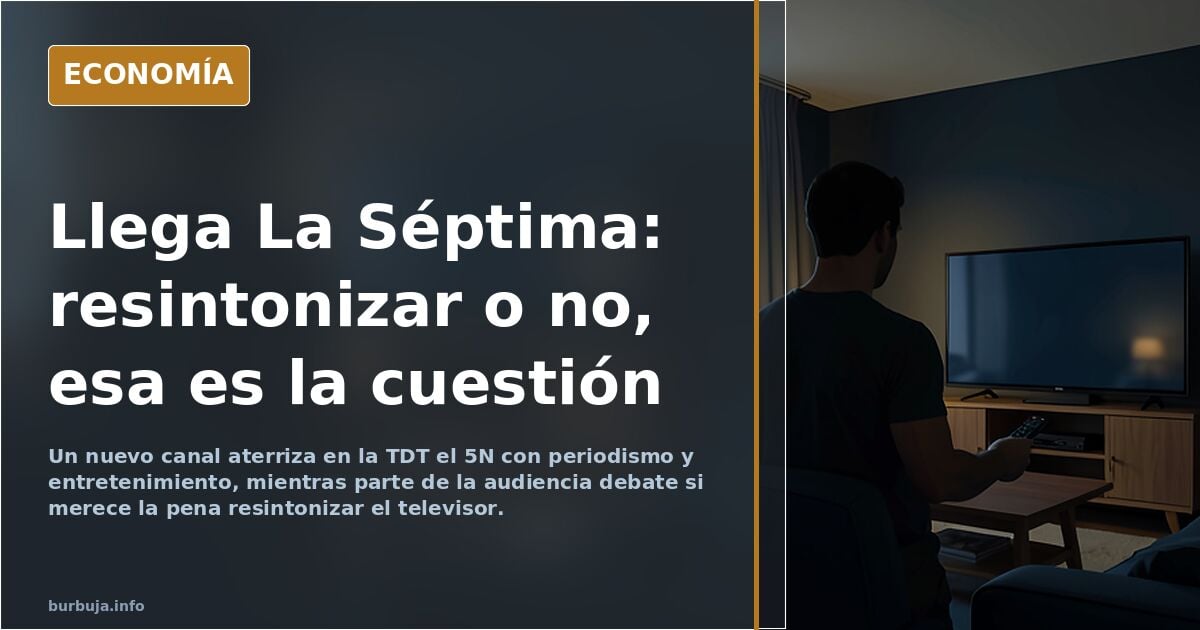
La Séptima arrives on DTT with no explanation of its funding
A remote control nobody wants to pick up. That gesture sums up November 5, 2026, when La Séptima’s new channel slipped into Spanish televisions — in some cases, according to several reports, without the viewer touching anything. The project’s launch has been met with a mix of technical curiosity and economic distrust: the question circulating isn’t what they broadcast, but who pays for it. Underlying this is the suspicion that the answer involves the government.
According to those who have watched it, the programming schedule is not a cardboard studio. There is production, there are live links, there is the pace of an Argentine news channel. What is missing, for now, is public accounting. The cost of such a deployment hangs in the air like the elephant in the room: if private money doesn't add up, someone will have to cover the rest.
Who pays for La Séptima and where does the money come from?
The issue of shareholding and financing is the axis of skepticism. The possibility that the channel functions as a backup for public broadcasting, with public money behind it and propaganda disguised as news, is openly raised. The comparison with lasensla weighs heavily: it is recalled that its economic salvation came through political decisions, and speculation arises that the PP (People's Party) might do the same when the time comes. No one has shown a balance sheet, and in a sector where numbers rule, that is an anomaly.
The precedent of right-wing media is cited as a counterweight: when a channel of that sign was launched, it went bankrupt within a year. The conclusion drawn is uncomfortable for both enthusiasts and critics: in Spain, ideological channels do not sustain themselves alone. Either there is a concession, or there is a patron, or there is a closure.
Programming: journalism, pundits, and a forum muse
The content also generates equal parts resentment and curiosity. The most discussed hire is Noor Ben Youssef, presenter of one of the main programs and, as highlighted, with links to the Segarro embassy. This detail fuels suspicions about the editorial line on foreign policy, specifically regarding Western Sahara. The accusation of serving foreign interests circulates without proof, but it circulates.
On an aesthetic level, criticism is unanimous on one point: the selection of female presenters trinc a very specific pattern. Some read this as a commercial strategy — attracting male viewers of a certain age — while others see it as a contradiction with the pogre discourse attributed to the project. Production, however, is recognized as solid: a single studio reused throughout the day, fast pace, breaking news messages on screen, and simultaneous broadcast on YouTube, something other channels in the industry do not do.
There is a domestic detail that repeats itself: the channel appears tuned in without user intervention on some televisions, which has triggered theories of silent imposition. Forced resintonization as a metaphor for everything else. With that doubt on the table — who pays, whom they serve, and why it is on the dial unrequested — the launch leaves more questions than certainties. And a disorienting fact: even the most critical voices cannot agree on whether the product is trash or simply well-executed competition.
Also available in: Deutsch
Summary of a discussion on Burbuja.info - Foro de economía, actualidad y política., translated from Spanish and reviewed before publication. Read the full discussion (65 replies).
More summaries
-
Moncloa hands Contreras a new TV channel with a 15-year licence
Spain's government awards José Miguel Contreras a new television channel with a 15-year licence, while the PRISA chairman refuses to approve the project.
-
La Séptima: Channel Promoted by the Government Delegation
The Madrid Government Delegation promotes La Séptima, launching Nov 5. Critics point to Entrecanales and Manzano as the key shareholders.
-
Former Podemos train driver defends Spanish government on La Sexta
Eugenio Parreño told La Sexta that the LZB signalling system is "totally safe" despite the computer failure before the Urda crash, which left 69 dead and 64 missing.
-
Dabiz Muñoz's €19 Sandwich: The Business of Gourmet Storytelling
A sandwich 'designed' by Dabiz Muñoz sells for €18.95 in Spanish airports. Forum calculations suggest a cost of just €1.50 per unit.
-
Brent Crude Plunges 7% to Three-Week Lows
Brent drops 5.31% to $113 amid futures expiry and US release of 45 million barrels from strategic reserves.
-
Spain: Worker's Rights Trump Privileges in Dismissal Ruling
Catalonia High Court rules Prosegur dismissal unfair after tolerating 21 days of absence, ordering €34,401.91 compensation.