
LA Police Shoot and Kill Man Wielding Machete
A man with a machete caused chaos in Los Angeles and was shot dead. The incident reignites debate on police use of force.
English · Original discussion in Spanish · Published
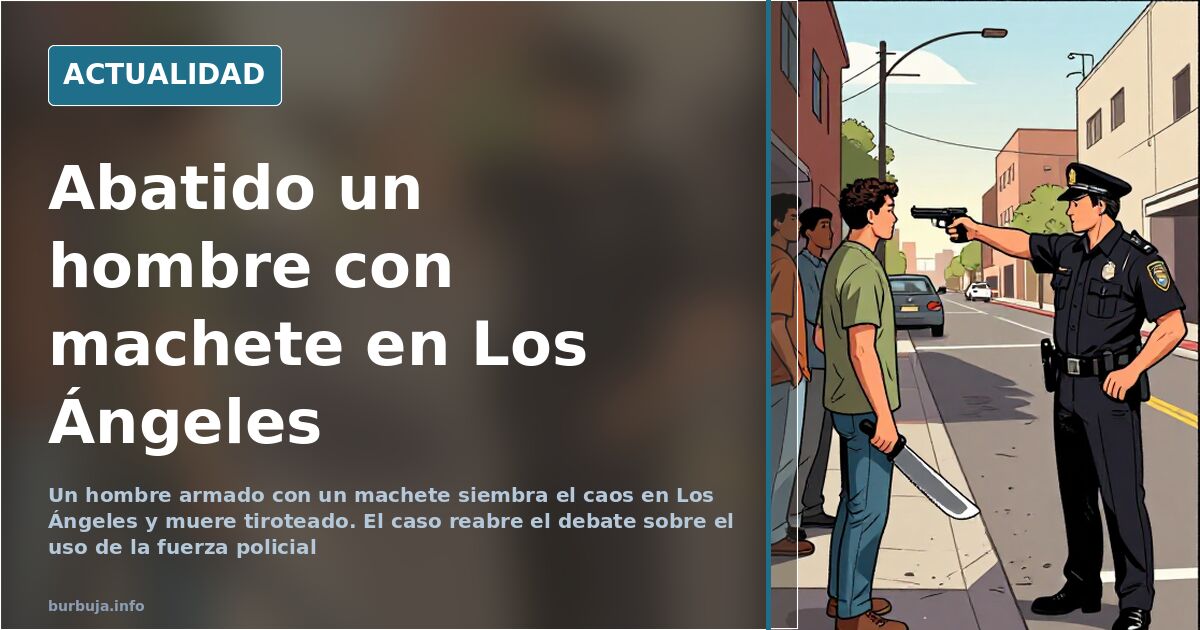
The 'Suicide by Cop' Phenomenon Repeating in the United States
A man armed with a machete walked through a Los Angeles street, threatening passersby. Police arrived, attempted to subdue him, and ended up shooting him dead. The script unfolded with hardly any variation. And that is precisely the detail that is most unsettling: the predictability of the outcome.
The scene—recorded and rapidly disseminated—immediately sparked a discussion about the use of force, mental health, and the American tendency to resolve situations with bullets that in other countries would be handled with a taser or, directly, with hours of negotiation. What no one disputes is the outcome: the man died.
What is the 'Suicide by Cop' that Repeats in the US?
It's called suicide by police and it's not an invented label: it's a category that American criminology has handled for decades. It describes someone who, determined to die but unable to do so by their own hand, provokes officers until they shoot. They don't want to live; they want others to kill them.
The most common interpretation of the images is this. "The guy committed suicide, he was looking for this," summarizes part of the analysis, which maintains that the suspect "used the police to end it before throwing himself onto train tracks." This fits with the detail that, even when cornered, he did not drop the weapon and continued advancing.
Why Officers Don't Shoot for the Legs
The classic movie scene unfolds. Why doesn't anyone hit him in the knee? The technical answer is far from Hollywood: a moving target, at a few meters, and advancing towards you, cannot be stopped with a precise shot. And an officer facing a large blade at medium distance has only seconds to decide.
Those who have practiced shooting explain it bluntly: "If they shoot for the legs, he has time to take out at least one cop." The other piece of the argument is that, when life is at risk, the sequence is rapid and multiple. Instructors insist on instinctive shooting over precision shooting. It's not for show; it's trained reflex.
The Excess of Shots and the Lingering Doubt
The most discussed point is the number of bullets. Once the suspect falls and is no longer a threat, the question is unavoidable: why keep shooting? "They riddle him with bullets, and he still manages to take two or three steps," points out one interpretation, which, far from seeing it as defense, reads it as a control problem.
American protocols allow for continuous firing while danger is perceived. The problem is that this perception is subjective and rarely reviewed with the same rigor as the facts. Death by multiple impacts is not investigated the same way as a traffic infraction.
The Echo in Spain: Comparisons That Don't Quite Add Up
As soon as the video was released, the issue became a mirror to discuss Spain. Some argue that the outcome here would be different—more bureaucracy, less decisiveness—while others resort to clichés about the impunity of crime. The problem is that the comparison is almost always made without data.
What is verifiable is that in the United States, the combination of abundant firearms, police trained to shoot, and a high rate of deaths during interventions produces these kinds of endings with a frequency that doesn't exist here. The specific number of cases, however, no one put on the table.
If anything is clear from this event, it's that the script will continue to repeat: someone challenging the police with a bladed weapon, officers responding with lead, and a two-day debate that changes no protocols. It's likely that next time the video will be watched the same way, and the ending will be the same. Until someone decides to count how many cases there are.
A man armed with a machete walked through a Los Angeles street, threatening passersby. Police arrived, attempted to subdue him, and ended up shooting him dead. The script unfolded with hardly any variation. And that is precisely the detail that is most unsettling: the predictability of the outcome.
The scene—recorded and rapidly disseminated—immediately sparked a discussion about the use of force, mental health, and the American tendency to resolve situations with bullets that in other countries would be handled with a taser or, directly, with hours of negotiation. What no one disputes is the outcome: the man died.
What is the 'Suicide by Cop' that Repeats in the US?
It's called suicide by police and it's not an invented label: it's a category that American criminology has handled for decades. It describes someone who, determined to die but unable to do so by their own hand, provokes officers until they shoot. They don't want to live; they want others to kill them.
The most common interpretation of the images is this. "The guy committed suicide, he was looking for this," summarizes part of the analysis, which maintains that the suspect "used the police to end it before throwing himself onto train tracks." This fits with the detail that, even when cornered, he did not drop the weapon and continued advancing.
Why Officers Don't Shoot for the Legs
The classic movie scene unfolds. Why doesn't anyone hit him in the knee? The technical answer is far from Hollywood: a moving target, at a few meters, and advancing towards you, cannot be stopped with a precise shot. And an officer facing a large blade at medium distance has only seconds to decide.
Those who have practiced shooting explain it bluntly: "If they shoot for the legs, he has time to take out at least one cop." The other piece of the argument is that, when life is at risk, the sequence is rapid and multiple. Instructors insist on instinctive shooting over precision shooting. It's not for show; it's trained reflex.
The Excess of Shots and the Lingering Doubt
The most discussed point is the number of bullets. Once the suspect falls and is no longer a threat, the question is unavoidable: why keep shooting? "They riddle him with bullets, and he still manages to take two or three steps," points out one interpretation, which, far from seeing it as defense, reads it as a control problem.
American protocols allow for continuous firing while danger is perceived. The problem is that this perception is subjective and rarely reviewed with the same rigor as the facts. Death by multiple impacts is not investigated the same way as a traffic infraction.
The Echo in Spain: Comparisons That Don't Quite Add Up
As soon as the video was released, the issue became a mirror to discuss Spain. Some argue that the outcome here would be different—more bureaucracy, less decisiveness—while others resort to clichés about the impunity of crime. The problem is that the comparison is almost always made without data.
What is verifiable is that in the United States, the combination of abundant firearms, police trained to shoot, and a high rate of deaths during interventions produces these kinds of endings with a frequency that doesn't exist here. The specific number of cases, however, no one put on the table.
If anything is clear from this event, it's that the script will continue to repeat: someone challenging the police with a bladed weapon, officers responding with lead, and a two-day debate that changes no protocols. It's likely that next time the video will be watched the same way, and the ending will be the same. Until someone decides to count how many cases there are.
Summary of a discussion on Burbuja.info - Foro de economía, actualidad y política., translated from Spanish and reviewed before publication. Read the full discussion (156 replies).
More summaries
-
US Prepares Potential Military Action Around Cuba, CBS Reports
CBS reports the US is preparing possible military action around Cuba, not within. Spain's "law of grandchildren" and oil factor influence calculations.
-
Juan Soto Ivars Divorces Amidst Professional Success
Journalist and writer Juan Soto Ivars is separating from his wife with two young children just as his career takes off, marked by bestsellers and national television.
-
Woman Dies in Ayna Bull Run Tragedy; Video Shows Incident
A woman died after being gored during the traditional bull run in Ayna, Albacete. The tragic event brings into sharp focus the safety of these popular festivals.
-
Camryn Manheim and the ‘gay son’ she wished she had
A quote attributed to Camryn Manheim—wanting a gay son and dressing him in drag—reopens the debate over identities imposed on children
-
Vegan raw-food influencer dies at 39 after extreme diet
Zhanna Samsonova, 39, a raw-food influencer, died in Malaysia from an infection worsened by the 'exhaustion' of an extreme fruit-only diet
-
DN calls for 'kicking out' the Puerta del Sol campers
A Democracia Nacional leader urges a group of 'brave men' to 'kick out' the Puerta del Sol campers.