
La Palma Confined 33,000 Due to Gases, No Evacuation Order Issued
On Dec 13, 2021, La Palma confined 33,000 in three municipalities due to sulfur dioxide. A full island evacuation was never ordered. Read more...
English · Original discussion in Spanish · Published
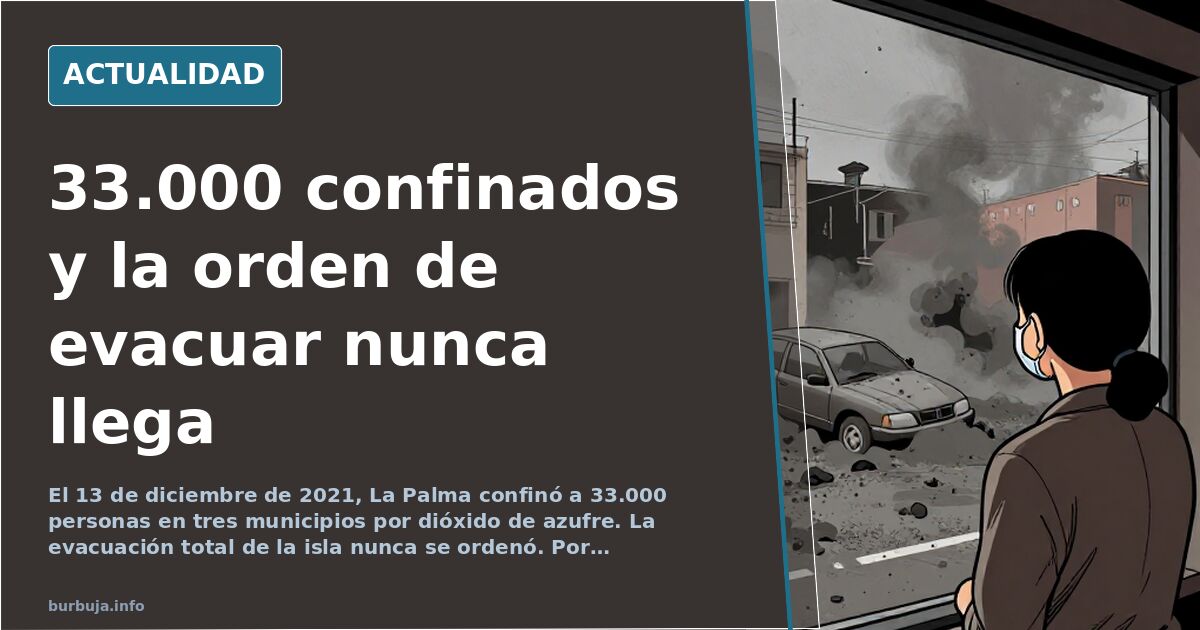
La Palma Confines 33,000 Due to Gases, Avoids Ordering Full Evacuation
On December 13, 2021, three municipalities on La Palma proge up under lockdown. Los Llanos de Aridane, El Paso, and Tazacorte confined nearly 33,000 people to their homes as air quality exceeded sulfur dioxide thresholds, becoming «extremely unfavorable». The Cumbre Vieja lava flow continued its descent, raising the persistent, uncomfortable question: why had no one ordered a larger-scale evacuation sooner?
The paradox is stark. The worse the situation becomes, the more expensive it is to move people. Confining people is cheap, reversible, and announced via a decree. Evacuating an island is a decision no one wants to make. Weeks passed with the western population trapped between ash and an official message urging against panic.
The Lockdown That Preceded the Evacuation
The SO2 lockdown was the administrative response to a problem that had been growing for months. Evacuations had been conducted town by town, street by street, as the lava advanced. Some argued this gradual displacement was, in fact, a phased evacuation that no one wanted to name.
Meanwhile, a team from the Guardia Civil and Involcan activated gas detection alarms, measuring a «potentially lethal danger» on the ground. Four people had to evacuate hastily during a sample collection.
Experts Who Didn't Foresee the Eruption
The most common criticism wasn't aimed at the scientific committee but at the perceived lack of a plan. While volcanic unpredictability is a given, so is the possibility of a hot ash explosion traveling at over 200 km/h. What was jarring was the sense that no one had anticipated the location, timing, or duration.
Two viewpoints are prevalent. One argues that prior signals (sulfur in wells, micro-earthquakes) existed, and the alert level should have been raised sooner. The other emphasizes that ordering a traumatic evacuation without certainty is as irresponsible as not doing so, and that scientists on the ground never recommended such a drastic measure.
The Lava Delta: A Growing Threat Under the Sea
The focus shifted from smoke to water. The delta formed by lava meeting the sea was, according to the most cited analysis, perched on a 1,000-meter cliff, supported by water with an unstable base. The theory: solidifying against the sea creates a hollow cliff that could collapse, suddenly releasing more material.
This led to the proposal of advancing the evacuation of coastal areas before the terrain itself made the decision. This should be considered a working hypothesis, not an announcement: collapses and their coastal effects were debated without consensus.
Can an Entire Island Be Evacuated?
This is the crux of the matter. The island isn't a single point on the map; it includes municipalities tens of kilometers from the cone, where people neither see the lava nor smell the sulfur, and an economy that falters if the entire population is displaced. Half the island remained oblivious to the eruption, save for the smoke plume on the horizon.
The other hurdle is financial. Who pays for temporary housing, livestock, lost crops, and hotels? When the issue is crowd control, machinery moves quickly; when it involves damages and resettlement, administrations tend to look away.
The Press, Experts, and the Narrative
The strain affected the media. The tone of news reports, theme music, and the insistence on calm while images showed otherwise were criticized. Some even suggested scientific committee members should seek other employment.
Meanwhile, everyday scenes told more than official statements: neighbors sweeping black gravel from sidewalks when, by common sense, they should have been packing. This mix of routine and threat was something no one managed effectively.
The Ending That Didn't Happen
As the lava consumed even the live webcam, the situation remained unchanged: no total evacuation, air quality lockdowns, and an island divided between those who left and those who stayed to await instructions. How much worse must a volcano get before someone signs the order no one wants to sign?
On December 13, 2021, three municipalities on La Palma proge up under lockdown. Los Llanos de Aridane, El Paso, and Tazacorte confined nearly 33,000 people to their homes as air quality exceeded sulfur dioxide thresholds, becoming «extremely unfavorable». The Cumbre Vieja lava flow continued its descent, raising the persistent, uncomfortable question: why had no one ordered a larger-scale evacuation sooner?
The paradox is stark. The worse the situation becomes, the more expensive it is to move people. Confining people is cheap, reversible, and announced via a decree. Evacuating an island is a decision no one wants to make. Weeks passed with the western population trapped between ash and an official message urging against panic.
The Lockdown That Preceded the Evacuation
The SO2 lockdown was the administrative response to a problem that had been growing for months. Evacuations had been conducted town by town, street by street, as the lava advanced. Some argued this gradual displacement was, in fact, a phased evacuation that no one wanted to name.
Meanwhile, a team from the Guardia Civil and Involcan activated gas detection alarms, measuring a «potentially lethal danger» on the ground. Four people had to evacuate hastily during a sample collection.
Experts Who Didn't Foresee the Eruption
The most common criticism wasn't aimed at the scientific committee but at the perceived lack of a plan. While volcanic unpredictability is a given, so is the possibility of a hot ash explosion traveling at over 200 km/h. What was jarring was the sense that no one had anticipated the location, timing, or duration.
Two viewpoints are prevalent. One argues that prior signals (sulfur in wells, micro-earthquakes) existed, and the alert level should have been raised sooner. The other emphasizes that ordering a traumatic evacuation without certainty is as irresponsible as not doing so, and that scientists on the ground never recommended such a drastic measure.
The Lava Delta: A Growing Threat Under the Sea
The focus shifted from smoke to water. The delta formed by lava meeting the sea was, according to the most cited analysis, perched on a 1,000-meter cliff, supported by water with an unstable base. The theory: solidifying against the sea creates a hollow cliff that could collapse, suddenly releasing more material.
This led to the proposal of advancing the evacuation of coastal areas before the terrain itself made the decision. This should be considered a working hypothesis, not an announcement: collapses and their coastal effects were debated without consensus.
Can an Entire Island Be Evacuated?
This is the crux of the matter. The island isn't a single point on the map; it includes municipalities tens of kilometers from the cone, where people neither see the lava nor smell the sulfur, and an economy that falters if the entire population is displaced. Half the island remained oblivious to the eruption, save for the smoke plume on the horizon.
The other hurdle is financial. Who pays for temporary housing, livestock, lost crops, and hotels? When the issue is crowd control, machinery moves quickly; when it involves damages and resettlement, administrations tend to look away.
The Press, Experts, and the Narrative
The strain affected the media. The tone of news reports, theme music, and the insistence on calm while images showed otherwise were criticized. Some even suggested scientific committee members should seek other employment.
Meanwhile, everyday scenes told more than official statements: neighbors sweeping black gravel from sidewalks when, by common sense, they should have been packing. This mix of routine and threat was something no one managed effectively.
The Ending That Didn't Happen
As the lava consumed even the live webcam, the situation remained unchanged: no total evacuation, air quality lockdowns, and an island divided between those who left and those who stayed to await instructions. How much worse must a volcano get before someone signs the order no one wants to sign?
Summary of a discussion on Burbuja.info - Foro de economía, actualidad y política., translated from Spanish and reviewed before publication. Read the full discussion (408 replies).
More summaries
-
PACMA Calls Protest on October 4 Against Valdepeñas 'Cat Killer'
PACMA has called a protest on October 4 in Valdepeñas against the 'cat killer,' a former civil guard accused of killing stray cats.
-
Guardia Civil: Deaths in Service and the End of OCON Sur
OCON-Sur disappeared in 2022, and the Guardia Civil has suffered casualties in Barbate, Jerez, Huelva, and Almería.
-
Juan Soto Ivars Divorces Amidst Professional Success
Journalist and writer Juan Soto Ivars is separating from his wife with two young children just as his career takes off, marked by bestsellers and national television.
-
Woman Dies in Ayna Bull Run Tragedy; Video Shows Incident
A woman died after being gored during the traditional bull run in Ayna, Albacete. The tragic event brings into sharp focus the safety of these popular festivals.
-
Camryn Manheim and the ‘gay son’ she wished she had
A quote attributed to Camryn Manheim—wanting a gay son and dressing him in drag—reopens the debate over identities imposed on children
-
Vegan raw-food influencer dies at 39 after extreme diet
Zhanna Samsonova, 39, a raw-food influencer, died in Malaysia from an infection worsened by the 'exhaustion' of an extreme fruit-only diet