
La Cabra opens in Madrid with filter coffees up to 20 euros
La Cabra has opened on Calle de las Infantas in Madrid with manual filter coffees up to 20 euros per brew and seasonal pastries, featuring light roasting and direct sourcing.
English · Original discussion in Spanish · Published
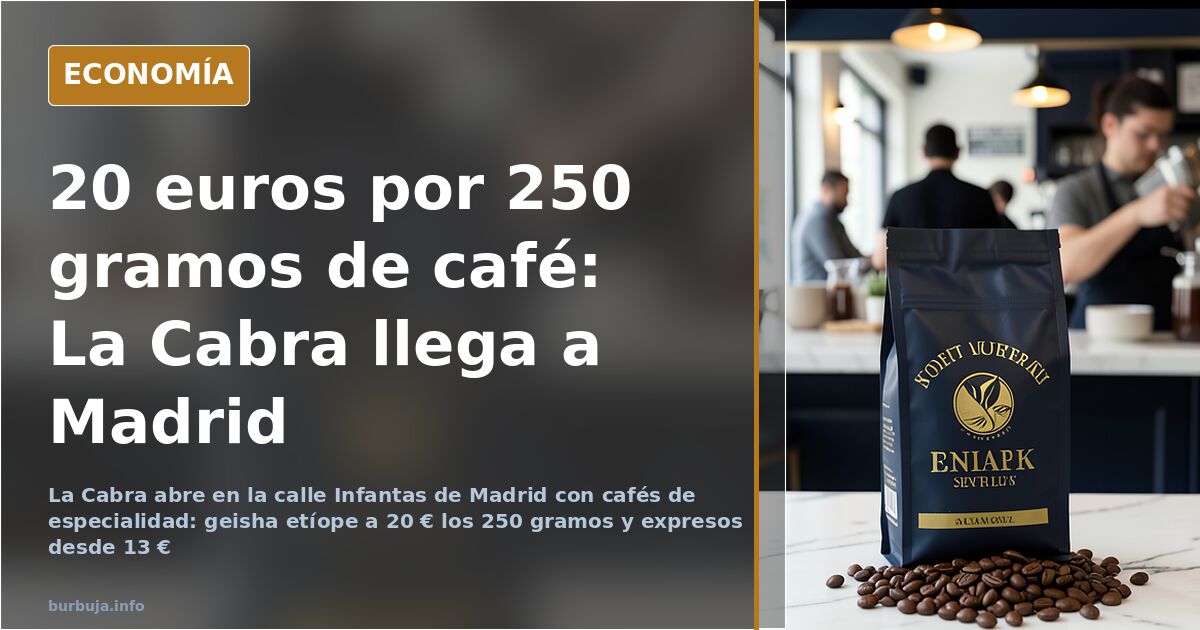
La Cabra opens in Madrid with filter coffees up to 20 euros
Twenty euros. That is the price of the most expensive coffee served by La Cabra at its new location at number 25 Calle de las Infantas, in Madrid's Justicia neighborhood. It is not an ordinary cup: it is an Ethiopian geisha from Gesha Village, a microlot from the Oma region that the Danish company sells in 250-gram bags and which, served as a manual filter brew at the bar, can cost up to 20 euros per preparation. The company, founded in Aarhus in 2011 by Esben Piper, has spent fifteen years championing light roasting and now lands in Madrid, taking over the premises of a former silversmith's shop from the mid-19th century.
The news has landed in a city where specialty coffee coexists with dark-roasted torrefacto and tall glasses. And that is where the noise begins.
What a coffee at La Cabra really costs
It is worth separating two things that an easy headline conflates. The 250-gram bag of geisha costs 20 euros and, according to a calculation circulating in the thread, yields about 30 cups, which would put the coffee at around 0.66 euros per serving if you make it at home. At the bar, the menu offers around 12 different coffees: the Terra espresso, with notes of chocolate and hazelnut, and a second profile that rotates with the harvest, such as the Kenyan Kiangoi at 13 euros. The manual filter brews, prepared with a Hario Switch, range from eight to twenty euros per preparation.
General manager Regina Mejía explains it plainly: the lighter the roast, the less the coffee's notes are muted. Geishas, she says, are subtle, almost like a tea, floral and sweet, with an aroma that reminds her of geraniums and honey.
Price as a social filter: the hipster-posturing argument
The most common reaction does not question the quality. It questions the customer. Some argue that these places are aspirational luxury for showing off on social media, and that without Instagram much of the specialty café scene would not exist. The thesis, stated without nuance, is that the price does not buy a product but social status.
The counterargument comes from the product and the margin side: a low-yield variety, delicate to grow and with lots sold at auction, cannot cost the same as an industrial blend. And the target customer, according to this reading, is not the usual local but the affluent foreigner who has settled in Madrid and pays without blinking.
Seasonal pastries and an open bakery
The place is small: a bar, a long table, seats by the window and an open bakery where sourdough breads, croissants and cardamom buns that change with the season are made. Among the most curious creations are a buckwheat choux filled with fig compote and finished with fig-leaf oil, and a saffron tartlet with an almond base, white chocolate ganache and vanilla mousse. On the savory side, a morning plate with bread, aged cheese and butter from the Madrid cheese shop Formaje.
The knock-on effect that worries people more than the 20 euros
The antiestéticar running through the conversation is not that someone pays 20 euros. It is that the place next door raises its prices too. The concern is that a neighborhood bar will look at La Cabra's storefront and decide to pass on its own cost increases under the premium excuse. Add to that the constant comparison: five euros for a coffee on an expensive street in central Madrid versus 3.40 for a small Coca-Cola in a bar in the provinces.
La Cabra arrives with fifteen years of experience, its own roastery in Copenhagen and direct sourcing at origin. Whether that is enough to sustain the bill on Infantas is the question the shop will answer at the register, not on the menu.
Key facts
- 20 euros: price of the most expensive coffee at the bar and of the 250-gram bag of Ethiopian geisha.
- 8 to 20 euros: range of the manual filter brews prepared with a Hario Switch.
- 13 euros: price of the natural-process Kenyan Kiangoi at the time of the visit.
- 12 different coffees on the menu, with two espresso profiles.
- 2011: year the first coffee shop peine in Aarhus.
Also available in: Deutsch
Summary of a discussion on Burbuja.info - Foro de economía, actualidad y política., translated from Spanish and reviewed before publication. Read the full discussion (120 replies).
More summaries
-
Neighbors Denounce Drug Dealing Outside San Antón Parish
Residents of Chueca and Justicia denounce drug dealing and filth outside San Antón Parish, managed by Padre Ángel.
-
Madrid: 18 rooms at €550 in a 300m² apartment
A 300m² flat in Madrid offers 18 rooms at €550 each, totaling €9,900 monthly. This coliving model strains the rental market.
-
Madrid Working-Class Flat: 1963 Apartment Without Elevator for €369,000
A 53m² flat in a 1963 building without an elevator is selling for €369,000 in a Madrid working-class neighborhood: nearly €7,000 per square meter.
-
Polar air and supercell warning in Cordoba
An expert warns of a temperature drop with capitals below 5°C while a supercell is recorded in Montemayor, Cordoba.
-
Spain's pensioners are turning out en masse to defend their pensions and vote for Sánchez
A pensioner says in a viral video that he will not hand over his pension to the PP and VOX over the train accidents. The gesture mixes rail grievances and voting.
-
October inflation in Spain holds at 4.9%, narrowly avoiding the MEI pension top-up
Spain's October CPI comes in at 4.9%, three tenths short of triggering the MEI surcharge. Italian inflation stands at 5.4% and the ECB keeps rates at 2.5%.