
La Bola de Cristal Turns 40: A Clash Over Spain's Beloved 80s Saturday Show
La Bola de Cristal celebrates 40 years, sparking debate over its legacy as a cultural touchstone or tedious relic of Spain's early public TV era.
English · Original discussion in Spanish · Published
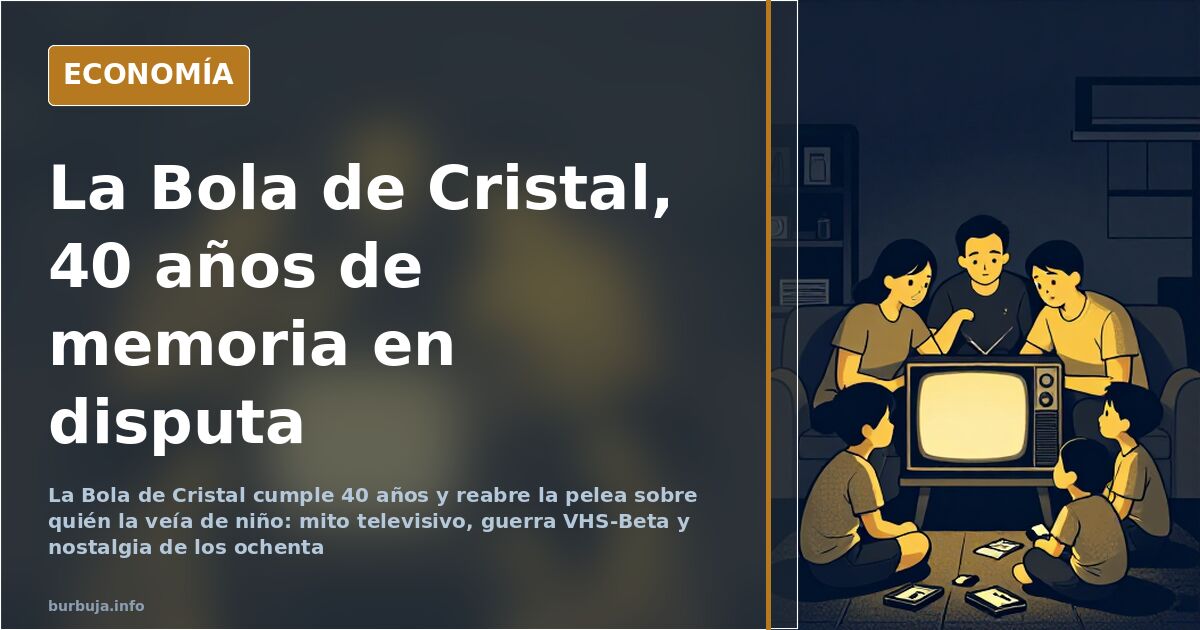
La Bola de Cristal Turns 40: A Clash Over Spain's Beloved 80s Saturday Show
La Bola de Cristal was watched by an entire generation. And yet, almost no one remembers watching it. These two statements coexist in the narrative about the program that RTVE broadcast on Saturday mornings during the 1980s, and which the public broadcaster now celebrates with a special antiestéticature on its director, Lolo Rico, and the rebroadcast of its best episodes. For some, it was a tedious display of puppets and adults in disguise. For others, it was one of the few formats that did not treat children like simpletons. The controversy is not about television. It is about who holds the memory of an entire decade.
What was La Bola de Cristal and why was it broadcast on Saturdays?
The show occupied the Saturday morning slot, when half of Spain's children were outside, sleeping without school, or playing football with neighborhood friends. This is where the first misunderstanding begins: there was no competition. There were only two channels, as several participants recall, so if you didn't watch La Bola de Cristal, you watched something equally limited, or turned off the set. Comparing that audience to today's fragmented market makes no methodological sense.
The format mixed segments, music, puppets, and purchased series. La Bruja Avería and the Electroduendes are the characters most cited, almost always just those two. Some children got hooked on the series the show served between sketches: La Familia Monster, Embrujada, a black-and-white production that many discovered right there. Others simply changed channels.
Was it a program for children or pre-teens?
The age mismatch explains much of the responses. Some were eight or nine years old and fell outside the target audience; some were four or five and understood nothing of what was on screen. The format targeted an older audience, not those who just wanted to see cartoons at nine in the morning and encountered theater, live music, and puppets.
This clash of expectations is the economic core of the issue: the schedule of the era was not designed to segment audiences, but to fill a time slot with a single product. Those who did not fit the mold had no alternative. Today that is unthinkable, and back then it was the only offer available.
The 1987 RTVE slowdown and the censorship controversy
The political content of the program is at the center of the discussion. With Pilar Miró's arrival at RTVE's direction in 1987, much of the political and social criticism of sections like Los Electroduendes had to stop, according to the account collected in the program's file. Some read this slowdown as pure censorship; others interpret it as the natural end of a format whose audience had left it behind. Both versions continue to circulate without an arbitrator to settle them.
One of the most remembered sections, the Ministry of Missiles and Humanities, is read today with a hint of irony as an involuntary prophecy. Whether humor ages better or worse than a current sketch is another matter. The program lasted a short time, and its footprint far exceeds its actual broadcast, which says more about the audiovisual ecosystem of the time than its quality.
Was La Bola de Cristal a brainwashing program?
The accusation appears again and again, almost always in the same form: explicit political content served to an audience that could not filter it. Some of its screenwriters are even cited, who allegedly acknowledged the purpose in interviews published in media such as Público. The defense is equally blunt: those who watched La Bola de Cristal also watched bullfighting with their grandfather, and that did not turn anyone into anything specific.
The ability of television to shape an ideology is overvalued in both directions. A child absorbs the entire schedule, with its series, commercials, and silences, and the bias is not put by just one sketch. Forty years later, the political label still works better as a throwaway weapon than as a diagnosis.
From the VHS vs. Beta war to Spain's first video club
The conversation drifts, at some point, to home technology, and there appears an economic episode from a textbook. The Beta format was put on sale in 1975 and reached some living rooms before VHS. Those who had one boast of having bought better; those who had the other remind them that they could not exchange tapes with anyone. The format war was won by VHS, and that defeat is still discussed today with the same enthusiasm.
The data available place Spain's first video club in 1980, in Barcelona. In Biscay, for a time, there was only one, in a department store in Bilbao. In 1981, some homes already recorded from TV: among the preserved tapes is one of 23-F, though not live —it is from days later and without a channel logo, placing it before 1982—. Some had two devices by the end of the decade to copy movies, removing the commercials.
[Cajón Desastre, Planeta Imaginario, and the nostalgia business[/B]
The succession came with Cajón Desastre, which did broadcast cartoons and tonalidad series, and with Planeta Imaginario, defended as a high-level cultural product. The delay with which foreign children's series arrived here explains almost everything: Jem y The Holograms, from 1985, was not seen in Spain until 1990, and other titles took even longer. That is why nostalgia clings to four or five series and not twenty.
With La Bola de Cristal back in public programming and its anniversary as an excuse, the memory of the 1980s will be reformatted again every so often. It is likely that half will continue to deny having seen it. And it is likely that the other half will continue to remember, in reality, the series that were shown in between.
Also available in: Deutsch
Summary of a discussion on Burbuja.info - Foro de economía, actualidad y política., translated from Spanish and reviewed before publication. Read the full discussion (265 replies).
More summaries
-
Viral slap on TVE reporter in Ceuta sparks media bias debate
An unverified video shows a man slapping a TVE reporter in Ceuta, and the media silence reopens the double standard debate.
-
Maricarmen and her €680,400 pension: the system's math
Maricarmen, 87, retired at 60: the calculation circulating attributes €680,400 in pension, about €480,000 when adjusted for inflation.
-
PACMA's housing proposals in Spain
PACMA's housing agenda includes affordable rent, curbing speculation and banning clauses that exclude pets from rental contracts.
-
Spain's Núñez Feijóo agrees to Jordi Wild interview (Abascal and Sánchez also invited)
Alberto Núñez Feijóo has accepted an interview with Jordi Wild after the YouTuber's public invitation. He is the first politician to take the step.
-
What happened to the Villamanín winners' Christmas lottery money?
The Villamanín festival committee in Spain cashed the 2013 El Gordo Christmas lottery prize and the winners demanded their share. Here's how the case ended up in court.
-
Vox candidate threatens to shoot opponent in Spain
A Vox candidate in Teruel, Spain said "if we have to shoot you, we will" and the party called it an unfortunate situation. Here's why it matters.