
Kyiv Fall Prediction Failed: Encirclement Never Closed
Predictions of Kyiv falling in days and encircling Ukraine's eastern army failed, as Kharkiv remained untouched despite being just 30 km from the Russian border.
English · Original discussion in Spanish · Published
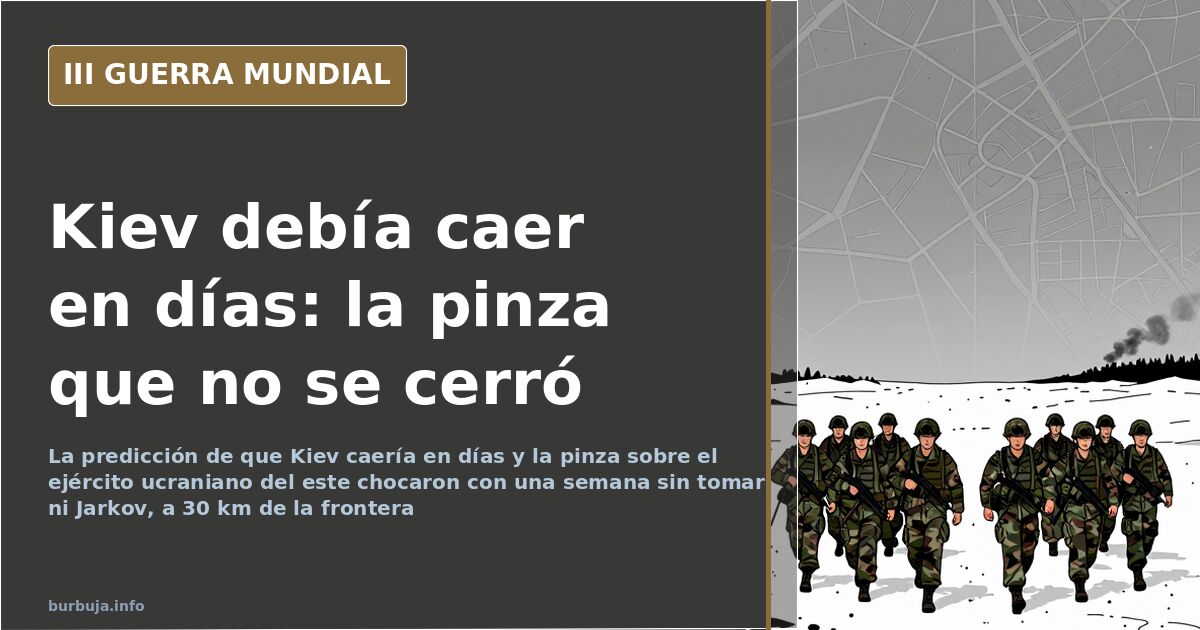
Kyiv Fall Prediction Failed: Encirclement Never Closed
Kyiv was expected to fall within days. That was the bet: reinforcements were arriving, ammunition supplies were tightening, and a pincer movement would close the net around the bulk of the Ukrainian army deployed in the east. The forecast didn't speak of months or negotiations, but of one week. The week passed. And many others trinc.
What was the pincer on the Ukrainian eastern army?
The thesis relied on simple geometry: forces entering from the north and south to cut off the rear of units concentrated in the country's east and south. The calculation was stark: a well-executed pincer would trap around 70% of the Ukrainian army. No joke. The analogy with Cannae — Hannibal surrounding and annihilating a superior force — appeared again and again. If the main force remained inside the pocket, organized resistance would collapse on its own.
The pessimistic variant was equally explicit: those who managed to escape westward would be within artillery range, with no room to reorganize. In other words, the pocket did not require a perfect siege. It was enough to turn the rear into an uninhabitable place.
Why didn't Kyiv or Kharkiv fall in the first week?
The calendar was the first judge, and it ruled against the prediction. The capital did not fall. Nor did Kharkiv, a smaller city located just 30 kilometers from the Russian border, the type of objective that should have surrendered before Kyiv on paper. The argument came from neither side: it came from chronology. If the advance was so slow as not to take a border city in seven days, the temporal premise of the pincer collapsed on its own.
A variant of the thesis ordered objectives by phases: first Donbas, then Kharkiv and Odesa, and the capital last. Control of Kyiv, in this reading, would isolate the entire strip east of the river and make supply impossible. On the map, it fit. On the calendar, it did not.
What role was attributed to reinforcements trained in urban combat?
Reinforcements were the missing piece, and among them were cited units with experience in urban combat, designed to fight street by street in a densely populated capital. The expectation later became an object of irony: the same units were mentioned as proof that the rapid assault never arrived. Those expecting a short battle for the city were betting precisely against what urban combat produces: attrition, days, and more days.
A poll split at 50%
No prediction holds if the audience itself doesn't believe it. The associated poll regarding the tracking remained divided at 50%, a tie that years later would be read as the best summary of the uncertainty of 2022. Half bought the enveloping maneuver and imminent fall; the other half did not. Reviewed with distance, that tie says less about the outcome and more about how little was known then. The certainty with which the end was announced did not match the internal division.
Why talk about industrial war and attrition?
As months passed, part of the interventions reframed the argument without abandoning it. A week was no longer promised: there was talk of an industrial war, of attrition, of a front line that only moves when the advantage is clear. In parallel, another reading circulated, more uncomfortable: that arms supplies by NATO countries seek to prolong the conflict to wear down Russia, and that this turns Ukrainian territory into a scenario of mutual exhaustion. The comparison with Afghanistan also emerged. None of these theses reached closure.
From Cannae to the rescue: four and a half years later
Time turned the discussion into an archive of predictions. Four and a half years later, messages that resurface review the prophecies one by one: the pincer, the encirclement, the fall of the capital, the running out of ammunition. The tone shifted from certainty to joke. Someone confesses to having burned through Red Storm Rising, Tom Clancy's novel, four times. Others defend a colder reading: in an industrial war, time is not measured in weeks.
It remains there, exactly there. The same chronology that dismantles the seven-day fall feeds the thesis of slow attrition. Two narratives, one single calendar.
Kyiv was expected to fall within days. That was the bet: reinforcements were arriving, ammunition supplies were tightening, and a pincer movement would close the net around the bulk of the Ukrainian army deployed in the east. The forecast didn't speak of months or negotiations, but of one week. The week passed. And many others trinc.
What was the pincer on the Ukrainian eastern army?
The thesis relied on simple geometry: forces entering from the north and south to cut off the rear of units concentrated in the country's east and south. The calculation was stark: a well-executed pincer would trap around 70% of the Ukrainian army. No joke. The analogy with Cannae — Hannibal surrounding and annihilating a superior force — appeared again and again. If the main force remained inside the pocket, organized resistance would collapse on its own.
The pessimistic variant was equally explicit: those who managed to escape westward would be within artillery range, with no room to reorganize. In other words, the pocket did not require a perfect siege. It was enough to turn the rear into an uninhabitable place.
Why didn't Kyiv or Kharkiv fall in the first week?
The calendar was the first judge, and it ruled against the prediction. The capital did not fall. Nor did Kharkiv, a smaller city located just 30 kilometers from the Russian border, the type of objective that should have surrendered before Kyiv on paper. The argument came from neither side: it came from chronology. If the advance was so slow as not to take a border city in seven days, the temporal premise of the pincer collapsed on its own.
A variant of the thesis ordered objectives by phases: first Donbas, then Kharkiv and Odesa, and the capital last. Control of Kyiv, in this reading, would isolate the entire strip east of the river and make supply impossible. On the map, it fit. On the calendar, it did not.
What role was attributed to reinforcements trained in urban combat?
Reinforcements were the missing piece, and among them were cited units with experience in urban combat, designed to fight street by street in a densely populated capital. The expectation later became an object of irony: the same units were mentioned as proof that the rapid assault never arrived. Those expecting a short battle for the city were betting precisely against what urban combat produces: attrition, days, and more days.
A poll split at 50%
No prediction holds if the audience itself doesn't believe it. The associated poll regarding the tracking remained divided at 50%, a tie that years later would be read as the best summary of the uncertainty of 2022. Half bought the enveloping maneuver and imminent fall; the other half did not. Reviewed with distance, that tie says less about the outcome and more about how little was known then. The certainty with which the end was announced did not match the internal division.
Why talk about industrial war and attrition?
As months passed, part of the interventions reframed the argument without abandoning it. A week was no longer promised: there was talk of an industrial war, of attrition, of a front line that only moves when the advantage is clear. In parallel, another reading circulated, more uncomfortable: that arms supplies by NATO countries seek to prolong the conflict to wear down Russia, and that this turns Ukrainian territory into a scenario of mutual exhaustion. The comparison with Afghanistan also emerged. None of these theses reached closure.
From Cannae to the rescue: four and a half years later
Time turned the discussion into an archive of predictions. Four and a half years later, messages that resurface review the prophecies one by one: the pincer, the encirclement, the fall of the capital, the running out of ammunition. The tone shifted from certainty to joke. Someone confesses to having burned through Red Storm Rising, Tom Clancy's novel, four times. Others defend a colder reading: in an industrial war, time is not measured in weeks.
It remains there, exactly there. The same chronology that dismantles the seven-day fall feeds the thesis of slow attrition. Two narratives, one single calendar.
Also available in: Deutsch
Summary of a discussion on Burbuja.info - Foro de economía, actualidad y política., translated from Spanish and reviewed before publication. Read the full discussion (106 replies).
More summaries
-
Ukraine holds Donbas as Russia eyes Odesa
Ukrainian forces reinforce Severodonetsk, challenging collapse narratives while analysts point to Odesa as Moscow's next target.
-
The Russian encirclement east of the Dnieper that never came
Forecasts of a Russian encirclement east of the Dnieper set three days, then a week: the front didn't move at that pace, and the dates kept slipping.
-
Russia Cedes Kherson Banks of Dnipro River, Ukraine Crosses
Russia abandons the right bank of the Dnipro in Kherson. Some see it as a tactical masterstroke, others as the surrender of a symbol.
-
Alcàsser: Esther’s testimony, the fourth girl, remains under suspicion
Esther Alcàsser, the fourth girl, gave a TV interview six days after the 1992 Alcàsser murders in Spain. Her account and timeline discrepancies fuel ongoing controversy.
-
Munich Security Conference ends with tears as Europe loses US shield
The Munich Security Conference concluded with President Christoph Heusgen in tears, highlighting European anxiety over the end of American security guarantees.
-
Israel Strikes Iran: Contradictions in Official Justifications
Israel attacked Iran after Trump's 60-day ultimatum. Netanyahu cites nine nuclear bombs, but this warning has persisted since 1993.