
Kupyansk Video, Metadata and the War of Narratives
A video allegedly showing Ukrainian troops executing civilians in Kupyansk fuels debate over metadata and a red armband.
English · Original discussion in Spanish · Published
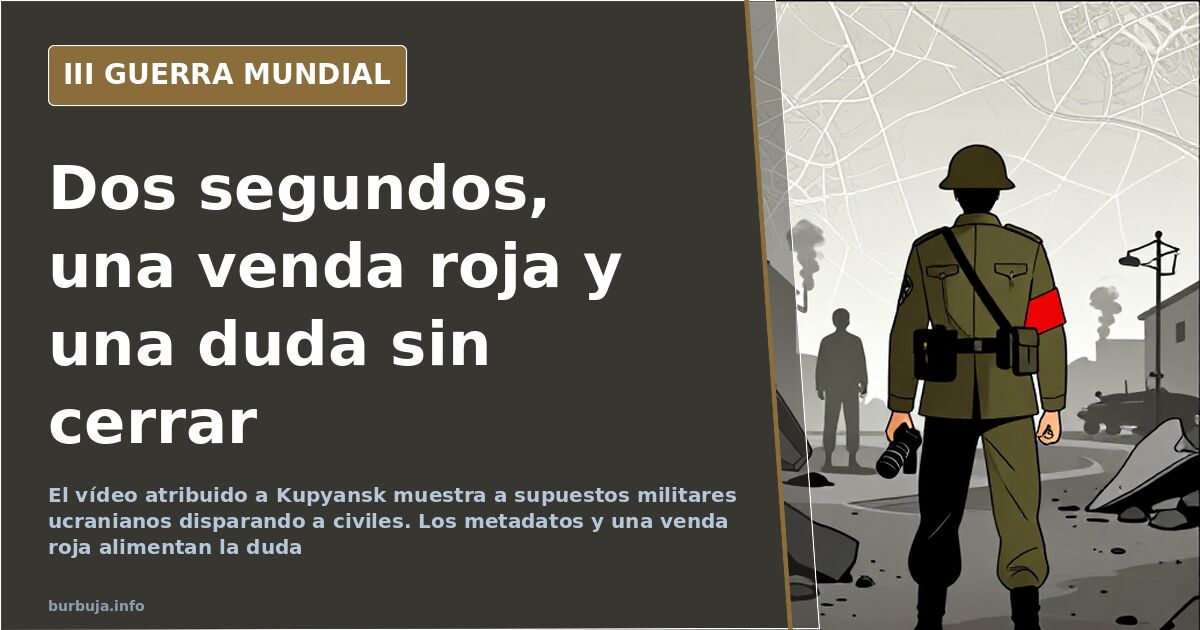
Kupyansk: A dubious video and the war for narrative control
When exactly was the circulating video attributed to the capture of Kupyansk filmed? This question seems like a technical detail but is actually the only one that matters. A clip lasting just seconds, supposedly showing soldiers in Ukrainian uniforms shooting civilians accused of collaboration, has been bouncing between those citing it as proof of war crimes and those claiming it is manipulated. The file's internal date and the tonalidad of an armband have become the battlefield.
What the video shows and what it is attributed to
The most widespread version claims the material was published by a source linked to the Ukrainian Army and shows soldiers executing people identified as collaborators in Kupyansk. Based on this, some analysts argue it depicts violence against civilians in territory reclaimed by Kyiv. The accusation is serious, and as of this discussion, no independent body had verified it: there is only a video, an attributed authorship, and a chain of contradictory accounts. The clip lasts barely two seconds.
It is important to separate what is seen from what is inferred. The images alone do not identify the side, location, or date. Those asserting the perpetrators are Ukrainian rely on the file's origin, not anything visible on screen. Those arguing the opposite perform the same exercise in reverse. That gap is precisely where the two opposing interpretations reside.
Why is the video's date the key to the case?
The first piece of evidence presented is the metadata. According to circulating readings, the file was recorded on October 9, 2022, at 13:24 and published the same day. From this comes the most repeated argument: if victims appear wearing winter coats, the scene cannot correspond to summer, when the city was entered. This detail would debunk, according to this line of thought, the later explanation that the images came from the phone of a Russian soldier who died months earlier during the summer heatwave.
The clothing detail is striking because it is verifiable by anyone opening the video: it requires no forensic analysis or access to the original file. It is also the type of data prone to manipulation, because clothes are visible, but the temperature on a specific day is not. Part of the discussion insists that the full breakdown of the metadata, layer by layer, leaves little doubt; this breakdown is not reproduced here because reading it requires the complete material.
The red armband: Montage or proof of the opposite?
Here the narrative splits in two. Those defending the video's authenticity claim the original tape showed Ukrainian uniforms and that someone later added a red band and patches to make the soldiers look Russian. A crude edit, according to this version. Others read exactly the same thing in reverse: that conspicuous armband would be proof the clip is fabricated from start to finish. A recurring observation points to propagandist logic: if the goal were to incriminate Moscow, no one would publish just two loose seconds; they would release the full video.
Media silence and the European framework
In the shadow of the video, the conversation drifts into familiar territory. It is argued that major Western media have not covered the episode, and this silence is deduced as tacit confirmation. In parallel, the issue mixes with Ukraine's status as a candidate for EU membership—hence the irony about accession requirements—and NATO's role, in a line arguing that Western support funds the conflict. These are theories circulating among opinion currents, not verified facts.
At the extreme end of this arc appears a heavier accusation, describing the Ukrainian state as a incivil structure and Europe as its funder with public money. This is a recurrent claim in a segment of the analysis and, as such, is noted: there is no record of any judicial ruling backing it, and presenting it as a proven fact would be as reckless as ignoring the debate.
From 2014 to 1943: The weight of precedent
Another part of the analysis looks back in time. It recalls that violent episodes have been reported in the country's east since 2014 and cites the violent deaths of militia commanders—attributed to car bombs and devices placed in homes—as proof of a pattern. Further back still, massacres from World War II in Volinia, Lvov, or Babi Yar are cited to sustain alleged historical continuity. The comparison is debated and backed by no court; what it reveals, above all, is how much the present is read through the lens of the past.
Echoes of personal memory also emerge. A veteran of these discussions recalls that in civil wars neighbors have been killed due to old grudges, using political labels as alibis. The parallelism is debatable, but it explains why so many readers distrust any side issuing certificates of collaboration.
A video no one closes
The minute-by-minute breakdown, including recording time, victim clothing, and editing layers, circulates without either side yielding. In the end, a two-second clip will remain circulating on social networks, alongside two narratives armed to the teeth to interpret it. The version fires first; verification, if it arrives, always lags behind.
When exactly was the circulating video attributed to the capture of Kupyansk filmed? This question seems like a technical detail but is actually the only one that matters. A clip lasting just seconds, supposedly showing soldiers in Ukrainian uniforms shooting civilians accused of collaboration, has been bouncing between those citing it as proof of war crimes and those claiming it is manipulated. The file's internal date and the tonalidad of an armband have become the battlefield.
What the video shows and what it is attributed to
The most widespread version claims the material was published by a source linked to the Ukrainian Army and shows soldiers executing people identified as collaborators in Kupyansk. Based on this, some analysts argue it depicts violence against civilians in territory reclaimed by Kyiv. The accusation is serious, and as of this discussion, no independent body had verified it: there is only a video, an attributed authorship, and a chain of contradictory accounts. The clip lasts barely two seconds.
It is important to separate what is seen from what is inferred. The images alone do not identify the side, location, or date. Those asserting the perpetrators are Ukrainian rely on the file's origin, not anything visible on screen. Those arguing the opposite perform the same exercise in reverse. That gap is precisely where the two opposing interpretations reside.
Why is the video's date the key to the case?
The first piece of evidence presented is the metadata. According to circulating readings, the file was recorded on October 9, 2022, at 13:24 and published the same day. From this comes the most repeated argument: if victims appear wearing winter coats, the scene cannot correspond to summer, when the city was entered. This detail would debunk, according to this line of thought, the later explanation that the images came from the phone of a Russian soldier who died months earlier during the summer heatwave.
The clothing detail is striking because it is verifiable by anyone opening the video: it requires no forensic analysis or access to the original file. It is also the type of data prone to manipulation, because clothes are visible, but the temperature on a specific day is not. Part of the discussion insists that the full breakdown of the metadata, layer by layer, leaves little doubt; this breakdown is not reproduced here because reading it requires the complete material.
The red armband: Montage or proof of the opposite?
Here the narrative splits in two. Those defending the video's authenticity claim the original tape showed Ukrainian uniforms and that someone later added a red band and patches to make the soldiers look Russian. A crude edit, according to this version. Others read exactly the same thing in reverse: that conspicuous armband would be proof the clip is fabricated from start to finish. A recurring observation points to propagandist logic: if the goal were to incriminate Moscow, no one would publish just two loose seconds; they would release the full video.
Media silence and the European framework
In the shadow of the video, the conversation drifts into familiar territory. It is argued that major Western media have not covered the episode, and this silence is deduced as tacit confirmation. In parallel, the issue mixes with Ukraine's status as a candidate for EU membership—hence the irony about accession requirements—and NATO's role, in a line arguing that Western support funds the conflict. These are theories circulating among opinion currents, not verified facts.
At the extreme end of this arc appears a heavier accusation, describing the Ukrainian state as a incivil structure and Europe as its funder with public money. This is a recurrent claim in a segment of the analysis and, as such, is noted: there is no record of any judicial ruling backing it, and presenting it as a proven fact would be as reckless as ignoring the debate.
From 2014 to 1943: The weight of precedent
Another part of the analysis looks back in time. It recalls that violent episodes have been reported in the country's east since 2014 and cites the violent deaths of militia commanders—attributed to car bombs and devices placed in homes—as proof of a pattern. Further back still, massacres from World War II in Volinia, Lvov, or Babi Yar are cited to sustain alleged historical continuity. The comparison is debated and backed by no court; what it reveals, above all, is how much the present is read through the lens of the past.
Echoes of personal memory also emerge. A veteran of these discussions recalls that in civil wars neighbors have been killed due to old grudges, using political labels as alibis. The parallelism is debatable, but it explains why so many readers distrust any side issuing certificates of collaboration.
A video no one closes
The minute-by-minute breakdown, including recording time, victim clothing, and editing layers, circulates without either side yielding. In the end, a two-second clip will remain circulating on social networks, alongside two narratives armed to the teeth to interpret it. The version fires first; verification, if it arrives, always lags behind.
Summary of a discussion on Burbuja.info - Foro de economía, actualidad y política., translated from Spanish and reviewed before publication. Read the full discussion (158 replies).
More summaries
-
Instagram Post Details 3-Hour Gender-Based Attack, Igniting Debate
A public denunciation of gender-based violence on Instagram reignites debate on transactional relationships, breakups, and lack of compensation.
-
Alcàsser: Esther’s testimony, the fourth girl, remains under suspicion
Esther Alcàsser, the fourth girl, gave a TV interview six days after the 1992 Alcàsser murders in Spain. Her account and timeline discrepancies fuel ongoing controversy.
-
Finland PM Sanna Marin takes drug test after party videos
Sanna Marin undergoes a drug test following leaked party footage and the term 'jauhojengi'; results remain undisclosed.
-
Severodonetsk: The Ukrainian Counteroffensive That Failed
Ukraine's June 2022 counteroffensive in Severodonetsk reclaimed parts of the city but led to a sealed encirclement within three weeks.
-
Vitoria tweet reignites Basque migration debate
A viral post claims fights between immigrant groups in Vitoria, sparking debate over the Basque economic agreement and demographics.
-
Telegraph: Ukraine’s counteroffensive stalls, not deadlocked
The Telegraph analysis argues Ukraine is running out of time, with France and Germany as reluctant partners.