
KOSPI down 21% since October as South Korea's government urges calm
The KOSPI has fallen more than 21% since October, dragged down by Samsung and SK Hynix. South Korea's prime minister calls for calm on X as margin debt mounts.
English · Original discussion in Spanish · Published
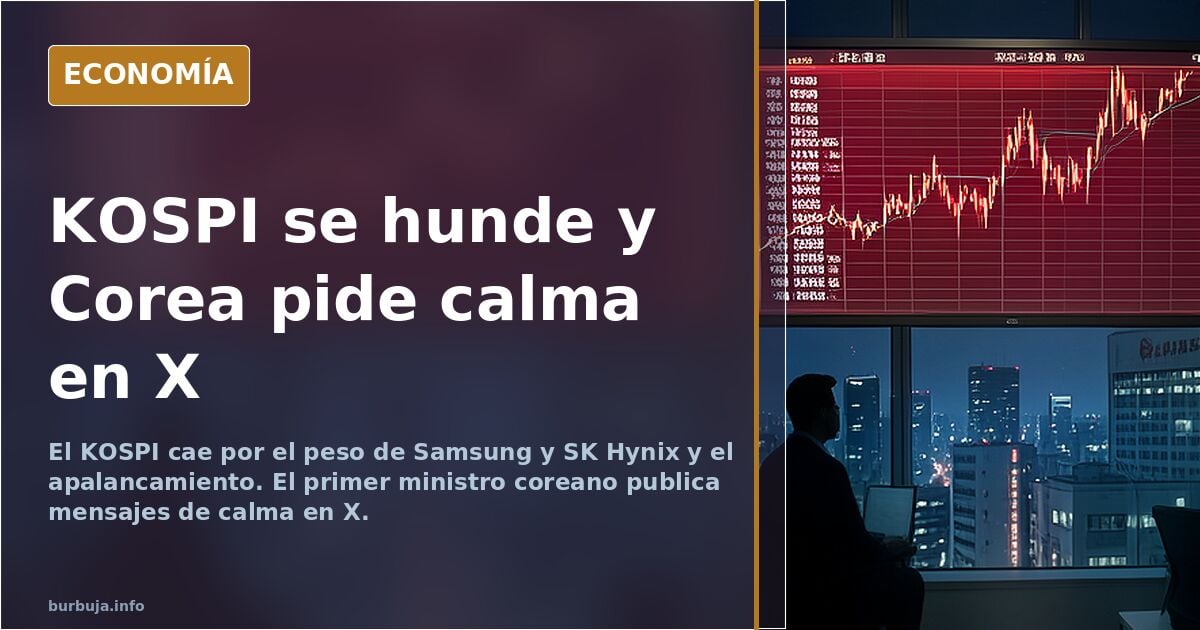
The KOSPI has fallen more than 20% since October and Seoul's government urges calm
South Korea's benchmark stock index has lost more than 21% since October 1, according to real-time market tracking. The country's prime minister has taken to X to post reassuring messages, along the lines of: life goes on and drastic decisions are unwise. The underlying reason is not a bank failure or widespread panic: it is that the KOSPI is, in practice, a listed RAM memory fund with two legs.
Samsung Electronics accounts for nearly 29% of the index and SK Hynix around 23%. Together they make up more than half of the KOSPI's market capitalization. When the semiconductor cycle turns, the whole index turns with it. And the cycle has turned: after a year and a half of vertical gains driven by memory demand tied to the AI expansion, the market has begun pricing in China making cheap RAM in volume and the possibility that the AI bubble could burst.
Leverage, the real hole
What turns a correction into a national misfortune is debt. In South Korea there is a word for this: bitu, investing with borrowed money. Broker margin loans, personal loans earmarked for stocks and, above all, a young generation that sees buying a home in Seoul as impossible and bets everything on equities as the only path to social mobility.
With more than half the index concentrated in two memory stocks, a chip-cycle downturn translates into margin calls and forced liquidations in a chain. According to accounts circulating in the thread, many leveraged investors have seen their accounts fall to zero. This is no anecdote: it is a phenomenon with a collective dimension that explains why the government has stepped forward with preventive messages on social media.
Is this a crisis like 2008?
No. And it is worth saying clearly, because the comparison is circulating. In 2008 the financial system was at the center of the problem and starting prices were normal. Here the starting point was an excessive run-up: some KOSPI ETFs still hold year-to-date returns close to 60%, even after the crash. An investor who entered a year and a half ago is still in the green; one who entered leveraged three months ago is not.
The distinction matters. The index had risen 85% in five years. A 20% drop from highs is a textbook correction within an uptrend, not the collapse of an economy. The nuance that does hold is another one: leverage amplifies any correction until it becomes a social problem, because the one losing is not an investment fund, it is a young person with a personal loan.
The KOSPI as a leading indicator for the Nasdaq
The thesis has a real core and a poor measurement. South Korea is a pure beta economy: export-driven, cyclical, leveraged at the household level, with two memory behemoths weighing nearly 30% of the index. When the global dollar tap tightens, the first to feel it are those borrowing dollars to finance exports.
The pattern held during the dot-com crisis: the KOSPI peaked in early January 2000, around 1,050-1,060 points, and the Nasdaq did not top out until March 10, at 5,048. A two-month gap. At the bottom of the ravine, the KOSPI sat around 500 and the Nasdaq around 1,100 in 2002. Same hole, different calendar. But that only happens when the shock is specifically in semiconductors, telecoms or technology. It is not a universal law.
The detail nobody looks at: the car
While the index plunges, in Spain some people look at the matter from the repair-shop angle. Replacing the screen of a Kia Sportage costs 12,000 euros, according to prevailing prices. A headlight, 2,400. On an i20 or a Rio, the bill runs around 8,000. For a two- or three-year-old car, the repair can be worth more than the vehicle itself.
It is a curiosity that says something about the Korean economic model: the same obsession with productivity and scale that built two memory giants has also created an expensive, captive parts structure. The consumer pays for the industrial efficiency in another way.
Where the analysis stands
The index has bounced 2% in a recent session. Since January 1 it is up 32%; since October 1 it is down 21%. Both figures are true at the same time and describe two different investors: the one who bought a year ago and the one who took on leverage a quarter ago. The prime minister keeps posting. Nobody yet knows how many accounts have been wiped out.
Also available in: Deutsch
Summary of a discussion on Burbuja.info - Foro de economía, actualidad y política., translated from Spanish and reviewed before publication. Read the full discussion (64 replies).
More summaries
-
South Korea faces demographic collapse with birth rate at 0.72
South Korea's fertility rate has dropped to 0.72, prompting projections of a population decline to 38 million by 2070.
-
YouTube Analyst Predicts 50-60% Drop in Indices and Gold
A veteran trader with 40 years of experience forecasts a 50-60% crash in stock indices and gold, sparking debate on whether money printing will prevent the collapse.
-
Spain to Overtake South Korea in GDP Per Capita by 2025
Spain grew 3.2% while South Korea stagnated, according to an analysis predicting a GDP per capita reversal after ten years.
-
Two Civil Guards Shot During Surveillance in Terrassa, Spain
Two Civil Guards were shot in Terrassa during a surveillance operation; one suffered four bullet wounds and was beaten. The incident highlights security concerns in Spain.
-
Ebola scare in Italy: the economic cost of a false alarm
Two suspected Ebola cases in Milan tested negative, but panic has already triggered hoarding and a migration debate in Italy
-
Spain's 121 MPs without honour: flawed individuals or a product of the system?
121 PSOE MPs keep Sánchez in power despite the scandals. Is it individual dishonour or a flaw in Spain's closed-list system? An analysis of the debate dividing opinion.