
Galician nationalist icon Xosé Manuel Beiras dies at 90
Xosé Manuel Beiras, the Marxist intellectual who shaped Galician nationalism, has died at 90. His legacy and rift with Yolanda Díaz define the BNG's future.
English · Original discussion in Spanish · Published
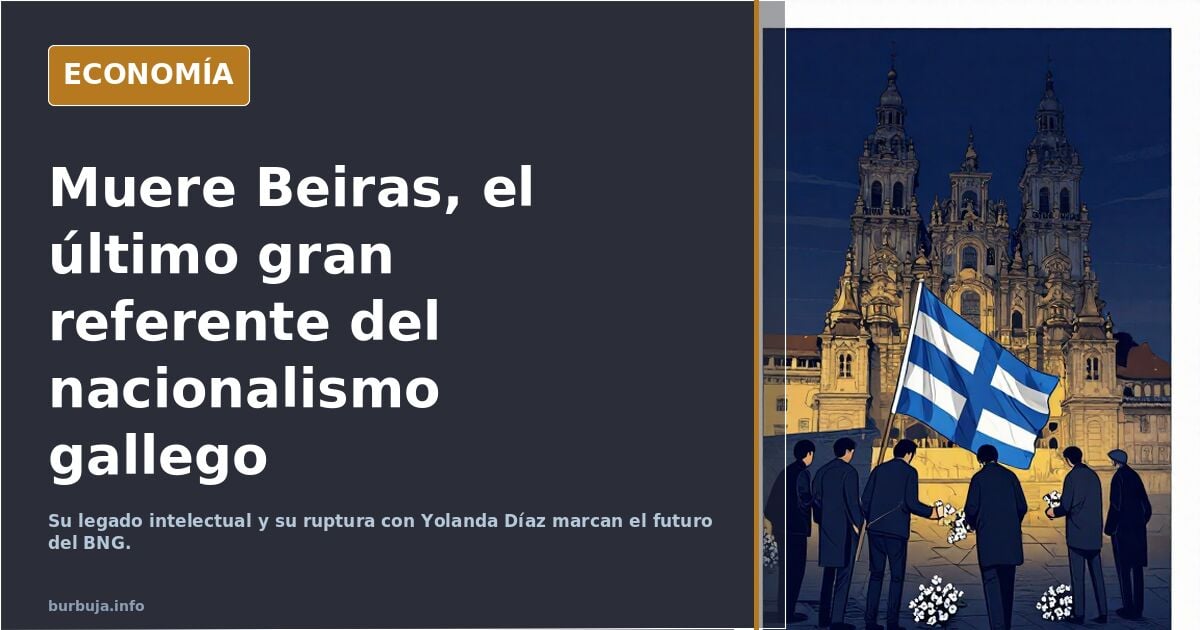
Beiras dies: The uncomfortable legacy of Galician nationalism
Xosé Manuel Beiras died at the age of 90. The news, reported by outlets like elDiario.es, marks the end of a figure who dominated Galician nationalism from Castelao's death well into the 21st century. His passing raises questions about the future of the BNG (Bloque Nacionalista Galego) and the type of politics he represented: intellectual, blunt, combative, and possessing a mobilization capacity his successors have failed to replicate.
From professor to leftist nationalist reference
Beiras was not a conventional politician. Born into a wealthy family in Santiago de Compostela—according to forum comments, he grew up in a 400-square-meter house with an estate in the city center—he studied abroad and learned piano. This privileged background, which some view as contradictory to his Marxist discourse, allowed him to navigate intellectual circles with ease. He held a chair at the university, like Fraga, though their styles were opposites: while the PP founder played dominoes in local taverns, Beiras played Chopin nocturnes on the piano.
His political career began in moderate nationalism before shifting toward radical left positions. He founded the Bloque Nacionalista Galego (BNG), transforming it into the hegemonic force of Galician nationalism. Under his leadership, the BNG achieved its best historical results, although it never governed the Xunta (regional government). His tenure leading AGE (Alternativa Galega de Esquerda) also left a mark, with electoral results that surprised both allies and opponents.
The economic legacy: Nationalism or Marxism?
Beiras's economic impact is debated. Some argue that his shift toward Marxism diverted Galician nationalism from a moderate land-defense project, hindering serious economic development. Others defend his consistency and ability to connect with working classes during industrial crisis and emigration.
His discourse was never compliant with economic power. He harshly criticized infrastructure policies and the productive model, advocating for endogenous development in Galicia. Relations with business leaders were tense, though he once praised Amancio Ortega as an exemplary entrepreneur. This apparent contradiction—Marxism alongside praise for Inditex's founder—summarizes the complexity of a character who defied categorization.
Relationship with Yolanda Díaz and the current left
One of the most discussed episodes of his later years was his break with Yolanda Díaz. Beiras stated she was "the first person who betrayed me," a phrase revealing the generational and strategic fracture between classic nationalism and the new left. Díaz, who started in the PCE (Spanish Communist Party), moved through Izquierda Unida, Podemos, the Mareas, and Sumar, embodying a more pragmatic and less ideological style than Beiras.
This tension between old and new nationalism is key to understanding the BNG's present. Current leader Ana Pontón has moderated the discourse but retains the radical essence, according to analysts. The party remains Galicia's second force and aims to govern, but lacks Beiras's charismatic leadership.
Reactions and debates on his figure
Beiras's death has sparked mixed reactions. From those praising his honesty and integrity to critics of his ideological drift and inability to build a governing project. Personally, his love for music and blunt character are remembered, traits he justified as ways to connect with supporters.
His political legacy now rests with a generation that did not live through the Spanish Transition or the BNG's founding. The question is whether Galician nationalism can survive without a figure of his stature, or if his disappearance accelerates moderation and identity loss. What is clear is that Beiras was an unrepeatable politician, for better and for worse.
What remains of Beiras's nationalism in today's Galicia?
Also available in: Deutsch
Summary of a discussion on Burbuja.info - Foro de economía, actualidad y política., translated from Spanish and reviewed before publication. Read the full discussion (121 replies).
More summaries
-
Ana Pontón: BNG Candidate and Political Science Graduate
BNG candidate Ana Pontón faces criticism over her political science background and management, as the PSOE signals it will support her presidency.
-
Amancio Ortega Donates €100M to Spanish Flood Victims
The Amancio Ortega Foundation pledges €100 million to municipalities hit by Spain's DANA floods, sparking fiscal and political debate.
-
Feijóo Criticizes Free Cinema Subsidies for Spain's Richest
Feijóo opposes universal subsidies for cinema and trains, arguing they benefit billionaires like Amancio Ortega rather than those in need.
-
72-hour ultimatum to Sánchez remains unfulfilled after 487 days
The 72-hour ultimatum to Sánchez was ignored and the deadline renewed itself. The timeline of failed predictions of his downfall goes back to 2014.
-
Spain's Sánchez and Puente linked to brothels in funding scandal
First report connects Spanish PM Sánchez and Transport Minister Puente to prostitution, sparking debate on opaque party financing.
-
Spain's Cyber Command warns of worst-case scenario
Vice Admiral Javier Roca states cyberattacks are far more likely than missiles and urges Spain to take digital defense seriously.