
King stays in Paiporta as Sánchez leaves amid boos
Felipe VI remained in Paiporta while Pedro Sánchez left under jeers. The contrast reignites debate over the DANA response and political costs.
English · Original discussion in Spanish · Published
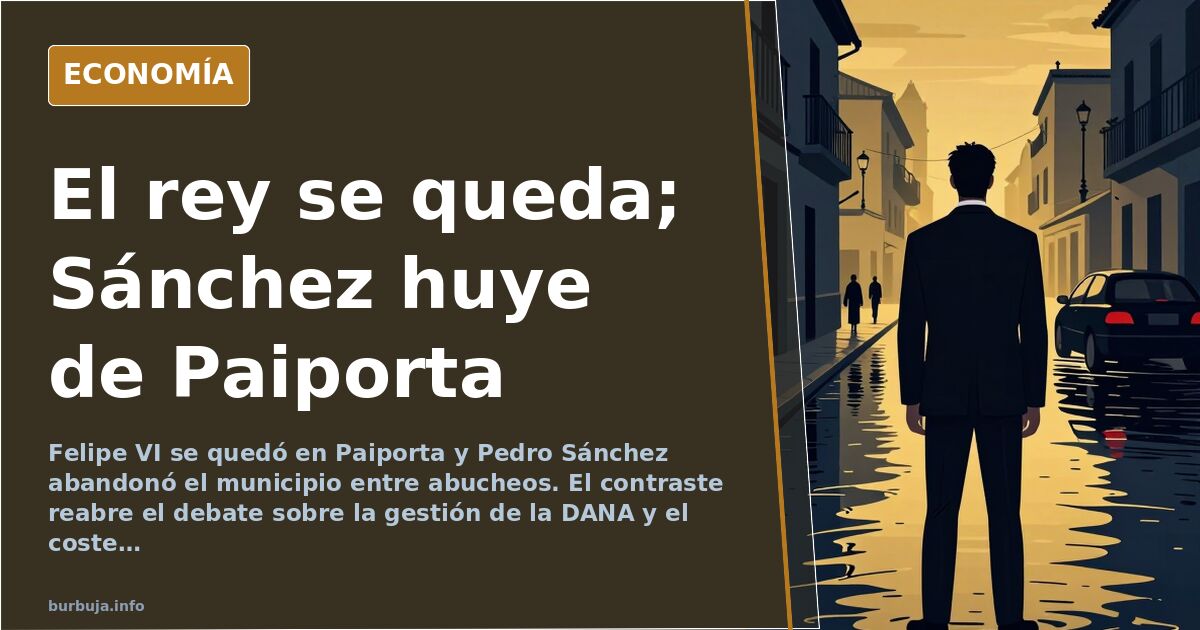
King stays in Paiporta as Sánchez leaves amid boos
The scene was captured on hundreds of phones: Felipe VI removed his protection to approach residents of Paiporta while Pedro Sánchez, visibly affected, left the municipality amidst shouts and insults. The visit by authorities to areas flooded by the Valencia DANA (severe storm) ended with the Prime Minister exiting the town center and the Royal Household holding its ground amid a public outcry that ignored protocols.
The episode, which concluded without injuries, has peine discussions on disaster management and who bears the political cost of an emergency that left hundreds dead and unquantified material damage. The Vice President and ministers present were heckled by residents who had been without water, electricity, or official aid for days. The lingering question is simple: why did the King stay while the Prime Minister left?
Timeline of a visit that went wrong
The day began with normal protocol. Authorities toured flood-affected points, but as they pogre through Paiporta, the atmosphere grew tense. Shouts of "get out" and complaints about slow aid multiplied until continuing the tour became impossible. According to those present, the turning point came when a group of neighbors surrounded the entourage and someone threw objects near security guards.
The official version speaks of "ultra groups" instrumentalizing discontent. The version circulating among attendees differs: ordinary people, fed up with promises and delays, who found in the visit the only channel to express their anger. There are no official figures on participants or arrests. Confusion over who ordered the retreat—whether the Government, the Royal Household, or the Government Delegation—remains unresolved.
King removes protection; Sánchez accelerates exit
The most circulated image shows Felipe VI separating from his security detail to speak with residents. The monarch stayed in the street after the Prime Minister had already left. This contrast, amplified by social media, has fueled the thesis that the Monarchy emerges strengthened while the Government is weakened. Some argue the King had no choice: staying was the only possible gesture before such a magnitude emergency. Counterarguments suggest his presence four days after the flood was late and accompanied by those responsible for the delays.
Regarding Sánchez's departure, interpretations vary. Some speak of "flight" due to the risk of losing control. Others describe a tactical retreat to avoid adding fuel to the fire. What is certain is that the Prime Minister has not returned to the area since then, and his team has avoided confirming when he will.
Why did the King stay and the PM leave?
Protocol differences explain part of the contrast. The King lacks executive powers, making his presence symbolic; the Prime Minister embodies the State's response, so his withdrawal reads as fleeing responsibility. The Royal Household does not depend on the Government to decide whether to stay or go, whereas the Prime Minister is tied to La Moncloa's agenda and security risk assessments.
An additional factor is accumulated weariness. Four days of waiting to see authorities in submerged municipalities turned any visit into a powder keg. The King, with less political exposure, could afford to stay; Sánchez, bearing full management responsibility, could not.
Official narrative vs. street narrative
The government version insists the visit was disrupted by "organized minorities" and that ensuring everyone's safety was the priority. The version heard in Paiporta is that people were not organized by anyone: they simply lacked responses for days and seized the first opportunity to shout. Between both narratives lies an uncomfortable fact: no official figures on personal injuries or affected homes have been published since the initial balance.
The discussion on the DANA has evolved into a political tug-of-war over who manages the emergency better. The central Government and the Generalitat (regional government) exchange accusations regarding early warnings and competence distribution, while affected municipalities await direct aid.
What happens now with reconstruction?
Focus has shifted to aid. Victims demand rapid compensation and tax exemptions that remain unspecified. The Insurance Compensation Consortium (Consorcio de Compensación de Seguros) has received thousands of applications, but assessment timelines stretch over months. Infrastructure reconstruction, according to early estimates, will exceed billions of euros.
Meanwhile, politics continues on another plane. The opposition demands accountability while the Government defends its actions. No one has resigned. No one has accepted blame. And in Paiporta, as in the rest of the zero zone, the repeated question is not who won the image battle, but when the money will arrive.
Analysis stalls right there: at the point where politics replaces management. With available data, it is impossible to know if the failed visit will have electoral consequences. What is known is that the image of the King staying and the Prime Minister leaving is already part of the catastrophe's narrative. And that this narrative, like all others, will be written against time.
Also available in: Deutsch
Summary of a discussion on Burbuja.info - Foro de economía, actualidad y política., translated from Spanish and reviewed before publication. Read the full discussion (153 replies).
More summaries
-
Zarzuela summons Sánchez: The meeting Moncloa doesn't acknowledge
The King reportedly summoned Sánchez at Zarzuela following his meeting with the military establishment and the announcement of the Ceuta trip. The official agenda makes no mention of the encounter, and...
-
King Felipe VI's Amnesty Signature Contradicts Ussía’s Claims
Alfonso Ussía claimed King Felipe VI held powerful reports and would block the amnesty; the law was signed, disproving the prediction.
-
Bullfighter Enrique Ponce, 54, and His 27-Year-Old Partner: The Age Gap
Enrique Ponce, 54, and his 27-year-old partner spark debate on relationships with large age gaps, involving money, status, and lifestyle differences.
-
Ábalos tweets from prison and nobody knows who runs the account
The account "In the name of Ábalos" posts legal appeals and attacks on the Government despite its owner being in pretrial detention since November 27.
-
Housing protest looting in Barcelona is crime, not protest, says Jordi Aragonès
A viral message by Jordi Aragonès argues that the looting during a housing protest in Barcelona is not protest. The text separates crime from political demands.
-
Tesla's Giga Berlin hits 7,000 Model Y units per week
Giga Berlin reaches 7,000 Model Y units in a single week and announces expansion works for 2027, with possible new models joining the German line.