
Killing a kitten litter: vet vs. river in Spain
A cat gives birth and the owner asks about euthanasia costs and methods, highlighting rural practices, adoption options, and animal protection laws.
English · Original discussion in Spanish · Published
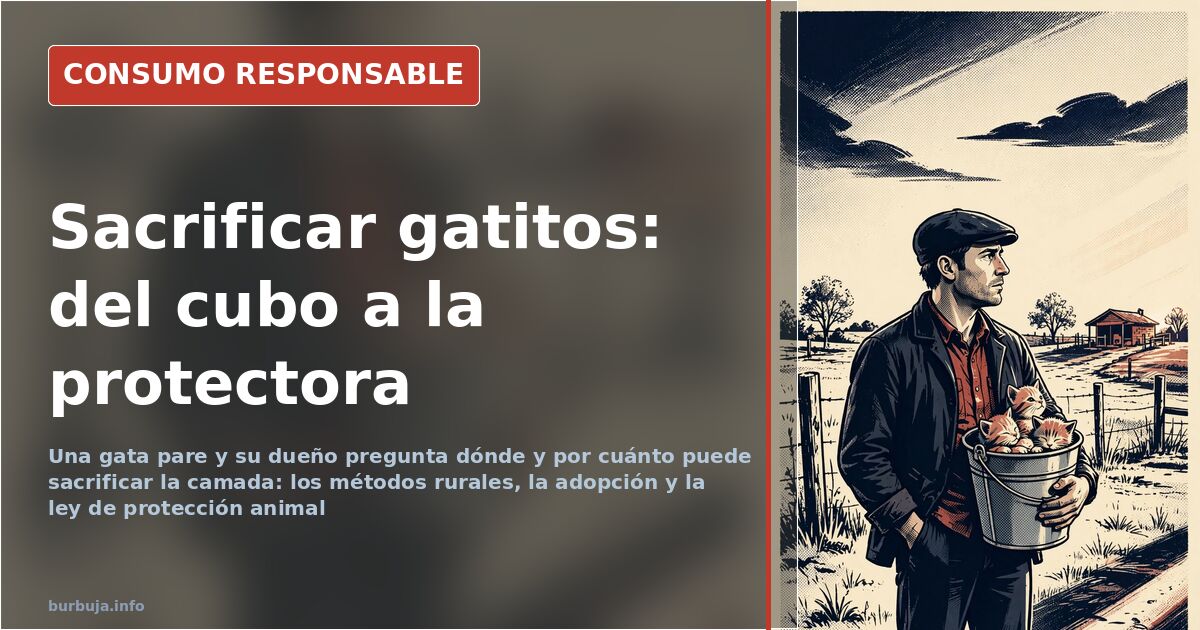
Euthanizing a kitten litter: from water buckets to shelters
A cat has given birth, and its owner announces they do not intend to keep the litter. They want to know if they can euthanize the kittens themselves at home or if they must pay a veterinarian, and how much it would cost. This is the starting point. The ensuing conversation answers almost everything except that: there is no fee schedule, no cited article, and no definitive legal answer. What emerges is a map of what happens to cats when no one is watching.
From water buckets to the hills: rural population control methods
The starkest response does not come from a clinic. It comes from the rural world, described by a forum user as casually as reporting the weather. In towns with many cats, according to their account, population control has always been practiced to prevent proliferation, with a threshold set at 2 or 3 cats per household. Methods—drowning them in the river, burying them, beating them, abandoning them in the hills—vary by household. Methods, whatever you prefer. Two additional points complete the picture: natural mortality rates for first-time litters are extremely high, and even if the practice were illegal, no one would find out.
Another account places the scene in a specific village, where the method was drowning puppies in a bucket or burying them. The narrator describes it simultaneously as brutality and something prohibited. The custom exists. The prohibition exists too. Between the two, no one is verifying anything, which is exactly why the owner's question remains unresolved. No one disputes that the practice occurs; they dispute that it is discussed. Setting the threshold at two or three cats per house demonstrates how deeply internalized this management is.
Is it legal to euthanize the litter at home?
No message provides regulations, articles, or precedents. The legal doubt remains open from start to finish, and the only thing that slips through is the realization that reality bypasses the question itself. When no one checks, the discussion shifts from law to ethics. There, the tone splits: some reject even raising the issue; others admit the root problem is not the litter, but the lack of foresight.
Costs also appear nowhere. No one mentions a veterinary fee, public or private; what is offered are alternatives to euthanasia, not prices for it. The economic doubt that started everything—how much it costs for a professional to do it—dies without an answer.
Sterilize first, give away later
There is no disagreement on the cause. Sterilizing the cat was the prior obligation, the original error, and at the same time, the only thing still fixable. For the already-born kittens, the repeated solution is adoption, via very specific channels: a photo ad on milanuncios.com, the platform nolotiro.org, the local shelter or refuge—with addresses provided for those in Valencia—and even veterinary faculties, which might take some for practical training, an uncomfortable option indeed.
And it works. In just a few replies, two offers to take them appear, one double so the cat isn't alone when no one is home. It is also noted that while nursing, they incur no expense or work, so there is room to place them. As a curiosity, the case of a first-time mother cat who gave birth to only two kittens—one white with blue eyes, the other black with green eyes, from different fathers—is described.
Animal protection law, in the background
The issue drifts, like almost everything, into politics. The clash between Podemos and the PSOE (Spanish Socialist Workers' Party) over a future animal protection law is brought up, with Ione Belarra accusing their coalition partners of standing "on the side of abusers," according to a text from Libertad Digital. The connection to a domestic litter is forced, yet there it is: whoever defends bullfighting but not puppies, or vice versa, becomes the underlying argument.
Political noise helps decide nothing practical. While parties debate who stands on the side of animals, the operational question—where do these kittens go this week?—still has the same old answers.
The twist: the litter that perhaps never existed
Then comes the twist. Several interventions identify the initial post as a provocation by someone known for starting animal rights debates to criticize people who defend bullfighting but not unborn children. The interpretation: the goal is not killing kittens, but constructing an opinion framework where any animal protection law seems reasonable. The litter, literally, ends up being irrelevant. The question of what peine to the kittens remains, unsurprisingly, unanswered.
Based on what is on the table, the likely outcome is that such a litter ends up in a photo ad, gets adopted, and sterilization arrives late. And in the next town with cats, the scene repeats without anyone writing a line. Neither can be proven; both are described as normal.
Also available in: Deutsch
Summary of a discussion on Burbuja.info - Foro de economía, actualidad y política., translated from Spanish and reviewed before publication. Read the full discussion (109 replies).
More summaries
-
Meat, Testosterone, and Libido: Diet vs. Evolution Debate
High animal protein intake boosts libido? The clash between carnivore advocates and vegetarians over testosterone, evolution, and diet.
-
Animal Protein: The Debate Over Vegan Diets Settled in the Knee
Humans are not vegetarian and need animal protein: the thesis reopening the debate between omnivores and vegans on B12 and collagen.
-
Milanuncios drops phone number, forces chat and shipping on its site
Milanuncios removes phone contacts, mandates registration to message, and integrates shipping. Sellers report a sharp drop in buyer inquiries.
-
Total Renting: Is car leasing for individuals a financial trap?
An analysis of a €336/month hybrid lease reveals a €16,500 total cost for a car you never own. Is leasing worthwhile for private individuals in Spain?
-
Upgrading from 2.2 to 4.6 kW in a 1970s flat: the electrical certificate decides
Going from 2.2 to 4.6 kW in a 1970s flat in Spain may require a new electrical installation certificate and rewiring; one forum user reports about €1,000 of work in 2018.
-
NAC may help if you have a mental health disorder
In a trial of 50 adults with trichotillomania, 56% improved with NAC versus 16% on placebo at 12 weeks. What the evidence supports and what it doesn't.