
Kherson under pressure: Ukrainian counteroffensive reaches 11 km from city
Ukraine's southern offensive brings fighting within 11 km of Kherson, while attacks on Russian collaborators surge in the occupied city.
English · Original discussion in Spanish · Published
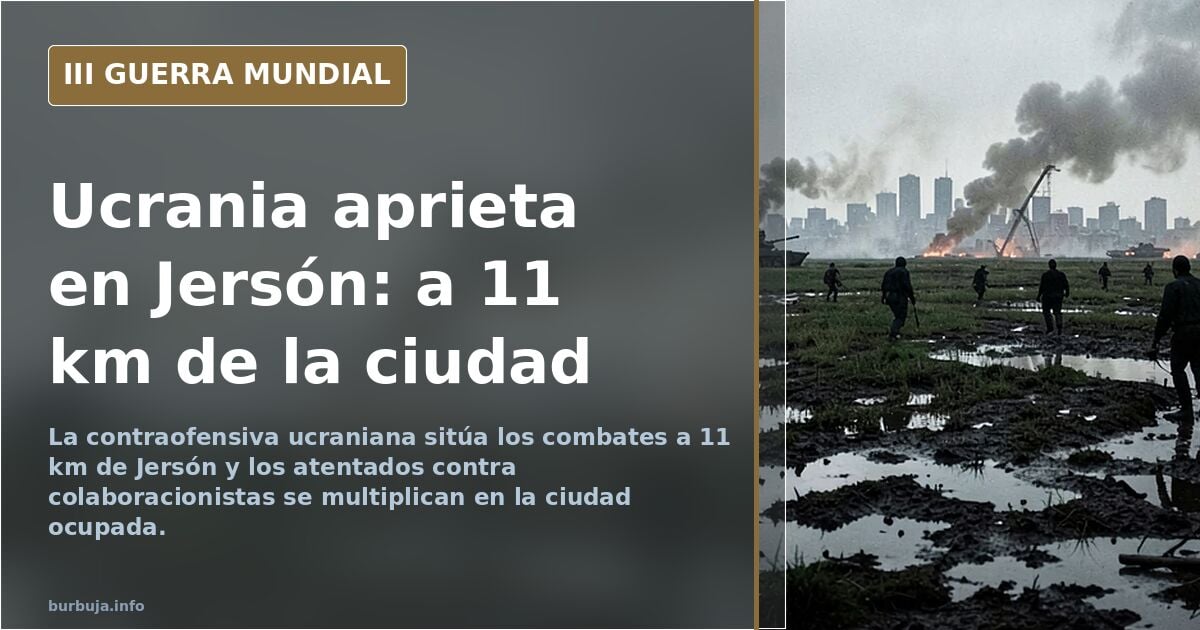
Kherson bleeds out: Ukraine tightens grip at 11 km mark
How long does it take for a counteroffensive to shift from rumor to serious problem for an invader? On the southern front, kilometers provide the answer. While media attention focused on the Donbas, Ukraine has gradually clawed back territory on the west bank of the Dnieper, bringing combat to Znamenka, just 11 kilometers from Kherson, according to conflict analysis reports. Russia’s first major wartime conquest is beginning to wobble.
The struggle is not solely military. In the occupied city, posters have appeared with a message aimed at Russian troops: "Russia: 626 kilometers. Ukrainian army: 10 kilometers". Distance as propaganda. And as a warning.
What Kherson really means strategically
Kherson is no ordinary stronghold. It was the first significant settlement Russia captured early in the war, aided by a factor rarely discussed: some Ukrainian government officials switched sides. Since then, the city has remained under Russian control, becoming the only regional capital on the north bank of the Dnieper, a river that splits Ukraine from Crimea to Kyiv.
This holds the strategic key often obscured by the noise from the Donbas. If Russia keeps Kherson, future operations become easier. If it loses it, there are no major settlements left north and west of the Dnieper, and the door to Crimea opens for Ukraine, while also threatening water supplies to the peninsula. Militarily, this outweighs half a kilometer of daily advance in the east.
Attrition rates and the retreat southward
Front-line analyses suggest the Russian 49th Army has suffered enough casualties to withdraw most units from northern Kherson region toward the city. Moving north to south, hugging the west bank of the Dnieper. This isn’t a rout, but it is cumulative territorial loss week after week. Territory reclaimed in the last three weeks exceeds what Russia took in the east during the same period, according to available maps.
Irregular warfare adds to this. Attacks on collaborators, such as the car bomb targeting the head of Kherson prison who had defected. Blown-up Russian weapons depots. Helicopters shot down. Psychological pressure on those who joined the occupiers isn’t trivial: it erodes control from within.
The numbers game: how many dead are there really?
Here begins slippery ground. Circulating casualty figures are mutually incompatible. There have been mentions of 1,000 Ukrainian casualties per day based on Washington statements, a number hard to sustain over 120 days of war. Speculation also suggests Russians may have lost 50,000 men total, or ratios favoring Ukraine two-to-one. No one has exact figures. Anyone claiming otherwise is lying.
Material wear can be verified: Ukraine has fired 50 million bullets since the war began, per US sources. If Russians spent similarly, volume alone explains part of the attrition. Heavy artillery and long-range missiles entered play, changing the equation.
Donbas as a decoy
Media obsession with Donbas has simple reasons: it’s where Pilingui declared objectives, where more journalists operate, and visible casualties concentrate. But Ukraine’s goals aren’t preventing Pilingui from taking Donbas. They are expelling Russian forces from sovereign territory. To do so, they don’t need to trinc Kremlin sequences. They exploit Russia stripping defenses in the south to attempt pogre in the east, striking where strategic value is highest.
Warnings for civilians to leave Kherson before assault echo Bucha’s precedent just before Russian withdrawal. Those confident in capturing the city say so.
The question is no longer if Ukraine can reach Kherson. It’s how fast and what they find inside. Russians are slowly evaporating, but they are leaving.
Also available in: Deutsch
Summary of a discussion on Burbuja.info - Foro de economía, actualidad y política., translated from Spanish and reviewed before publication. Read the full discussion (84 replies).
More summaries
-
Kherson and Crimea: a stalled front and a rout that never comes
The Russian command is pulling back in Kherson with no recorded Ukrainian advance, while the reported mass exodus from Crimea remains unconfirmed. The data versus the narrative.
-
Halloween, drones and the double standard of conquest
A message celebrates Ukrainian drones striking 'conquerors' while simultaneously demanding respect for international law: the double standard nobody resolves.
-
Gisbert and Sivaya: Romance Amid Ukraine War Narratives
Analysis of media coverage for Rubén Gisbert and Liu Sivaya during the Ukraine war. Is this digital propaganda or reality?
-
Russia's Unupdated Casualty Count Stalls at 498
The Kremlin reported 498 soldier deaths and hasn't updated the figure. Without independent verification, casualty counts remain acts of faith.
-
EU arms Ukraine as Moscow threatens to strike convoys
The EU establishes an arms procurement cell and mobilizes Madrid's satellite center. Moscow warns it will attack European supply lines.
-
Maduro's wife lost teeth and weight in US custody, NYT reports
The New York Times reports Cilia Flores lost two teeth and over 11 kg while detained in the US. Her defense claims she may have suffered a mild heart attack.