
Kharkiv: Russia deploys 50,000 troops for 30 km advance
Russia's Kharkiv offensive begins with 50,000 announced troops and five lost villages, while the front has gained 600 sq km in a year.
English · Original discussion in Spanish · Published
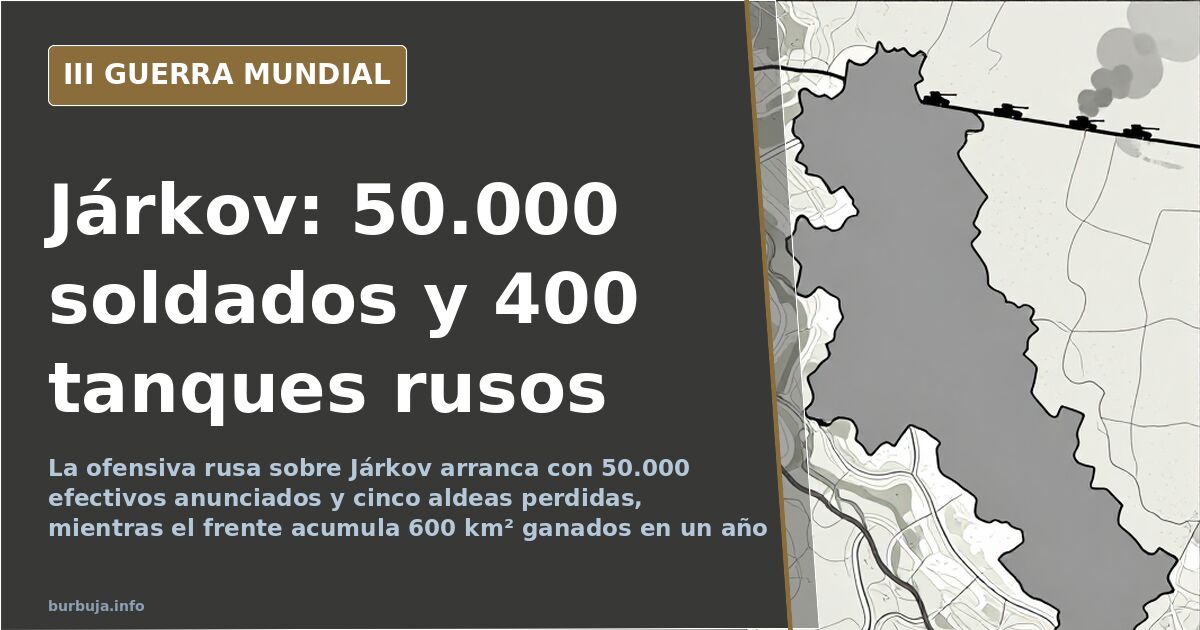
Kharkiv: Russian offensive advances 30 km after two years of war
How many soldiers and armored vehicles are needed to move a line that has barely shifted in two years? The Russian attack on the Kharkiv region began at dawn, around 5:00 AM local time, with multiple rocket launchers and reconnaissance patrols. In the first hours, Ukraine lost control of five villages scattered across the axes of Streleche, Krasnoye, Pylnaya, and Borisovka, heading toward Liptsov, and Pletenevka, en route to Volchansk. The figure used to size the assault —50,000 personnel, 400 tanks, and 900 vehicles— does not come from a military report but from prior announcements. And that is where it all starts.
What is known about the Russian advance in Kharkiv?
The maps used by analysts working for the Ukrainian Armed Forces themselves depict an infantry operation with limited armored support, protected by artillery fire, which has pushed back the Ukrainian line and created a wide gray zone. Translated: terrain that no one fully controls and which often precedes the consolidation of an advance.
The shape of the attack matters more than its size. Infantry advancing without an armored column ahead is not seeking to break through deeply; it seeks to fix, wear down, and force the opponent to move reserves from sectors where they are already scarce. This is the difference between a breakthrough offensive and a slow attrition machine.
Why is Russia opening a new front when 75% of the Ukrainian army is in Donbas?
Because the distribution of forces invites it. Around 75% of the Ukrainian army was concentrated in the Donbas. With such volume in a single sector, the thesis held for months is that opening a secondary breach is the only way to stretch the defender: if troops are not dispersed, the attack does not advance; if they are, defenses weaken where they were strong. On the front, talk has already begun of a new battle for a city that has changed hands several times.
The opposing view is older than this war. Heavily advertised offensives tend to remain just advertisements, and hiding a concentration of that size from satellites is impossible, regardless of who says otherwise. If the enemy knows where and when you will enter, surprise is replaced by arithmetic: who can hold out longer.
600 sq km in a year: measuring the advance using Formentera
The numbers that allow for comparison are of a different order. So far this year, the Russian army would have captured around 600 sq km, scattered in small points along the front, at a pace that, according to the most optimistic calculations, is accelerating as weeks pass. As a unit of measurement, the island of Formentera is 80 sq km, so the cumulative total equals several times the size of the island.
It sounds like a lot until you look at the whole map. Kharkiv is about 30 km from the Russian border and still has not fallen. That is the data point that breaks the epic narrative: two years later, the second-largest city in the neighboring country remains beyond the real reach of the offensive that was supposed to take it. The usual clichés also circulate —the alleged shortage of home appliances or rumors about the Russian president’s health— repeated more as markers of allegiance than as information.
Ukrainian mobilization and material spent earlier
Ukraine approved a mobilization law to incorporate hundreds of thousands of new soldiers intended to bolster new brigades. From the most critical analysis regarding Kyiv, it is argued that this machinery arrived late and poorly equipped: the material intended to equip those recruits had already been consumed on previous fronts, meaning each new kilometer of front line is paid for with resources that do not exist.
That is the crux of the matter. It counts less how many villages change hands in a week than how many men remain to be recruited and what they will be armed with. It is the kind of accounting that never appears on gray-zone maps.
One scene summarizes the discussion. Tanks are counted in hundreds in announcements, yet at the last Victory Day parade, some recall that the armored display consisted of a single T-34. Both images can be true depending on who tells them. The problem with this front is that, at this stage, choosing which one to believe no longer wins any war.
How many soldiers and armored vehicles are needed to move a line that has barely shifted in two years? The Russian attack on the Kharkiv region began at dawn, around 5:00 AM local time, with multiple rocket launchers and reconnaissance patrols. In the first hours, Ukraine lost control of five villages scattered across the axes of Streleche, Krasnoye, Pylnaya, and Borisovka, heading toward Liptsov, and Pletenevka, en route to Volchansk. The figure used to size the assault —50,000 personnel, 400 tanks, and 900 vehicles— does not come from a military report but from prior announcements. And that is where it all starts.
What is known about the Russian advance in Kharkiv?
The maps used by analysts working for the Ukrainian Armed Forces themselves depict an infantry operation with limited armored support, protected by artillery fire, which has pushed back the Ukrainian line and created a wide gray zone. Translated: terrain that no one fully controls and which often precedes the consolidation of an advance.
The shape of the attack matters more than its size. Infantry advancing without an armored column ahead is not seeking to break through deeply; it seeks to fix, wear down, and force the opponent to move reserves from sectors where they are already scarce. This is the difference between a breakthrough offensive and a slow attrition machine.
Why is Russia opening a new front when 75% of the Ukrainian army is in Donbas?
Because the distribution of forces invites it. Around 75% of the Ukrainian army was concentrated in the Donbas. With such volume in a single sector, the thesis held for months is that opening a secondary breach is the only way to stretch the defender: if troops are not dispersed, the attack does not advance; if they are, defenses weaken where they were strong. On the front, talk has already begun of a new battle for a city that has changed hands several times.
The opposing view is older than this war. Heavily advertised offensives tend to remain just advertisements, and hiding a concentration of that size from satellites is impossible, regardless of who says otherwise. If the enemy knows where and when you will enter, surprise is replaced by arithmetic: who can hold out longer.
600 sq km in a year: measuring the advance using Formentera
The numbers that allow for comparison are of a different order. So far this year, the Russian army would have captured around 600 sq km, scattered in small points along the front, at a pace that, according to the most optimistic calculations, is accelerating as weeks pass. As a unit of measurement, the island of Formentera is 80 sq km, so the cumulative total equals several times the size of the island.
It sounds like a lot until you look at the whole map. Kharkiv is about 30 km from the Russian border and still has not fallen. That is the data point that breaks the epic narrative: two years later, the second-largest city in the neighboring country remains beyond the real reach of the offensive that was supposed to take it. The usual clichés also circulate —the alleged shortage of home appliances or rumors about the Russian president’s health— repeated more as markers of allegiance than as information.
Ukrainian mobilization and material spent earlier
Ukraine approved a mobilization law to incorporate hundreds of thousands of new soldiers intended to bolster new brigades. From the most critical analysis regarding Kyiv, it is argued that this machinery arrived late and poorly equipped: the material intended to equip those recruits had already been consumed on previous fronts, meaning each new kilometer of front line is paid for with resources that do not exist.
That is the crux of the matter. It counts less how many villages change hands in a week than how many men remain to be recruited and what they will be armed with. It is the kind of accounting that never appears on gray-zone maps.
One scene summarizes the discussion. Tanks are counted in hundreds in announcements, yet at the last Victory Day parade, some recall that the armored display consisted of a single T-34. Both images can be true depending on who tells them. The problem with this front is that, at this stage, choosing which one to believe no longer wins any war.
Summary of a discussion on Burbuja.info - Foro de economía, actualidad y política., translated from Spanish and reviewed before publication. Read the full discussion (165 replies).
More summaries
-
Ukraine holds Donbas as Russia eyes Odesa
Ukrainian forces reinforce Severodonetsk, challenging collapse narratives while analysts point to Odesa as Moscow's next target.
-
Ukrainian Army Status: Resistance and Russian Offensive Analysis
Analysis of Ukrainian military resistance amid Russia's war of attrition and offensive operations.
-
Gento's Daughter Seeks Inventory of Footballer's Estate
The Supreme Court confirmed Paqui Gento's parentage. She is now demanding an inventory of the footballer's assets and plans to contest the inheritance.
-
Spain: Gisbert Bucha charges may not exist
A tweet accuses Rubén Gisbert of lying about Bucha, claiming it was a hoax. The hate speech charge divides even those who deny the case exists.
-
Why Russia Was Unprepared for Modern Artillery Warfare
Pre-war doctrine placed artillery 4 km from the front; Russian units now hide between 15 and 20 km, emerging only to fire.
-
Reported Russian Plan: Four Fronts, Odesa Excluded
The alleged Russian offensive plan splits attacks into four axes, postponing the Kyiv assault to 2023 and mobilizing 300,000 troops.